Showing posts with label contest. Show all posts

Thursday, October 12, 2017

Can I Win a Food Contest at the State Fair?

Entering a food competition at the state fair has never been high on my “bucket list” – until this year. Because I’m not a cook, know little about winning recipes, and seldom want to show my food projects to a judge, I’ve been content to observe winning entries and read about the winners. However, this year I was inspired to enter and compete.

Ribbons are ready for the winners.

For this year, I decided to enter the cooking competitions at the N.C. State Fair coordinated by the N.C. Department of Agriculture & Consumer Services. Specifically, I was attracted to the contest sponsored by the N.C. Peanut Growers Association that was held on Thursday, October 12. Each entry was to be “a delicious breakfast recipe that is filled with peanut flavor and will be sure to get your morning started with a smile.” I could place in a contest that featured peanuts, right?

Cooking contests are held annually at the N.C. State Fair.

The first critical step is to submit a recipe by the deadline, which was ten days before the date of the contest and meant that I had to brainstorm about possibilities even a month in advance. After evaluating several options, I picked a favorite, which I called “Peanut Buttery Breakfast Pizza,” that I hoped would be a winner.

My entry starts to take shape.

The recipe starts with a package of soft tortillas about five inches in diameter. After spreading a tablespoon of peanut butter on each tortilla, banana slices are added to half of the tortillas (the remainder are saved to use as “tops”). A little honey is drizzled and finely chopped peanuts are sprinkled over the tortillas with bananas. Next, the tortillas without banana slices are placed over the other tortillas. Finally, the doubled tortillas are sliced into quarters.

Doesn't my entry look like a winner?

On the day of the contest, entries are turned in mid-afternoon, and judging takes place an hour later. Judging is based on flavor and taste (50%), creativity (25%), and ease of preparation (25%). I felt good about the flavor/taste category (what is better than peanut butter and banana flavors?) and the ease of preparation (the entry only took me about 10 minutes to prepare). Each recipe needed to contain at least one-half cup of peanuts or peanut butter, and entries needed to serve six to eight judges. The winning recipes were awarded cash prizes: $200 for first place; $150, second; $100, third; and $50, honorable mention.

I proudly turn in my entry with high hopes.

I was amazed at the creativity of the winners. First place was spicy peanut butter and banana breakfast braid. Second place was peanut butter French toast with nutty pig candy. Third place was peanut butter and jelly pop tarts. One recipe, peanut butter and banana waffles, received honorable mention. Although all are creative, the level of preparation doesn’t seem that easy. At least I was on the right track by combining peanut butter and bananas. If I compete again, I need to give more consideration to creativity, which seems more influential than only 25%.

Lisa Prince, host of the TV program NC Flavor, announces the winners.

Although I left empty handed without receiving a prize, at least I got to see what the contest is like and didn’t have to buy an admission ticket to the fair. A major benefit of entering the contest is free admission to the fair – plus the experience gained to compete next year.

Meanwhile, the carnival-like food attracts the attention of the fairgoers more than a cooking contest.

Friday, June 12, 2015

Keeping Wild Foods in Our Culinary Culture

[Note: This post, prepared originally for the NC Folklife Institute's NCFood blog, is hosted on the institute’s website, with excerpts and a link to the website posted here.]

Is cooking with wild foods out of place in today’s modern society? Because it’s so old-fashioned, I was surprised by how many kids had entered the Wild Food Cooking Contest in RichmondCounty.  It’s the event of the spring in Ellerbe, NC, when youth and adults show off their skills for cooking deer, moose, rabbit, beaver, squirrel, and other wild game. After the judges have scored each entry, everything is served buffet-style as a tasting party for the participants, their families and friends, and others like myself who attend to see how wild our food once was and still can be.

Rabbit pot pie was one of the many
tasty entries in the Richmond County
Wi
Dishes prepared by kids age 16 and younger were the most interesting. They included teriyaki rabbit, beaver pot roast, rabbit pot pie, duck and dumplings, Eastern wild bear and wild hog sausage, and catfish stew. When I had the opportunity to sample them, each was so good that I could have made a complete meal of it.

My first surprise was not so much that young people had prepared tasty food; it was that the game, fowl, or fish could not have been purchased. It had to be hunted, trapped, or caught legally or received as a gift. The actual step of cooking is only the final stage in the process and only the visible one at the contest.

Saturday, June 8, 2013

Food Judging and BBQ Contests

A badge indicating certified judge
established credibility.
Do you enjoy tasting award-winning barbeque? When eating barbeque, do you compare it to a standard and rate it for taste or tenderness? If you do, you may want to attend a class and be trained as a certified judge by an authorized organization. Having the credibility of certification is particularly important when cooks are competing against each other such as in a BBQ contest.

Carol Bigler explains the judging process.
The judging class that I attended was taught by Randy and Carol Bigler of Huntsville, Alabama, who have been the Kansas City Barbeque Society's representatives to several state championships. In the class I learned how important the competitions are for the cooking teams and how much expense and effort each competitive event requires. I also realized that judging has to be taught. Even though some in the class might have thought that they are natural judges, they learned to apply consistently the Society’s standards.

Many BBQ cooking contests are now sanctioned by the Kansas City Barbeque Society -- not the most Southern of organizations since it is based in the mid-West (and also international) but it seems to be the leading group for sanctioning BBQ contests in the South as well as across the United States. The Society typically judges in four categories:
·        Shoulder, a pork entry that may be cooked in one piece or divided into two (arm picnic and Boston butt)
·        Pork ribs, which can be spare ribs (11 to 13 bones), St. Louis style (with brisket bone and all skirt meat removed), or baby back ribs (also known as loin ribs)
·        Chicken, prepared whole, half, or any combination; with or without skin; and all white or dark meat or a combination
·        Beef brisket, the underside chest muscle from beef cattle.
Regardless of category, I was surprised how the training class focused us on the quality of a meat’s cooking and not the category that the meat represented.

Large trailers haul everything
important for a cooking team.
Each category is judged according to three criteria: appearance, taste, and tenderness. A table captain presents each entry for judges to score appearance. Then each judge receives a sample to evaluate tenderness and taste on a scorecard. Each criterion is scored from a high of 9 (excellent) to a low of 2 (inedible), except when an entry is disqualified (and receives a score of 1). After a brief explanation and a few samples, most of the judges in training scored samples (prepared by a team that has already won regional awards) in relative uniform pattern -- proof that we were learning the Society’s standards.

In a contest, a table of six judges evaluates each entry, which can be submitted chopped, pulled, slices or diced. Each judge has to evaluate by the standards of the Society rather than personal preferences, and KCBS rules can be very specific. For example, although everyone has a personal idea of what makes a rib good, the Society specifies that the meat of an excellent pork rib must come off the bone with very little effort and only where the judge bites. The Society considers ribs overcooked if the meat falls all the entire bone while biting. In addition, a cook can use garnish such as green lettuce or parsley but no kale or red-tipped lettuce.

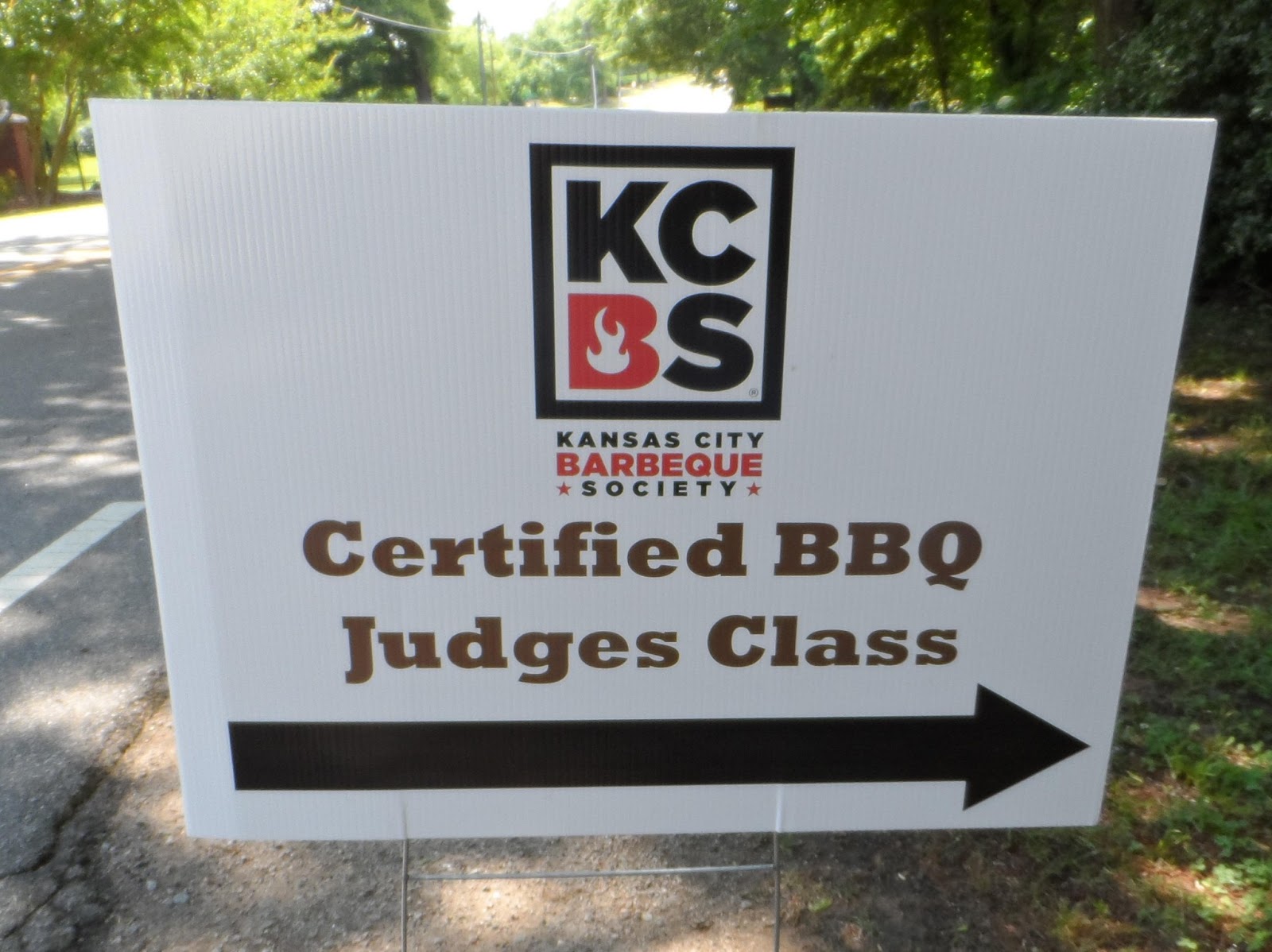
Sign alerts arrivals to location of class.
After attending six hours of instruction and sampling several entries in each category, I received what I wanted: Certification as a BBQ Judge. Now I’m ready to go on the road and judge. If you like barbecue and are interested in judging, learn more about the Society’s Judge Certification Program. Similar training classes are held in most states several times a year. The perks of a certified judge are great: tasting award-winning barbeque.

Wednesday, September 29, 2010

How About That Pecan Pie!

Have you ever entered a pie-making contest? When the pecan pie that I made was voted “best” at work, I was surprised because so many good cooks had entered with their favorites. How did I win? Creating a winning pie is just like playing baseball – avoid three strikes and you should find yourself in position to score. Making a pie itself is easy. The critical steps (all potential strikes) are deciding that you want to win, keeping the recipe simple, and showing up early.

First, decide if you really want to compete or only participate. When the contest was announced, I knew that I wanted to participate – if only to taste all the other entries. However, if I was going to complete all the effort for the contest, I wanted to do more than just participate. Because I had to make a “winning” pie, determining which pie to make was easy. Skip the fluffy and creamy ones. Pick a traditional sweet pie that evokes memories of good times with families, particularly at holidays, such as a pecan pie that is very traditional at Thanksgiving and Christmas, and you are guaranteed to receive a lot of votes.

Next, keep it simple – advice that works for almost every situation. For pie-making, use a proven recipe. To make a pie from scratch, according to Carl Sagan, the American astronomer, “you must first create the universe.” Not feeling like a scientist the night before the contest, I knew that I didn’t want to create a complicated concoction with many ingredients that would compete for attention. Just focus on the basics: sugar and butter. With a pecan pie, the lightly browned pecans on top catch everyone’s eye, and the gooey base sweetened with the right amount of corn syrup guarantees to produce a captivating taste and texture.

Finally, bring the pie early to the contest and insist that everyone take a small taste (even before the contest begins). The first impression scores high, and then the other arrivals are compared to yours. When you bring a pie to a contest, don’t be bashful. Jump right in and take a bite with everyone else and then begin to sample all the other entries. Don’t be a late entry, and never show up as the last entry when all the participants have made up their minds about which entry is the best.

Being ready for a contest also requires more preparation than just making a pie. Show up hungry. You don’t want to be tasting pies on a full stomach, and once you find one or two pies that you like, you might even want to take an extra piece and skip the next meal. In fact, at the next meal, start right. Because food contests prove that pies are our best menu choice, follow the advice of American writer Ernestine Ulmer: “Life is uncertain. Eat dessert first.”


For those who want the recipe:Recipe: The pecan pie recipe that I used is by Mama Dip (she has made it on ABC’s program Good Morning, America) – and it’s simple:
1 stick butter (or margarine)
1 cup sugar
1 cup light Karo syrup
3 eggs beaten
1 cup chopped pecans
1 unbaked 9” pie shell
Directions: Preheat over to 350 degrees. In a sauce pan, melt the butter but don’t let it brown. Mix in sugar and corn syrup and cook stirring over medium heat until sugar dissolves. Stir in eggs. Mix well. Stir in pecans. Pour into the pie and bake for 1 hour until firm. Serves 8.


P.S. Oh, yes, after you win the contest, enjoy wearing your crown.