|
A badge indicating certified judge
established credibility. |
Do you enjoy tasting award-winning barbeque? When eating barbeque, do you compare it to a standard and rate it for taste or
tenderness? If you do, you may want to attend a class and be trained as a certified
judge by an authorized organization. Having the credibility of certification is
particularly important when cooks are competing against each other such as in a
BBQ contest.
 |
| Carol Bigler explains the judging process. |
The judging class that I attended was taught by Randy and Carol Bigler of Huntsville, Alabama, who have been the
Kansas City Barbeque Society's representatives to several state championships. In the class I learned how important the competitions are for the
cooking teams and how much
expense and
effort each competitive event requires. I also realized that judging has to be taught. Even though some in the class might have thought that they are natural judges, they learned to apply consistently the Society’s standards.

Many BBQ cooking
contests are now
sanctioned by the
Kansas City Barbeque Society -- not the most Southern of organizations since it is based in
the mid-West (and also international) but it seems to be the leading group for
sanctioning BBQ contests in the South as well as across the United States. The
Society typically judges in
four categories:
·
Shoulder, a pork entry that may be cooked in one
piece or divided into two (arm picnic and Boston butt)
·
Pork ribs, which can be spare ribs (11 to 13
bones), St. Louis style (with brisket bone and all skirt meat removed), or baby
back ribs (also known as loin ribs)
·
Chicken, prepared whole, half, or any
combination; with or without skin; and all white or dark meat or a combination
·
Beef brisket, the underside chest muscle from
beef cattle.
Regardless of category, I was surprised how the training
class focused us on the quality of a meat’s cooking and not the category that the
meat represented.
 |
Large trailers haul everything
important for a cooking team. |
Each category is judged according to three criteria:
appearance, taste, and tenderness. A table captain presents each entry for
judges to score appearance. Then each judge receives a sample to evaluate
tenderness and taste on a scorecard. Each criterion is scored from a high of 9
(excellent) to a low of 2 (inedible), except when an entry is disqualified (and
receives a score of 1). After a brief explanation and a few samples,
most of the judges in training scored samples (prepared by a team that has
already won regional awards) in relative uniform pattern -- proof that we were
learning the Society’s standards.
In a contest, a table of six judges evaluates each entry, which can be
submitted chopped, pulled, slices or diced. Each judge has to evaluate by the
standards of the Society rather than personal preferences, and
KCBS rules can be very specific. For example, although everyone has a personal idea of what
makes a rib good, the Society specifies that the meat of an excellent pork rib
must come off the bone with very little effort and only where the judge bites.
The Society considers ribs overcooked if the meat falls all the entire bone while
biting. In addition, a cook can use garnish such as green lettuce or
parsley but no kale or red-tipped lettuce.
 |
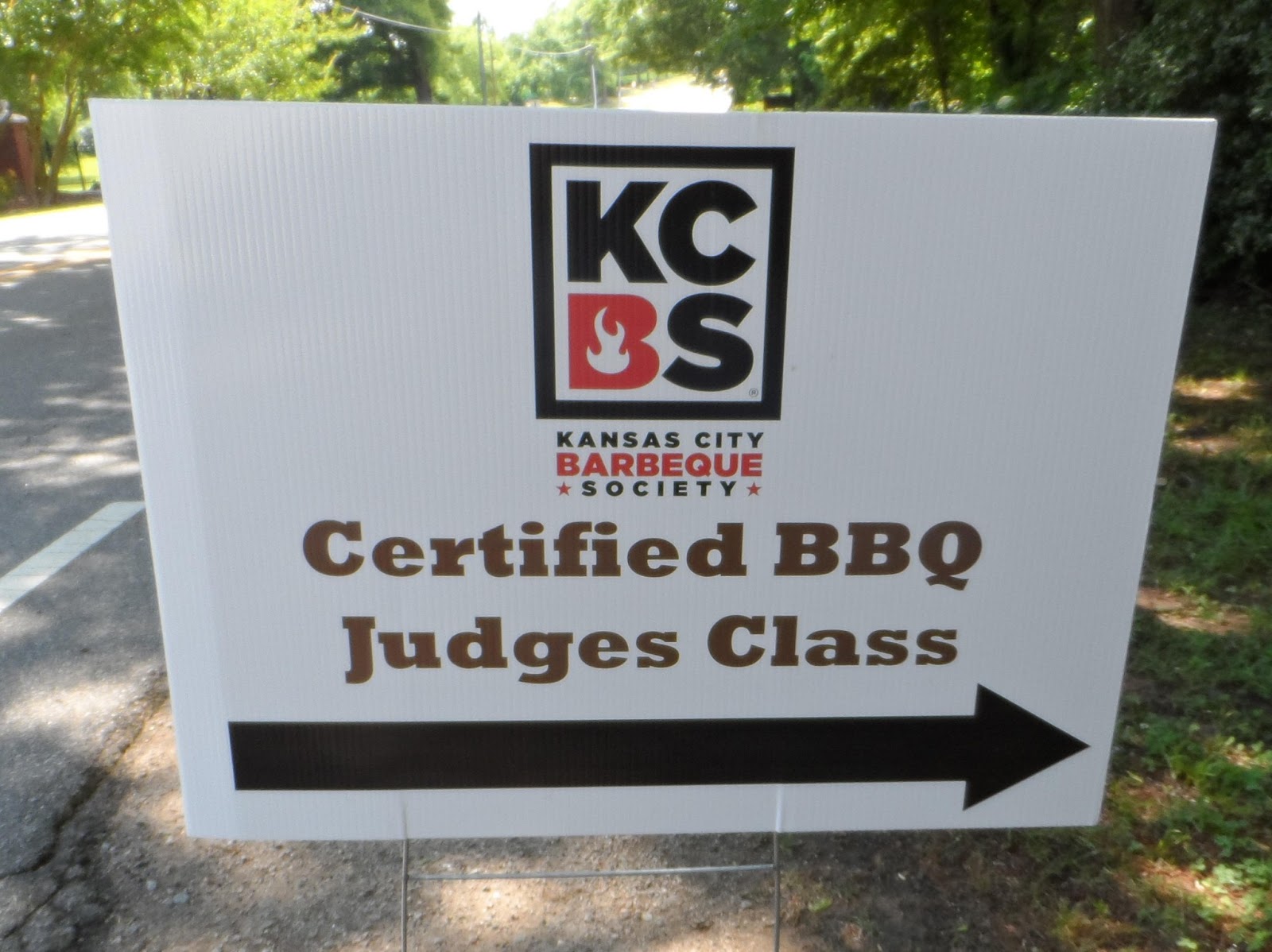
| Sign alerts arrivals to location of class. |
After attending six hours of instruction and sampling
several entries in each category, I received what I wanted: Certification as a
BBQ Judge. Now I’m ready to go on the road and judge. If you like barbecue and
are interested in judging, learn more about the Society’s Judge Certification
Program. Similar
training classes are held in most states several times a year. The perks of a certified judge are great: tasting award-winning barbeque.