Showing posts with label chicken. Show all posts

Monday, October 20, 2025

State Fair Food Attract Crowds Every Year

Bacon is served almost any way you want it.

What makes the food at a state fair so appealing? For some, it’s the novel approach for preparing familiar ingredients in an unusual way. For others, it’s finding food that they’ve never thought about eating before. And for many, it’s simply discovering something surprising on the fair’s midway among the throngs of people. And finally for a few, it’s observing the long lines at the food vendors and being curious about why so many people want what’s being sold.

Turkey legs are no longer as popular as they once were.

Standing in the midway, I watched couples and family groups walking together and sharing their recent purchases. Whether it was sweet or savory or a mixture of the two, every craving was satisfied quickly except where the lines at food vendors were extremely long.

The longest line was for donuts.

New Foods This Year

New foods at the N.C. State Fair this year were innovative concoctions of very inspired imaginations. Lines were long to order fried frozen watermelon, cookie butter frozen banana, freeze-dried marshmallows, chicken feet (baked, fried, and barbecued), and deep-fried lamb chops. Of course, old favorites were also part of the food scene again this year.

Eye-Catching

What first caught my eye was a fried waffle served on a stick. Topped with whipped cream and strawberry sauce, it also captured the attention of many others, particularly kids.

What can be better than a fried strawberry waffle?

Street Corn 

Street corn (elote) has become more popular each year. With origins in Mexico, it has quickly gained a following throughout the South. Grilled corn on the cob is slathered in a creamy sauce that is a mixture of mayonnaise, chili powder, and garlic. Next it is topped with cheese, chili powder, and lime juice. Then it is served on a skewer and eaten hot. Less popular was Hawaiian street corn that was served in half a pineapple.

Hot off the grill, street corn is slathered in a creamy sauce.

Pickles And More Pickles

A popular food vendor was Mr. Pickles Concessions. Of course, it was not the only one with pickles on the menu. Some of the unusual pickle items were flaming-hot Cheetos pickle pizza, Nashville hot pickles, pickle fries, pickle pop (a frozen treat made from dill pickle juice), pickle soup (really!), and a pickle sub (sliced deli meat stacked on a dill pickle sliced in half that served as a bun).

Pickle fries were sold by several food vendors.

Comfort Food

For me, nothing is more satisfying than banana pudding after tasting something sharp, spicy, or hot. Fortunately, there was no line at a banana pudding vendor that I spotted just in time to remove an unusual flavor from my mouth. See if you think these new items fit in the category of comfort food: Cheerwine lemonade, fried turkey leg, coconut shrimp on a stick, potatoes loaded with bacon and cheese, deep-fried cheese curds, fried fish and waffles, and a frozen banana covered in peanut butter, jelly, and nuts.

Banana pudding is a great way to finish a visit to the state fair.

How many people go to a state fair just to say that they tried one of the novel foods for the first time? Creative food is clearly a reason that the fair continues to be so popular.

Wednesday, January 15, 2020

Sharing Favorite Foods with Family and Friends


If you want a lot of great home-cooking, your best bet is the all-you-can eat Southern buffet at Fuller’s in Pembroke, NC. Although Fuller’s is open daily, the Sunday crowd seems like family and makes the restaurant lively.

On that day more tables are taken by family groups than on other days. Tonya Rouben, who grew up in Pembroke, was having lunch with 11 family members who still live in the area. Now living in Atlanta, Rouben says, “I wish I had a place with home-cooking like this where I live. I love the barbecue and fried chicken. “A lot of Lumbees are in the kitchen cooking. It’s hard to beat Native American cooking,” she adds.


Sisters in Faith

At a table for eight, LaVica Farmer of Fayetteville, NC, was eating with her sisters in faith, including one who is 93. All are members of Bethany Presbyterian in Lumberton, NC, that was formed in 1875 and has a historic African-American legacy. Some are descendants of families who established an adjoining academy in 1903 and built the current church building in 1938.


They were with Rev. Helane Church, the pastor at Bethany, and were spending the day praising the Lord, eating Southern food and praising the Lord again. They had just attended the 9 o’clock service in Lumberton conducted by Church before coming to Fuller’s for lunch. Then they were attending an afternoon service, again conducted by Church, at Freedom East Presbyterian in Raeford, NC.

Service and Atmosphere

“Not only is the food delicious, but the service and atmosphere are a treat, so warm. I’ve lost count of how many times I’ve been here. We come here as often as we can,” says Farmer. Although she did not make one of the iconic collard sandwiches, Farmer says she came close. “I got some fatback, fried cornbread, and ate them with collards,” she adds.

The church ladies appreciate Fuller’s approach for serving fish. “We like ours with the bone in, which is what is on the buffet, but they also made a bowl of boneless just for us. This is a treat,” says Farmer, holding a piece of croaker.

Elder Linda Carter of Lumberton remembers eating at the original location of Fuller’s in that city. It opened in 1986 but was closed permanently after being inundated by eight feet of floodwater from Hurricane Matthew in 2016. About the original location, she says, “I went there a long, long time. The same people who now work here remember your face. They are like family.”


New and Repeat Customers

At another table was Lasheena Jones, who was visiting Fuller’s for the first time with nine family members aged 8 to 74, all from Florence, S.C. Although her favorite on the buffet is the turnip greens, her cousin Francenia Cooper says, “The pork sausage is the best.”

You can tell customers who are new by how they hesitate before going to one of the four buffet stations from a repeat customer who makes a beeline for the favorite. Only in the South would more people hover around the station for vegetables than the one for main dishes. Such was the case where 20 vegetables make customers linger and struggle with narrowing the options before filling their plates.

My favorites are anything green — collards, limas, peas, cabbage, turnip greens, okra (fried). With just a third of the plate now open, I had a hard time choosing among rutabagas, mashed potatoes, corn, succotash, mac ‘n’ cheese and nine more. (Yes, mac ‘n’ cheese is a vegetable.) The second most popular station has main dishes — chopped pork barbecue, chicken (fried, baked and barbecue), fried crab, shrimp and fried fish, sliced roast beef, pork sausage, chicken livers — plus breads such as hushpuppies, biscuits and corn fritters.

Desserts at Fuller's

Customers are not timid about taking desserts — some have at least three. Chocolate layer cake (four layers), strawberry shortcake and banana pudding seem to be the top choices. Other choices included a fruit cobbler, a vanilla layer cake and self-serve soft ice cream. When the dessert station runs out of space, sometimes more desserts are on the fourth station, which is mostly salad ingredients.


The buffet stations are brightly lighted by clerestory windows, a series of small windows along the top of the building near the roofline. Don’t worry about anything on the buffet being stale or sitting too long. Items are continually taken by customers and quickly replenished by servers, who keep the chicken — an obvious favorite — piled high.

Table of Brotherhood

Kristyn Sabara, one of the servers, said that Sunday is the most popular day and a waitlist that day around 1 p.m. is common, although the buffet price of $12.99 on Sunday is $4 more than on weekdays. A menu is also available, but most choose the buffet.

Fuller’s brings to life the dream of Dr. Martin Luther King Jr., who envisioned how we would “sit down together at the table of brotherhood.” People of all colors and heritages — once separated by the power of Jim Crow — mingle as they enjoy favorite foods. The scene could be improved only if everyone were served family-style and sat at one communal table.


Note: The post is based on my article about Fuller's published in the January 2020 issue of OutreachNC Magazine.

Saturday, September 21, 2019

Moravian Chicken Pie, a Tradition Worth Preserving

Moravian chicken pie
Moravian chicken pie is a very savory dish.
How many times have I enjoyed Moravian chicken pie, a savory meat pie? I‘m not sure. Because I grew up in Winston-Salem, NC—the center of Moravian culture in America—it was featured often at church suppers.

This regional specialty is a flaky double-crusted pie packed with tender chicken that is served in slices with a rich gravy. A humble dish that is appetizing and hearty, it brings together chicken, pasty and gravy in a simple format with nothing else. Because the chicken has been boiled and chopped into bite-size pieces before being baked in the pie, it is deliciously tender, and the rich gravy guarantees a flavorful taste that is moist.

Moravian chicken pie
Chicken pies on the serving line at Fairview Moravian Church in Winston-Salem are ready to be served.

Colonial Origin

That city in the Piedmont region of the state grew out of the colonial settlements of Moravians known as Wachovia, a tract of almost 100,000 acres purchased in 1752 from John Carteret, the British statesman known as the 2nd Earl Granville.

Colonial Moravian settlers
Each table is decorated with a centerpiece of early Moravian settlers in colonial dress.

Most accounts credit the Moravians who in 1766 founded the town of Salem (that merged with the industrial town of Winston in 1913) as being the originators of the pie. They were familiar with meat pies, a staple of their diet in Europe. The Moravian Church, one of the world’s oldest Protestant denominations, has its roots in central Europe that is now part of the Czech Republic. Early Moravian immigrants to America began arriving—with their baking traditions—in 1735 in Pennsylvania to escape persecution by governments and state churches in Europe.

Serving line
The serving line is staffed with very efficient (and experienced) church volunteers.

Simple Recipe

Unlike some Moravian culinary traditions—such as sugar cake (my favorite), cookies, and spiced tea—that are very popular at Christmas, the chicken pie is served year-round. Little has changed to the pie’s recipe since it was first served in colonial times. Unlike traditional chicken pot pies, the Moravian pie doesn’t have any vegetables.

Chicken gravy
A rich chicken gravy is ladled on top of each pie serving.

True to the Moravians’ simple, frugal lifestyle, the pie requires only five ingredients that would have been readily available: chicken, broth, flour, butter and salt. The pie was likely a way to use scraps of cooked meat.

Plate of chicken pie supper

Supper includes more than chicken pie. Fairview Moravian plates also have country ham, green beans, apples, and a biscuit.

The Tavern in Old Salem, a family-operated restaurant built in 1816 as an annex to the historic 1784 tavern, is steeped in Moravian traditions and history. Embracing its heritage, it serves a Moravian chicken pie and gravy for Sunday brunch and a tavern chicken pie with gravy, potatoes, and green beans as a plate at lunch on other days.

Sign of Fairview Moravian Church
Proceeds of annual suppers at Fairview Moravian Church have paid for mission projects and building improvements.

Community Appreciation

Although I didn’t grow up in a Moravian Church in Winston-Salem (which still shares the distinction of having the highest concentration of Moravians in North America with Bethlehem, Pa.), members of my church (a Presbyterian one) and other neighboring churches were admirers of the Moravian pie, so much so that it was routinely duplicated by congregations at events regardless of their denominations.

Congregation members and guests linger after eating supper to enjoy each other's company.

In addition to satisfying the appetites of a church and the local community, chicken pie suppers (yes, they are not called "dinners") have also enriched social connections as well as contributed to fundraisers and building programs. According to Moravian archives, churches in Winston-Salem held chicken pie suppers as fundraisers as early as 1920.

Moravian cole slaw
A tangy Moravian cole slaw is served family style at each table.

Enjoying the pie at Fairview Moravian Church in Winston-Salem, which I still consider as a “neighborhood church,” with its congregation made me appreciate even more how Moravians have enriched our culture—religious, social, musical, culinary, and other aspects. I’m glad that the chicken pie served more often than at only Christmas.

Placemats come complete with the Moravian blessing (on lower left corner).

Note: Several recipes are available online, including, this one recently in Our State magazine.


Sunday, October 20, 2013

Food, Service, and Prices from Yesterday at the Chicken Coop

[Note: This post, prepared originally for the NC Folklife Institute's NCFood blog, is hosted on the institute’s website, with excerpts and a link to the website posted here.] 

A few places serving food in our state are caught in a time warp and remain unchanged since the days that they opened. Price’s Chicken Coop, established in 1962, in the South End of Charlotte is definitely one. Seeing the name of Chicken Coop, you know exactly what to order.

The classic southern dish is fried chicken. Although just about every home in the South has a favorite family recipe, in the Charlotte area the preferred chicken is marinated in a secret blend for more than a day before being fried in peanut oil by the Price family. The prices are almost as popular as the chicken itself. A to-go chicken box is as low as $6.25, and a chicken sandwich only $3.40.


Saturday, June 8, 2013

Food Judging and BBQ Contests

A badge indicating certified judge
established credibility.
Do you enjoy tasting award-winning barbeque? When eating barbeque, do you compare it to a standard and rate it for taste or tenderness? If you do, you may want to attend a class and be trained as a certified judge by an authorized organization. Having the credibility of certification is particularly important when cooks are competing against each other such as in a BBQ contest.

Carol Bigler explains the judging process.
The judging class that I attended was taught by Randy and Carol Bigler of Huntsville, Alabama, who have been the Kansas City Barbeque Society's representatives to several state championships. In the class I learned how important the competitions are for the cooking teams and how much expense and effort each competitive event requires. I also realized that judging has to be taught. Even though some in the class might have thought that they are natural judges, they learned to apply consistently the Society’s standards.

Many BBQ cooking contests are now sanctioned by the Kansas City Barbeque Society -- not the most Southern of organizations since it is based in the mid-West (and also international) but it seems to be the leading group for sanctioning BBQ contests in the South as well as across the United States. The Society typically judges in four categories:
·        Shoulder, a pork entry that may be cooked in one piece or divided into two (arm picnic and Boston butt)
·        Pork ribs, which can be spare ribs (11 to 13 bones), St. Louis style (with brisket bone and all skirt meat removed), or baby back ribs (also known as loin ribs)
·        Chicken, prepared whole, half, or any combination; with or without skin; and all white or dark meat or a combination
·        Beef brisket, the underside chest muscle from beef cattle.
Regardless of category, I was surprised how the training class focused us on the quality of a meat’s cooking and not the category that the meat represented.

Large trailers haul everything
important for a cooking team.
Each category is judged according to three criteria: appearance, taste, and tenderness. A table captain presents each entry for judges to score appearance. Then each judge receives a sample to evaluate tenderness and taste on a scorecard. Each criterion is scored from a high of 9 (excellent) to a low of 2 (inedible), except when an entry is disqualified (and receives a score of 1). After a brief explanation and a few samples, most of the judges in training scored samples (prepared by a team that has already won regional awards) in relative uniform pattern -- proof that we were learning the Society’s standards.

In a contest, a table of six judges evaluates each entry, which can be submitted chopped, pulled, slices or diced. Each judge has to evaluate by the standards of the Society rather than personal preferences, and KCBS rules can be very specific. For example, although everyone has a personal idea of what makes a rib good, the Society specifies that the meat of an excellent pork rib must come off the bone with very little effort and only where the judge bites. The Society considers ribs overcooked if the meat falls all the entire bone while biting. In addition, a cook can use garnish such as green lettuce or parsley but no kale or red-tipped lettuce.

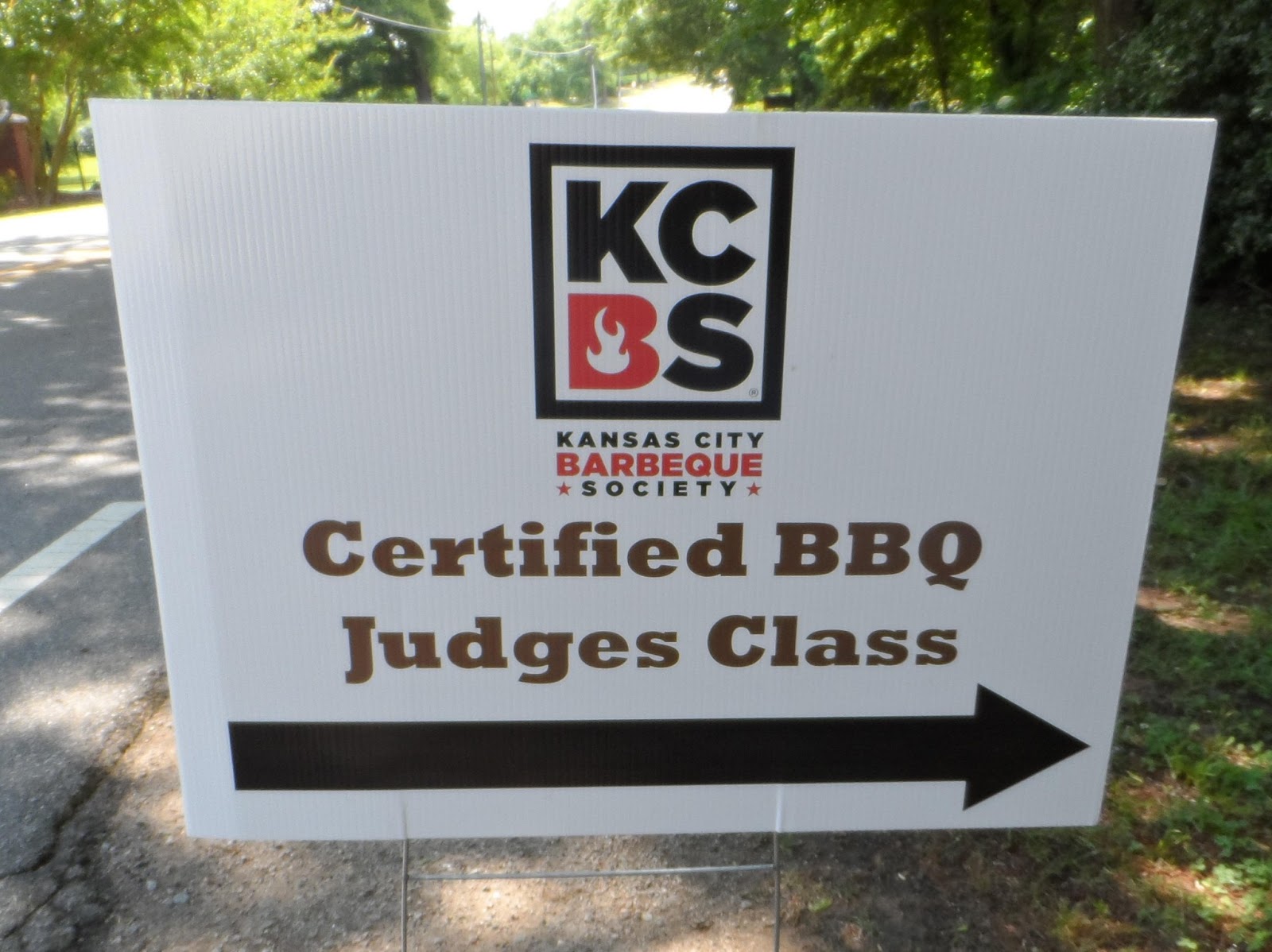
Sign alerts arrivals to location of class.
After attending six hours of instruction and sampling several entries in each category, I received what I wanted: Certification as a BBQ Judge. Now I’m ready to go on the road and judge. If you like barbecue and are interested in judging, learn more about the Society’s Judge Certification Program. Similar training classes are held in most states several times a year. The perks of a certified judge are great: tasting award-winning barbeque.

Sunday, November 21, 2010

Barbecuing for the Lord: Street Ministry Fixes Good Southern Food

Love and mercy are on the menu on N.C. 5 between Aberdeen and Pinehurst. “This is St. Paul’s, and street ministry is on the move. It’s God’s plan, not ours,” says Valerie Washington, a church volunteer whose passion is helping people in need.

In the area of Jackson Hamlet some drivers slow down on Fridays for a reason other than the 35 mph speed limit as they see smoke, and many are stopping to taste what’s on the grill. All the smoke is for a good cause.

Leo Thomas“We are raising money to assist the needy,” says Leo Thomas, a volunteer cook for St. Paul’s Missionary Baptist Church in Jackson Hamlet. The grilling was “started to help families in need. We’ve been doing this for about two years,” he says. “The need is so great this year.”

The cooking is “part of layman’s league for the pastor. It benefits our benevolent fund,” he says. “The community has so many different needs, such as paying light bills. We try to help wherever we can.”

Thomas says the church used its grill proceeds last winter to provide complete turkey dinners to 68 families at Christmas in a combined effort with Mosaic Ministries in Seven Lakes and Greater Harvest in Midway. In addition, the money raised is used to purchase gift cards for families in need, says Anthony “Tony” Washington, an associate pastor at the church -- and Valerie’s husband.

More Than Chicken

The menu on Fridays usually features barbecued chicken and sometimes fish with sides that can include cabbage, cole slaw, baked beans and green beans. A plate is topped off with a slice of cake and drink. On some Fridays, the smoke is a little thicker because the volunteers are barbecuing ribs. The grill operation usually begins at 10 in the morning.

“We start to serve at 11 and stay until we sell out, usually by 3 pm. We always hope to sell 100-plus plates,” says Thomas. The church even offers plates free to law enforcement officers and a discount for the military, “but they usually give us donations,” Tony Washington says.

Ministry, Food and Education

Valerie Washington’s street ministry vision is influenced by her experience in New Jersey. “I came from a 3,000-member church in Atlantic City where street ministry and outreach are very important,” she says. “Feeding the homeless is really important in a large city. We brought that here with us. God sent us and has placed us in this path to minister.”Linda McDowell, church treasurer, and Valerie Washington, church volunteer

A regular volunteer at St. Paul’s roadside grill who loves barbecued chicken, she confesses, however, that her favorite dish is chicken and dumplings made by her grandmother. “It’s so good – an original Southern dish. My mom also made it for our family.”

Serving food for her church is only a part of what keeps her busy. She is still celebrating receiving a GED in June at Sandhills Community College. “I’ve been fighting for my diploma for 20 years,” she says. It took me a long time. The tutors at the college brought me a long way. I work at Wal-Mart, and going to school after work was a lot of pressure.”

She identified one tutor at SCC for special praise. “Mrs. Wanda Sweeney is one of the kindest, most courteous and most supportive persons,” says Valerie Washington. “She’s forever in her heart. I love her. They even gave me a party because I kept coming back, persevered and keep on going. I learned a lot at Sandhills Community College,” she says. She now plans to earn a cosmetology degree.

Even with a full-time job and additional stress as a student, she is typical of the St. Paul’s congregation who find time to enrich the community and enjoys each other’s fellowship when they work together on a ministry project.

Ministry and Military

Pastor Tony Washington St. Paul’s is a vital member of the area, says Tony Washington, who operates the grill when he’s not on duty with the Army. “The church is very family-oriented and has a membership of about 100,” says the Army noncommissioned officer, who was born in Pinehurst and has served around the world. “I’ve completed two tours in Iraq with one more overseas assignment to go, probably in Afghanistan.”

He says as he thinks of retirement from the military in about two years. Until then Thomas says he’ll continue to train soldiers for Iraq and Afghanistan. “My favorite Bible verses are from the 23rd Psalm because of where I go and the work that I do,” says the minister and soldier. “It’s very appropriate for me.”

Grilling is not a new activity for Washington, who says that he was about 11 years old when he handled a grill the first time while he was living in Texas. “In the South the young ones watch the grill. They are taught at a young age,” he says. Whether he’s barbecuing for the Lord or family and friends, he grills in the tradition-honored style of the South -- an open flame not fueled by propane. “Barbecue is very sacred,” he says with a smile as he mentions the dos and don’ts of barbecuing. “I never use propane. I always cook with wood and Kingsford charcoal.”

Community Commitment

The grill mission is a community effort, and St. Paul’s receives a lot of local support. Food Lion on N.C. 5 in Aberdeen “is one of our biggest supporters,” says Thomas. The store often “donates cake and drink and frequently gives gift cards, up to $50 depending on the need.” Other food is bought locally. “We buy our fish at Aberdeen Produce. When we serve ribs, we get them from Aberdeen Packing that sells to us at cost,” says Thomas. Some items are also provided by other community friends and church members.

In addition to serving the Lord, Tony Washington dreams of opening his own ribs restaurant and cooking full-time when he retires from the Army. “I definitely want to be on Highway 5. I’d like to have it between Aberdeen and Pinehurst. We have a commitment to this community,” he says.


Note: This posting is a slightly edited version of an article published originally in The Pilot (Southern Pines, NC) on November 21, 2010 (pages C1 and C6).