Showing posts with label barbecue. Show all posts

Saturday, January 1, 2022

How to Celebrate with New Year’s Day Food During a Pandemic

The boxed New Year's Day lunch had everything important.

It’s January 1 and time to celebrate with a Southern meal of collards, black-eyed peas, and cornbread, even though the world has been beset with the coronavirus pandemic for almost two years. What is a community to do when social distancing and mask-wearing are as important as serving traditional New Year’s Day food? 

A line of cars was waiting well before the start time.

Open a drive-through line is what Culdee Presbyterian Church in Moore County, NC, decided. Takeout is better than no food or no celebration at all. If students can learn remotely during a pandemic, people can enjoy food in a similar manner. 

Several volunteers were busy helping to keep the line moving.

The church’s congregation was busy early in the day preparing the food and assembling the boxes, and the takeout line was growing well before the start time. The long line of cars waiting for boxed lunches to take home was an indication of how much people enjoy celebrating together (even when they have to stay in their vehicles) and how important the food traditions of New Year’s Day can be. The desire to participate in a joint activity can override the reality of how little social inaction might occur. 

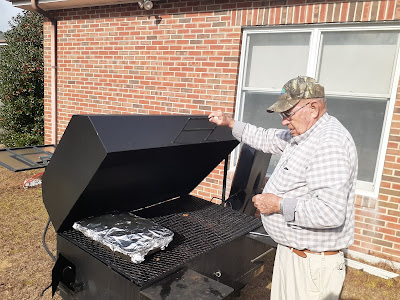
A pitmaster keeps the remaining barbecue warm.

The process was simple: Drive in, stop to order and pay, advance to pick up, and leave. No special orders. Every box was the same: Boston butt barbecue, collards, black-eyed peas, cornbread, and dessert (which was either a slice of pound cake or two cookies). The barbecue and dessert were added attractions—I would have gone for just the collards, black-eyed peas, and cornbread. 

So many cars were driving through the line and being served, I thought that the church would sell out early, well before the end time that was three hours later, and they did. Of course, most of us know to show up early for these events and then sit back and watch all the activity unfold. 

A sign at a busy intersection promotes the event in advance—without indicating the location (but the locals knew).

Starting the New Year correctly is so vitally important, and eating collard greens and black-eyed peas with cornbread guarantees good health and fortune (or so we have been told). If we do, life is good.


Note: An article about a different community gathering on New Year’s Day and its food traditions that I wrote for N.C.Food Blog of N.C. Folklife Institute is published here.   


Saturday, August 1, 2015

Run, Piggy, Run

Pig races are a crowd favorite
at the Peak City Pig Fest.
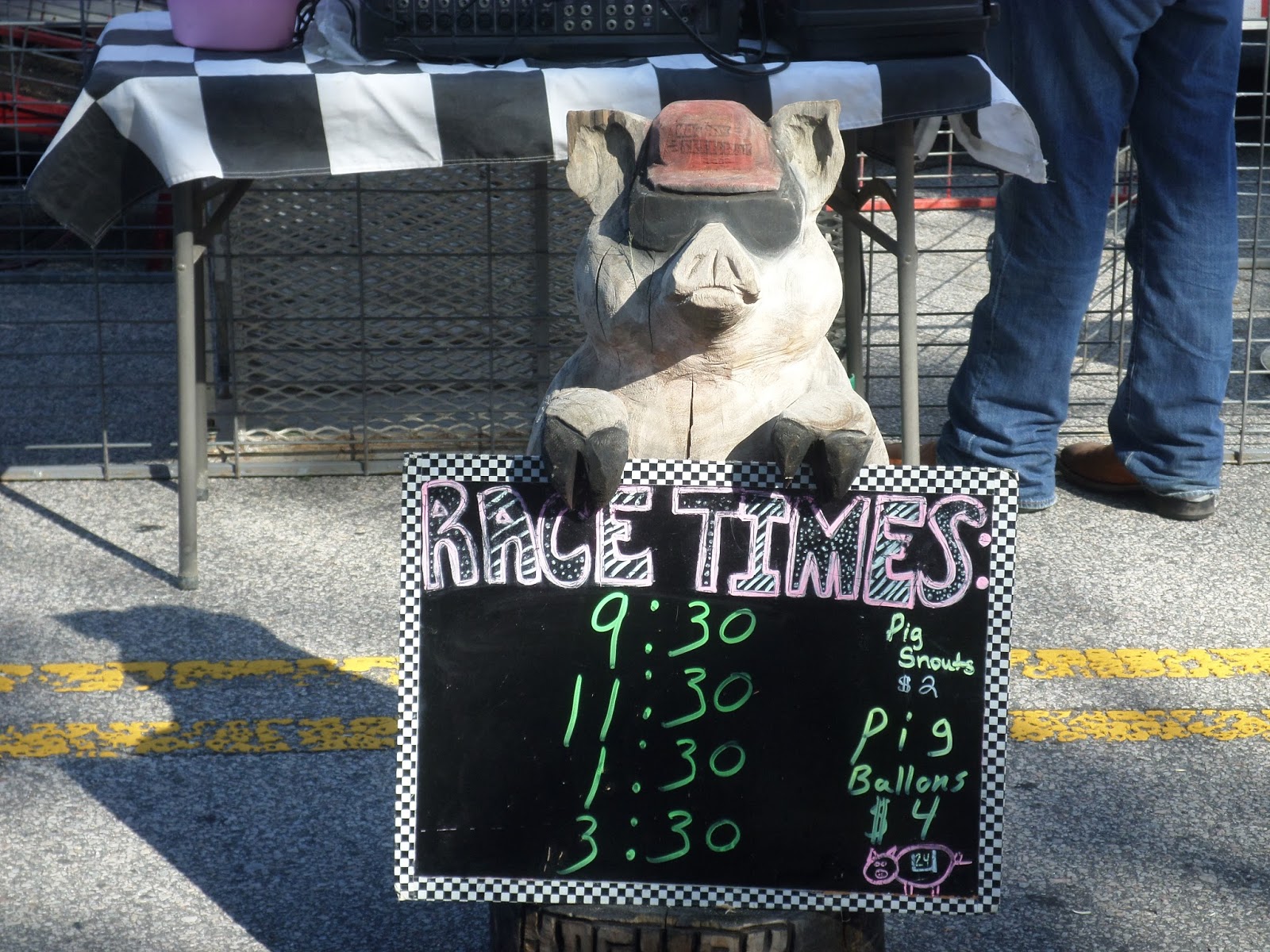
You really haven’t had an exciting summer unless you’ve been to a pig race. When I was in Apex for the Peak City Pig Fest, I knew that I couldn’t leave until I had watched one of the four pig races. They were a featured part of the festival, which included a barbecue cookoff with 48 cooking teams.

As the crowd ambles into the area of the “Hogway Speedway,” honky-tonk music blares on loudspeakers, interrupted by an occasional “Howdy” by a Minnie Pearl-sounding voice. As race time nears, Brent Cook, the emcee, counts down the minutes remaining. Then “The Call to Post” blares loudly. It sounds as authentic as the one at Churchill Downs before the start of the Kentucky Derby. However, at Hogway Speedway, the 33 high-tempo bugle notes are a recording rather than live, but they alert the crowd that a race is imminent. Because the notes are insufficient to call the pigs, Cook leads the crowd in a boisterous call of “Soo-o-o-o-ey” that ricochets down the street among the festival tents, displays, and food vendors.

The crowd surrounds the "hogway" before the start of each race.

Cook is from Newton, home of Circle C Farms, where the pigs bask in their glory between events and are groomed for their next weekend race. After “The Call to Post” recording, Cook introduces each racing pig as it runs to the starting gate and explains the special lingo that Hogway Speedway needs: the far side of the raceway is a hamstretch (rather than a backstretch) and a hambulance is called for any injured racer who pulls a hamstring or collides with others in a pigup (not a pileup).

Brent Cook starts a race.
The racing pigs also have names and numbers just like NASCAR heroes. For this festival, four pigs competed in each race. Although their names are a humorous resemblance of real drivers, their numbers are the same: #11, Hammy Hamlin (instead of NASCAR’s Denny Hamlin), #14 Squealing Stewart (instead of Tony), #24 Piggy Gordon (Jeff), and #88 Oinkhardt Jr. (Dale Earnhardt Jr.).

Just like NASCAR drivers on a real course, pigs run counterclockwise (must be a natural tendency). Oinkhardt Jr., the crowd favorite, won the 9:30 a.m. race. After the race is over, you learn why the pigs run so fast: it’s the reward. The winner gets to munch on a special plate of Wise’s Cheez Doodles. No treats for the losers, who have to wait until next race for another chance or the next meal after the long ride home.

Racing pigs pick up speed after a sharp turn.

When the races are over, the crowd returns to other areas of the festival to enjoy pork barbecue, ice cream, and other food. As everyone leaves, Cook calls out, “Don’t tell the pigs if you eat barbecue. They might squeal on you.” The pigs from Circle C Farms are also an annual tradition at the N.C. State Fair in Raleigh each October. Don’t miss them!


Note: This post appeared originally in the August 2015 issue of OutreachNC, a monthly magazine distributed in 10 counties of central North Carolina. Click here to see the article as it appeared in print.

Friday, February 20, 2015

Enjoying Barbecue Prepared Like When You Were a Kid

[Note: This post, prepared originally for the NC Folklife Institute's NCFood blog, is hosted on the institute’s website, with excerpts and a link to the website posted here.]

Have you ever passed a restaurant, wondered how good its food is, but didn’t stop because you were saving money by not eating out? That’s my story about North Carolina barbecue when I was growing up.

I grew up in the Piedmont in a stable but modest neighborhood of Winston-Salem. In the heart of
“Lexington-style” barbecue, the closest restaurant was less than a mile from my house. Although it was a place that I walked nearby when I carried daily newspapers, I never ate there because I didn’t have the extra coins to buy a sandwich.

The desire to taste barbecue in my hometown went unsatisfied for years because after college I lived out of state. Many years later when I visited Winston-Salem, I was disappointed that Simos Barbecue, the neighborhood diner which had opened in 1939, was no longer in business. It closed after the owner’s health had declined. Its closing disappointed not only me and others in the city but legions of former students at nearby Wake Forest University who went online to lament their sorrow.

Saturday, June 8, 2013

Food Judging and BBQ Contests

A badge indicating certified judge
established credibility.
Do you enjoy tasting award-winning barbeque? When eating barbeque, do you compare it to a standard and rate it for taste or tenderness? If you do, you may want to attend a class and be trained as a certified judge by an authorized organization. Having the credibility of certification is particularly important when cooks are competing against each other such as in a BBQ contest.

Carol Bigler explains the judging process.
The judging class that I attended was taught by Randy and Carol Bigler of Huntsville, Alabama, who have been the Kansas City Barbeque Society's representatives to several state championships. In the class I learned how important the competitions are for the cooking teams and how much expense and effort each competitive event requires. I also realized that judging has to be taught. Even though some in the class might have thought that they are natural judges, they learned to apply consistently the Society’s standards.

Many BBQ cooking contests are now sanctioned by the Kansas City Barbeque Society -- not the most Southern of organizations since it is based in the mid-West (and also international) but it seems to be the leading group for sanctioning BBQ contests in the South as well as across the United States. The Society typically judges in four categories:
·        Shoulder, a pork entry that may be cooked in one piece or divided into two (arm picnic and Boston butt)
·        Pork ribs, which can be spare ribs (11 to 13 bones), St. Louis style (with brisket bone and all skirt meat removed), or baby back ribs (also known as loin ribs)
·        Chicken, prepared whole, half, or any combination; with or without skin; and all white or dark meat or a combination
·        Beef brisket, the underside chest muscle from beef cattle.
Regardless of category, I was surprised how the training class focused us on the quality of a meat’s cooking and not the category that the meat represented.

Large trailers haul everything
important for a cooking team.
Each category is judged according to three criteria: appearance, taste, and tenderness. A table captain presents each entry for judges to score appearance. Then each judge receives a sample to evaluate tenderness and taste on a scorecard. Each criterion is scored from a high of 9 (excellent) to a low of 2 (inedible), except when an entry is disqualified (and receives a score of 1). After a brief explanation and a few samples, most of the judges in training scored samples (prepared by a team that has already won regional awards) in relative uniform pattern -- proof that we were learning the Society’s standards.

In a contest, a table of six judges evaluates each entry, which can be submitted chopped, pulled, slices or diced. Each judge has to evaluate by the standards of the Society rather than personal preferences, and KCBS rules can be very specific. For example, although everyone has a personal idea of what makes a rib good, the Society specifies that the meat of an excellent pork rib must come off the bone with very little effort and only where the judge bites. The Society considers ribs overcooked if the meat falls all the entire bone while biting. In addition, a cook can use garnish such as green lettuce or parsley but no kale or red-tipped lettuce.

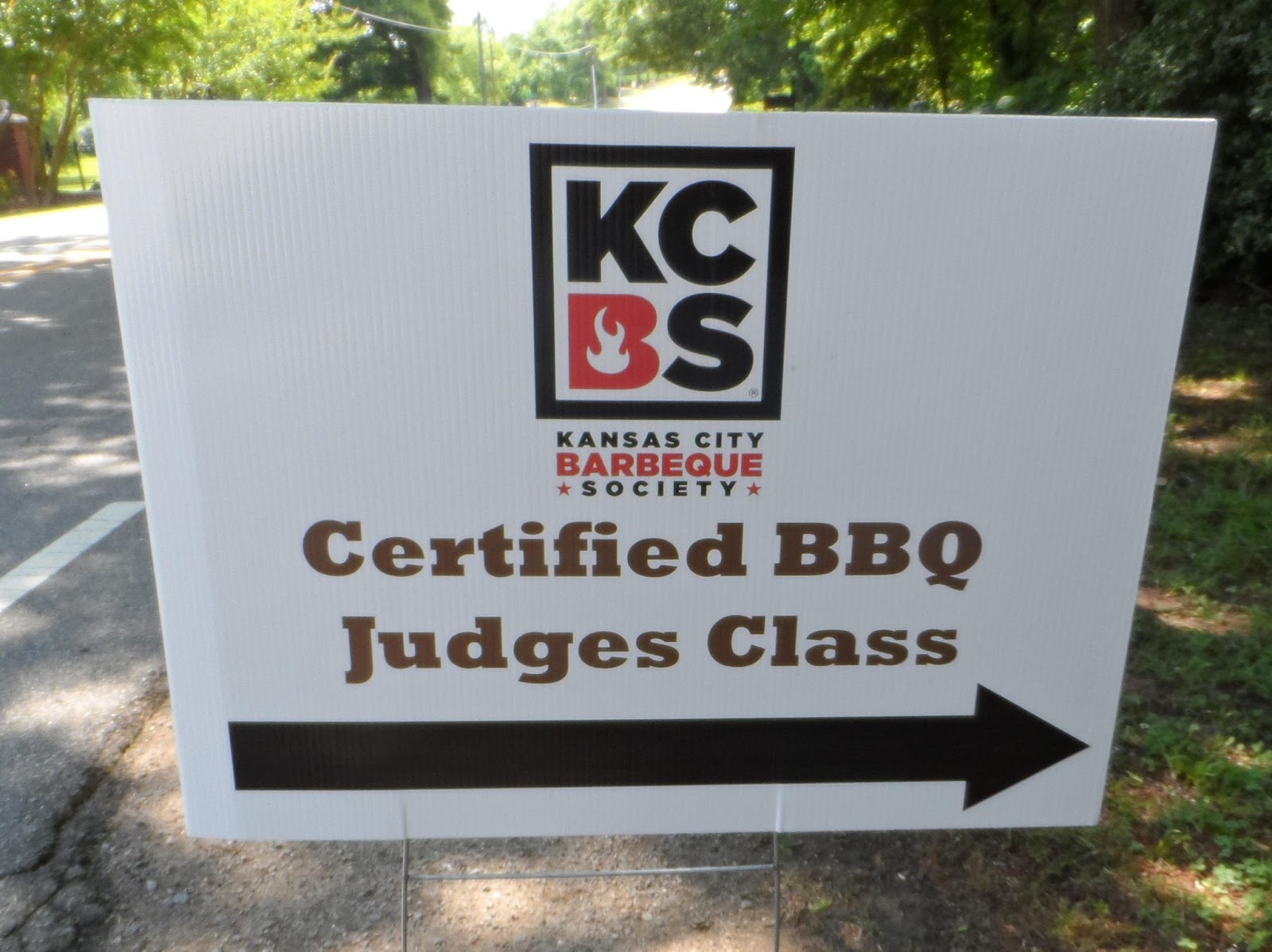
Sign alerts arrivals to location of class.
After attending six hours of instruction and sampling several entries in each category, I received what I wanted: Certification as a BBQ Judge. Now I’m ready to go on the road and judge. If you like barbecue and are interested in judging, learn more about the Society’s Judge Certification Program. Similar training classes are held in most states several times a year. The perks of a certified judge are great: tasting award-winning barbeque.

Sunday, November 21, 2010

Barbecuing for the Lord: Street Ministry Fixes Good Southern Food

Love and mercy are on the menu on N.C. 5 between Aberdeen and Pinehurst. “This is St. Paul’s, and street ministry is on the move. It’s God’s plan, not ours,” says Valerie Washington, a church volunteer whose passion is helping people in need.

In the area of Jackson Hamlet some drivers slow down on Fridays for a reason other than the 35 mph speed limit as they see smoke, and many are stopping to taste what’s on the grill. All the smoke is for a good cause.
Leo Thomas“We are raising money to assist the needy,” says Leo Thomas, a volunteer cook for St. Paul’s Missionary Baptist Church in Jackson Hamlet. The grilling was “started to help families in need. We’ve been doing this for about two years,” he says. “The need is so great this year.”

The cooking is “part of layman’s league for the pastor. It benefits our benevolent fund,” he says. “The community has so many different needs, such as paying light bills. We try to help wherever we can.”

Thomas says the church used its grill proceeds last winter to provide complete turkey dinners to 68 families at Christmas in a combined effort with Mosaic Ministries in Seven Lakes and Greater Harvest in Midway. In addition, the money raised is used to purchase gift cards for families in need, says Anthony “Tony” Washington, an associate pastor at the church -- and Valerie’s husband.

More Than Chicken

The menu on Fridays usually features barbecued chicken and sometimes fish with sides that can include cabbage, cole slaw, baked beans and green beans. A plate is topped off with a slice of cake and drink. On some Fridays, the smoke is a little thicker because the volunteers are barbecuing ribs. The grill operation usually begins at 10 in the morning.

“We start to serve at 11 and stay until we sell out, usually by 3 pm. We always hope to sell 100-plus plates,” says Thomas. The church even offers plates free to law enforcement officers and a discount for the military, “but they usually give us donations,” Tony Washington says.

Ministry, Food and Education

Valerie Washington’s street ministry vision is influenced by her experience in New Jersey. “I came from a 3,000-member church in Atlantic City where street ministry and outreach are very important,” she says. “Feeding the homeless is really important in a large city. We brought that here with us. God sent us and has placed us in this path to minister.”Linda McDowell, church treasurer, and Valerie Washington, church volunteer

A regular volunteer at St. Paul’s roadside grill who loves barbecued chicken, she confesses, however, that her favorite dish is chicken and dumplings made by her grandmother. “It’s so good – an original Southern dish. My mom also made it for our family.”

Serving food for her church is only a part of what keeps her busy. She is still celebrating receiving a GED in June at Sandhills Community College. “I’ve been fighting for my diploma for 20 years,” she says. It took me a long time. The tutors at the college brought me a long way. I work at Wal-Mart, and going to school after work was a lot of pressure.”

She identified one tutor at SCC for special praise. “Mrs. Wanda Sweeney is one of the kindest, most courteous and most supportive persons,” says Valerie Washington. “She’s forever in her heart. I love her. They even gave me a party because I kept coming back, persevered and keep on going. I learned a lot at Sandhills Community College,” she says. She now plans to earn a cosmetology degree.

Even with a full-time job and additional stress as a student, she is typical of the St. Paul’s congregation who find time to enrich the community and enjoys each other’s fellowship when they work together on a ministry project.

Ministry and Military

Pastor Tony Washington St. Paul’s is a vital member of the area, says Tony Washington, who operates the grill when he’s not on duty with the Army. “The church is very family-oriented and has a membership of about 100,” says the Army noncommissioned officer, who was born in Pinehurst and has served around the world. “I’ve completed two tours in Iraq with one more overseas assignment to go, probably in Afghanistan.”

He says as he thinks of retirement from the military in about two years. Until then Thomas says he’ll continue to train soldiers for Iraq and Afghanistan. “My favorite Bible verses are from the 23rd Psalm because of where I go and the work that I do,” says the minister and soldier. “It’s very appropriate for me.”

Grilling is not a new activity for Washington, who says that he was about 11 years old when he handled a grill the first time while he was living in Texas. “In the South the young ones watch the grill. They are taught at a young age,” he says. Whether he’s barbecuing for the Lord or family and friends, he grills in the tradition-honored style of the South -- an open flame not fueled by propane. “Barbecue is very sacred,” he says with a smile as he mentions the dos and don’ts of barbecuing. “I never use propane. I always cook with wood and Kingsford charcoal.”

Community Commitment

The grill mission is a community effort, and St. Paul’s receives a lot of local support. Food Lion on N.C. 5 in Aberdeen “is one of our biggest supporters,” says Thomas. The store often “donates cake and drink and frequently gives gift cards, up to $50 depending on the need.” Other food is bought locally. “We buy our fish at Aberdeen Produce. When we serve ribs, we get them from Aberdeen Packing that sells to us at cost,” says Thomas. Some items are also provided by other community friends and church members.

In addition to serving the Lord, Tony Washington dreams of opening his own ribs restaurant and cooking full-time when he retires from the Army. “I definitely want to be on Highway 5. I’d like to have it between Aberdeen and Pinehurst. We have a commitment to this community,” he says.


Note: This posting is a slightly edited version of an article published originally in The Pilot (Southern Pines, NC) on November 21, 2010 (pages C1 and C6).