Showing posts with label pig. Show all posts

Saturday, August 1, 2015

Run, Piggy, Run

Pig races are a crowd favorite
at the Peak City Pig Fest.
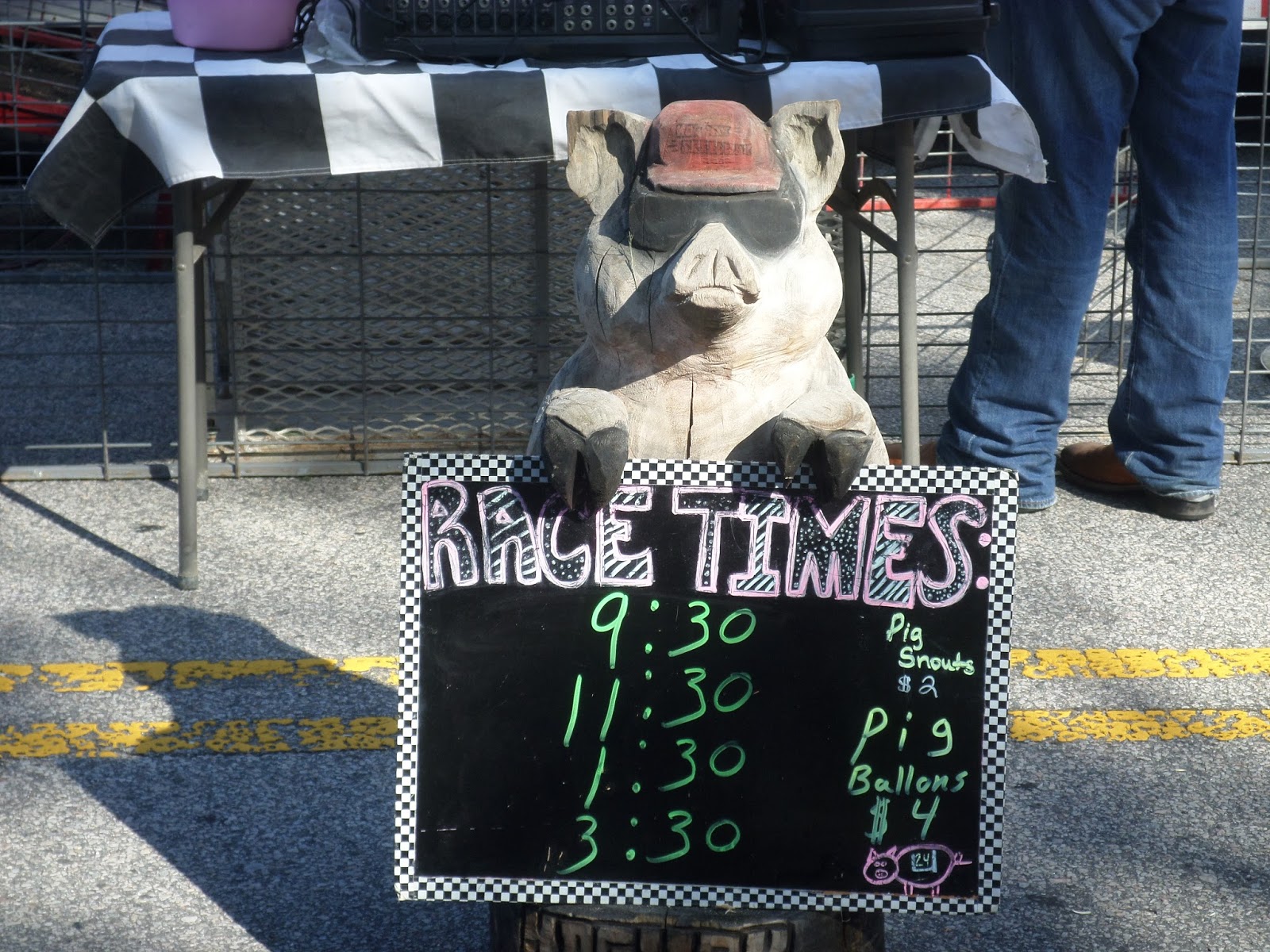
You really haven’t had an exciting summer unless you’ve been to a pig race. When I was in Apex for the Peak City Pig Fest, I knew that I couldn’t leave until I had watched one of the four pig races. They were a featured part of the festival, which included a barbecue cookoff with 48 cooking teams.

As the crowd ambles into the area of the “Hogway Speedway,” honky-tonk music blares on loudspeakers, interrupted by an occasional “Howdy” by a Minnie Pearl-sounding voice. As race time nears, Brent Cook, the emcee, counts down the minutes remaining. Then “The Call to Post” blares loudly. It sounds as authentic as the one at Churchill Downs before the start of the Kentucky Derby. However, at Hogway Speedway, the 33 high-tempo bugle notes are a recording rather than live, but they alert the crowd that a race is imminent. Because the notes are insufficient to call the pigs, Cook leads the crowd in a boisterous call of “Soo-o-o-o-ey” that ricochets down the street among the festival tents, displays, and food vendors.

The crowd surrounds the "hogway" before the start of each race.

Cook is from Newton, home of Circle C Farms, where the pigs bask in their glory between events and are groomed for their next weekend race. After “The Call to Post” recording, Cook introduces each racing pig as it runs to the starting gate and explains the special lingo that Hogway Speedway needs: the far side of the raceway is a hamstretch (rather than a backstretch) and a hambulance is called for any injured racer who pulls a hamstring or collides with others in a pigup (not a pileup).

Brent Cook starts a race.
The racing pigs also have names and numbers just like NASCAR heroes. For this festival, four pigs competed in each race. Although their names are a humorous resemblance of real drivers, their numbers are the same: #11, Hammy Hamlin (instead of NASCAR’s Denny Hamlin), #14 Squealing Stewart (instead of Tony), #24 Piggy Gordon (Jeff), and #88 Oinkhardt Jr. (Dale Earnhardt Jr.).

Just like NASCAR drivers on a real course, pigs run counterclockwise (must be a natural tendency). Oinkhardt Jr., the crowd favorite, won the 9:30 a.m. race. After the race is over, you learn why the pigs run so fast: it’s the reward. The winner gets to munch on a special plate of Wise’s Cheez Doodles. No treats for the losers, who have to wait until next race for another chance or the next meal after the long ride home.

Racing pigs pick up speed after a sharp turn.

When the races are over, the crowd returns to other areas of the festival to enjoy pork barbecue, ice cream, and other food. As everyone leaves, Cook calls out, “Don’t tell the pigs if you eat barbecue. They might squeal on you.” The pigs from Circle C Farms are also an annual tradition at the N.C. State Fair in Raleigh each October. Don’t miss them!


Note: This post appeared originally in the August 2015 issue of OutreachNC, a monthly magazine distributed in 10 counties of central North Carolina. Click here to see the article as it appeared in print.

Friday, October 3, 2014

Would You Order Livermush at a Classic Family Diner?

[Note: This post, prepared originally for the NC Folklife Institute's NCFood blog, is hosted on the institute’s website, with excerpts and a link to the website posted here.]

Want to step back in time and explore early food traditions of our state? Then stop at a family-owned diner that has been in business for more than 50 years. When you do, expect to find items on the menu that link back to days long ago.

Livermush on the sandwich menu
quickly aught my attention
The menu boards immediately caught my attention when I entered The Hub, a place popular for breakfast and lunch in Anson County. Located about 50 miles east of Charlotte on busy U.S. 74 that bypasses the downtown heart of Wadesboro, The Hub has been in business since 1961, according to Scott Drye, who began working in the diner when he was 11 and is the son of the owner. He said his father took over the diner in 1969 and has been operating it ever since.

Continue reading at the NCFood blog ...

Wednesday, June 22, 2011

Ossabaw Island Hog: 400 Years Later

Although I once believed that the hog and everything from ham to pulled pork were originally and uniquely Southern, I soon learned that the hog was a present to the Americas from Spanish explorers. However, I was really surprised when I encountered a hog in Georgia that closely resembles its colonial counterparts.

As part of a workshop on African American culture and history conducted by the Georgia Historical Society for the National Endowment for the Humanities, I visited Ossabaw Island to learn more about how culture has been preserved on the coast of Georgia (see “Ossabaw Island: Culture Preserved on the Coast of Georgia” for details).

The island’s mixture of salt marshes, freshwater ponds, forest, sandy beaches, and dunes has also helped preserve a special resident – the Ossabaw Island hog, which has flourished on its namesake Georgia home for about 400 years. Many historians believe the Spanish left hogs on Ossabaw in the 1500s.

The Ossabaw Island hog remains the closest genetic representative of the historic stock that Spanish explorers brought to North America, according to The Maryland Zoo in Baltimore. Because of the Ossabaw hog’s isolation, Oklahoma State University also considers it to resemble accurately its Spanish heritage unlike other Spanish pigs that escaped, became feral in southeastern forests, and eventually mixed with domestic pigs.

As a result, Colonial Williamsburg in 2005 began using Ossabaw Island hogs in its educational programs about animal husbandry and culinary practices of the 1700s because how closely they resemble their colonial counterparts (although they can no longer be removed from the island). “Their hair was heavy because they lived outside, and they were dark and oval. Today, pigs are rectangular and pink,” says Elaine Shirley of Colonial Williamsburg.

The hog that I encountered during a field trip to Ossabaw Island was not the typical Piggly Wiggly. In contrast to modern hogs, Ossabaw Island animals are typically black and have thick coats, upright ears, and long snouts; they also are rarely more than 20 inches in height or weight more than 100 pounds in their natural habitat. On Ossabaw, they also reproduce so frequently that one of the two Georgia wildlife technicians on island has a quota of reducing the swine population by 1,800 each year.

According to the American Livestock Breeds Conservancy, the Ossabaw Island hog is phenomenal because it has survived in a challenging environment known for heat, humidity, and seasonal scarcity of food. Although it may be as small as 100 pounds, it can store amazing amounts of fat to survive when little is available to eat. In addition, it has also been highly tolerant of dietary salt as it has learned to survive on the Georgia sea island.

Although the hog is not native to the American South, how we enjoy food from ham to pulled pork is connected to the culture of the region. The next time you eat high on the hog or fry some bacon, thank the Spanish explorers for contributing to our foodways and the Ossabaw Island hog for being a living record.