Showing posts with label foodways. Show all posts

Saturday, August 29, 2020

A Watermelon with a Story to Tell

Bradford Family Farm near Sumter, S.C.
The Bradford Family Farm attracts many interested travelers in August.

To buy a watermelon, would you drive more than 200 miles? Would you make a two-day roundtrip from Illinois to South Carolina to buy the “heirloom” watermelon that once was believed to be extinct after the 1920s?

Bradford Watermelon

I did, and another customer drove across several states for the Bradford watermelon that is being introduced again to chefs, gardeners and food enthusiasts around the world. It is considered to be the tastiest watermelon and has exceptional characteristics such as rich sweetness, delicious flesh, thin rinds, and large fruits (up to 40 pounds). 

Bradford watermelon
A Bradford watermelon in the field before being picked.

The Story

The story of the Bradford watermelon is as interesting as the melon itself is revered for its sweetness and flavor. On a blog, Nat Bradford describes how he discovered a book from the 1850s that lists his family’s watermelons as the absolute best of all market melons of the day. That discovery motivated him to learn more about their history and led him to find Prof. David Shields, an expert in Southern foodways. 

Nat Bradford slicing watermelon
Nat Bradford prepares a sample of his pickled watermelon rind with pimento cheese.

Because the Bradford watermelon was so prized, growers often stood guard with guns at night deter potential thieves. Some growers even used electrocuting wires and poisoned selected watermelons in their fields that were marked by signs to “pick at your own risk.” (However, this plan backfired when a farmer confused a safe melon for a deadly one and poisoned the family.) According to Shields, more people were killed in watermelon patches than in any other part of the American agricultural landscape except for cattle rustlers and horse thieves. 


In the 1840s, Nathaniel Napoleon Bradford (1809-1882), the sixth great-grandfather of Nat, began experimenting with watermelon seeds and crossed two varieties to create what became known as the Bradford watermelon. Although it was celebrated during the 1850s to 1910s, it fell out of favor as other varieties became more popular. Its thin skin wasn’t suitable for long-distance shipping and its unusual elongated shape (like an overgrown cucumber) made it difficult to stack. 

Customers line up to receive watermelons that had been ordered online weeks earlier.

At the sacrifice of flavor, watermelons were bred to have tougher, thicker skins to reduce flesh damage and to improve their abilities to be stacked ten deep and loaded on trains without bruising and splitting. In fact, at this time 93 percent of commercially available seed varieties disappeared, and the last commercial planting of the Bradford melon was in 1922. 

Farm products ready for sale
Products from the Bradford Family Farm are ready for sale.

Although commercial production had ended, generations of the Bradford family kept growing the original watermelon for personal use. Then it was “discovered” when food historians, principally Prof. David Shields, were connected with the Bradford family. Shields had been researching the history of watermelons. From agricultural journals and seed catalogs of the 19th century, he was able to determine the characteristics of the Bradford melon: “oblong, dark green rind watermelon with red flesh and white seeds weighing 30 lbs. fully grown. Depending on the soil it is grown in, the rind develops longitudinal reticulations (stripes).” 

If you're taking home more than one, extra trunk space is needed.

Bradford Family Farm

Nat Bradford, an eighth-generation watermelon grower and seed saver of the famed watermelon, has been growing it since he was five and was taught by his grandfather how to save seeds. On his farm, not more than 10 miles from the original breeding site, he grows one of the oldest surviving North American watermelons. Over the decades, the Bradford family was saving up to 4 percent of each year’s crop as seed melons to create plantings in the next season. 

More melons are delivered to the sales tent.

Six weeks after I had placed an order, I arrived at the farm, appropriately marked with a hand-painted wood sign. A few people were standing in line to pick up their orders at the sales tent. Only a few watermelons were there. I must have looked worried because Bradford told me that he’d have a few more soon. Within minutes a pickup truck came down a dirt road to the tent, and the crew began offloading more melons. 

Nat Bradford washes every watermelon before handing it to a customer.

Don’t think that I got a dirty melon! Nat washes every one before he places it in a customer’s arms. (Both arms are needed to carry something so huge to a car.) I had ordered two, and they needed a large trunk space for the ride home. The person behind me had ordered eight, which at $20 a melon is a sizeable order. One melon that I took home looks like an overgrown cucumber. Both the watermelon and cucumber are from the “Old World” (primarily Africa and Asia) and belong to the same family (Cucurbitaceae) as do squashes, pumpkins, and gourds, but they are only distantly related. 

Bradford watermelon
Is it a watermelon or a cucumber? Whatever it is, it's huge.

Bradford is certainly developing a following for his watermelons. He sold 500 online for pickup during two weekends of August (they grow late in the season). He also has a growing market for his family’s pickled rinds, watermelon molasses, and watermelon brandy. The Bradford family is continuing a multi-generational tradition of distilling the melon’s sugary juice into brandy as well as boiling it to make molasses. The melon’s sweet flesh makes it cherished for more than simply eating at a family dinner. 

Weeding is not a priority because walking in the patch would compact the soil.

Yes, my family is saving the seeds from the watermelons that we carried home. One day they may become a legacy gift.

Wednesday, July 1, 2015

Adding Bounce to Your Life

Would you invite Amos Owens into your home or ask him to attend your next party?

Perhaps the most famous moonshiner in North Carolina during his lifetime, Owens slipped into obscurity before many of us were born. In his heyday, however, he was often sought for his special concoction known as Cherry Bounce.

Amos Owens
His legendary recipe was three parts corn whiskey, one part cherry juice, and one part sugar. Although his corn whiskey was special, even more precious was the juice because it was pressed from the fruit by the bare feet of his beautiful daughters.

People from all over the South traveled to visit him and taste his celebrated beverage, which was renowned as far away as the Mississippi River. Old-timers even claimed that it had medicinal value. 

Rutherford County in western N.C. celebrates this legacy with the Cherry Bounce Trail to promote sightseeing in the area. As visitors enjoy the beauty of the county’s landscape and rural history, they can reminisce about “the memories of old-time moonshiners who frequented these hills and valleys years ago.” The trail passes by Cherry Mountain, a high peak on the horizon, where cherry trees still grow wild -- and once offered a safe haven to Owens and his moonshining neighbors for distilling liquor.

Owens, who was born in 1822, brought 100 acres near Cherry Mountain in 1845 and by 1851 had earned enough money from moonshining to buy the entire mountain itself. Here, according to a local schoolteacher who recorded Owens’ life history at his request before he died in 1906, cherry trees yield “every June a crop of fruit remarkable for its size and flavor.”

Every second Sunday in June, Owens invited friends to celebrate the black-heart cherries when they were the ripest. His festival was known for its food, dancing, and physical contests. His granddaughter observed that “people danced and drank for as long as the food and drink and money lasted. Some would get so drunk and carried away that they danced in the nude.”

Although the trees on Cherry Mountain are “found nowhere else,” versions of Cherry Bounce existed well before Owens’ lifetime. A popular drink in the 1700s, it was even made at Mount Vernon for George Washington (although without Owens’ illicit moonshine).

Owens’ arrests are still legendary. Once when revenue agents discovered his operation, he invited them into his home for breakfast. Although they declined food, they did accept his kind offer to sample his Cherry Bounce. After several drinks, one officer passed out, and another staggered into the woods and did not return for hours. Owens made no attempt to escape, and the officers arrested him when they regained their sobriety. After serving six months in jail, Owens returned to his home (known as “The Castle”) and renewed his operations.

Cherry Bounce served by Gary
Crunkleton at State of the Place conference
For most of his life, Owens was the Cherry Bounce King. Although he was also once locked up for an entire year, he continued to make moonshine until 1890 when he was arrested again. During this trial, a judge convinced him to stop violating “the law.” He returned home, became a devout member of his church, and never again fired up his still.

Fortunately today, Cherry Bounce enjoys new life in the hands of skilled mixologists, such as Gary Crunkleton, who operates his private eponymous club in Chapel Hill. When I attended the “State of the Plate” conference, which explored local and global connections of Southern foodways, Crunkleton was a speaker and provided samples of Cherry Bounce inspired by Owens’ recipe. Attending a conference never provided such a rewarding benefit.

Celebrate cherries from the N.C. mountains – whether you enjoy the fruit or drink – and think about the man who enhanced the lore of this state.


Note: This post appeared originally in the June 2015 issue of OutreachNC, a monthly magazine distributed in 10 counties of central North Carolina. Click here to see the article as it appeared in print.

Sunday, April 6, 2014

Grits & Groceries: At the Crossroads with a Rooster (and Pig's Tail)

Sometimes the best home cooking is at the crossroads of nowhere in the most remote area of a county, and sometimes a well-chosen name may give the best clue that the food is authentic down home cookin’. At Saylors Crossroads (the intersection of S.C. highways 284 and 185), Grits & Groceries near Belton, S.C., has become a destination for food-inspired travelers.

Belton, founded by families of Irish descent and chartered in 1855, advertises itself as a community of “rolling hills, small ponds, and lakes.” I can attest to the scenery and remoteness because on my trip there from nearby Greenville (only 22 miles to the northeast) my GPS device lost its signal and I roamed more than 45 minutes out of the way.

In eastern Anderson County, Belton boasts a population of fewer than 5,000. However, Grits & Groceries has a clientele that clearly exceeds the local population because its owners serve excellent traditional Southern food. Heidi and Joe Trull (whom I’d met a few years earlier on a field trip conducted by Southern Foodways Alliance) operate the establishment in an old country store that once was also a post office and radio station. At Grits and Groceries, they combine Cajun, Creole, and Southern cooking traditions that feature locally grown organic produce and dairy products. In addition, Heidi and Joe’s own extensive garden provides seasonal vegetables for the menu.

Both Heidi and Joe have more than simple Southern cooking roots. After circuitous career paths through kitchens in the Carolinas and other parts of the South, both were lured to New Orleans where they eventually joined Emeril Lagasse’s Nola restaurant in the French Quarter. Joe, in fact, was Emeril’s pastry chef for ten years; Heidi had even owned and operated her own restaurant, Elizabeth’s, before joining Nola.

Before I arrived at Saylors Crossroads, I thought I would order Carolina shrimp gravy and grits ($10.00) but instead was immediately attracted by the pimento cheese sandwich ($5.50) at a neighboring table and ordered one for myself; it is true regional tradition. My wife chose French toast stuffed with cream cheese and fresh strawberries ($8.00) — the best French toast that either of us has tasted. In addition, we also shared an order of praline bacon ($4.00), an excellent treat that provided an appealing contrast to our primary choices. However, most memorable was a plate of pig’s tail (not routinely on the menu) that we shared with a trio also attending the Potlikker Film Festival, which Southern Foodways Alliance conducts around the South (that weekend Greenville was the venue). Although we wanted to try one of Joe’s special homemade desserts (pies and cakes), we couldn't eat more so we compensated by taking home a copy of Heidi and Joe’s cookbook.

With a rooster on the corner at Saylors Crossroads, Grits & Groceries, which offers heaping servings of “real food, done real good” (Heidi’s slogan also still used by Elizabeth’s), is hard to miss (when you’re on the right road). If you do head that way, arrive at least before 2 p.m., when they close — and before you travel, check out the directions on their website that might cut 45 minutes out of your driving time.

Thursday, February 14, 2013

Getting Romantic on Valentine’s Day with N.C. Food Traditions

[Note: This post, prepared originally for the NC Folklife Institute's NCFood blog, is hosted on the institute’s website, with excerpts and a link to the website posted here.]

How do you celebrate Valentine’s Day? Many celebrate with traditional gifts such as sweet chocolates or red roses. Not me. I take advantage of the foodways traditions of North Carolina to make the day special.

Start Valentine's Day with
something special for breakfast.
First, start with a breakfast treat that says love better than chocolate: BoBerry Biscuits from Bojangle’s, which got its start in Charlotte in 1977. Instead of a standard biscuit, celebrate with a special made-from-scratch sweet biscuit baked with blueberry flavor and topped with icing. This Valentine’s special is a Tar Heel version of the English blueberry scone and gets taste buds thinking about the next foodways tradition to celebrate February 14.


Wednesday, July 18, 2012

Local Food: A Preferred Choice in the South

Peaches sold by local farmer:
$20 for 23-pound basket ($1.15 a pound)
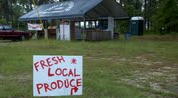
One of the worst cultural changes in the American South is how many residents neglect the availability of local fresh fruits and vegetables when once local produce was a mainstay of the Southern diet. Such produce today is easy to find and buy, particularly because farmers’ markets where local farms sell their crops have experienced a resurgence as well as community-supported agriculture programs have gained in popularity.

The following video illustrates how the buy local effort has even spread to college campuses:


The local produce available throughout the year is amazing, and my home state of North Carolina is one of several states in the South that provides a quick reference guide about the availability of fresh fruits and vegetables. In the summer months, one of the favorites where I live is peaches, which are available from May through September.

Farmer stand at state farmers' market
I occasionally visit the N.C. State Farmers’ Market in Raleigh, which is impressive with its selection and availability of peaches in season. In addition, because I live in the peach-growing Sandhills area of the state, I also have the opportunity to go to a you-pick-it farm as well as get local peaches through a community-supported agriculture program.

In fact, imagine the additional ways in this area for buying fresh peaches:
  • Local farmers’ market
  • Roadside stand operated by a local farm
  • Neighborhood grocery store that promotes local produce

However, the shock for me recently was a neighborhood grocery store that was promoting peaches – not locally picked but shipped from California – in the middle of the local peach season. How much expense is involved in transporting peaches from one side of the country completely across to the other side? It’s like “carrying coal to Newcastle” and is a complete waste of energy as well as a detriment to the local food economy (and the out-of-state peaches were 10 cents a pound more than local peaches being sold by a local farmer at a roadside stand about 2/10ths of a mile from the store).

Regional food chain has window display
that advertises fresh peaches ...
... but the small print indicates
that the peaches are out-of-state
(and cost 10 cents a pound more than local ones)

Several businesses, schools, and local communities have joined in an effort – known as the 10% campaign – to buy at least 10% of their food budgets from farmers in their local areas. The campaign, an effort to rebuild a local food economy, also helps to educate the public about food choices. Eating fresh fruits and vegetables as a regular part of a diet provides many long-term health benefits. Although the increasing obesity rates are a national problem, they are particularly troubling for the American South. Most states in the South exceed the national average for both adult and childhood obesity. 

Roadside stand with fresher, cheaper
peaches (less than 2/10ths of a mile
from regional grocery chain)
Even with the example of peaches being shipped across the country, the effort to buy locally is gaining support as many across the South are recruited to become a “locavore,” a word used increasingly by local food advocates. It was the word of the year in 2007 for the Oxford American Dictionary, even though it had only been coined in 2005 when residents on the West Coast were encouraged to eat only food grown or produced within a 100-mile radius. Although later in 2008 Congress defined “local food” much broader -- food marketed in the same state where produced or less than 400 miles from origin -- the “buy local” effort focuses on growers much closer.

What a shame that a regional grocery chain in the South (owned by a Belgium corporation), where peaches are grown with so much success, sees fit to ship them completely across the county and that local shoppers buy them. Be more selective, and enjoy produce that your area grows. Become a locavore.

Thursday, July 12, 2012

Banana Puddin' for Real

Don’t tell me that mamas and papas no longer have time to make banana puddin’ for their babies! Have you seen “trendy” grocery stores such as The Fresh Market selling pre-packaged banana puddin’? Is this where the Information Highway with incessant demands to stay connected to our smart phones, send irrelevant text messages, and check Facebook updates throughout the day has taken us?

Ready for sale at The Fresh Market
It’s bad enough that stores have sliced or cubed cantaloupe, watermelon and other summer delights to make them so easy to enjoy. All we have to do is open a cover: no messy slicing — but isn’t that half the fun of eating cantaloupe or watermelon? The joy of eating banana puddin’ is knowing that it’s homemade (and who made it).

Fortunately, these packages do include bananas unlike some places such as Smithfield's Chicken 'N Bar-B-Q that makes banana puddin’ without bananas. (Of course, this extends the shelf life by avoiding the chance that a banana slice can turn brown, but how they can call it banana puddin’ without its primary ingredient?) Any decent mama or papa never chooses banana puddin’ without bananas for their children when ordering fried chicken or pork barbecue.

Warning: A Connecticut
Yankee has made these 
cookies and hoodwinked 
Paula Deen.
What else is needed beside bananas? Nilla Wafers, of course. Even Paula Deen has screwed up this Southern tradition by substituting Pepperidge Farm Chessmen cookies for genuine Nilla Wafers. In her recipe on the Food Network, she wants you to use two bags of these high-falutin’ cookies by a company that traces its roots not to the South but to a Connecticut housewife (and is still based up yonder). At least Paula Deen has the decency to title her approach as “Not Yo’ Mama’s Banana Pudding,” so you know that you are making only a pretender. If you really want authentic banana puddin’, just follow the recipe on a box of Nilla Wafers or use the original recipe online by Nabisco World that calls for 45 wafers — and real bananas, of course (five sliced for this recipe).

What happens if you can’t eat all the puddin’ on the day that it’s made? Not a problem. Even day-old puddin’ is desirable because it’s “bold,” as Southern Culture on the Skids sings in “Banana Pudding”:
Banana puddin'
Yeah! It's day old and bold, baby.
So give me something funky with the skin on top
Something funky, that's what I've got.
Authentic puddin' just made for my classes
When I make banana puddin’ for my classes, no student ever asks, “Did you buy it?” Of course not! No self-respecting Southerner would dare to offer banana puddin’ that was not homemade. Stay true to Southern foodways: Put down your smart phone and start slicing fresh bananas.

Thursday, May 24, 2012

Blueberries: Summertime Treat in the South

Does anything make summertime more enjoyable than eating fresh blueberries, particularly those that you picked yourself? Chilled, fresh blueberries are such a delightful treat on a hot day. Visiting a you-pick-it location helps you appreciate the berries much more than simply buying them at a grocery store.

You-pick-it locations are plentiful in the South.

Because blueberries are grown throughout the South, being able to pick them as they ripen is easy. Most states, such as my home state of North Carolina, help by offering maps and directories of you-pick-locations on their agricultural websites. (North Carolina has more than 100 you-pick blueberry locations.) In addition, local you-pick-it farms get extra publicity in the South when official state festivals celebrate the blueberry in late May or in June.

The calyx forms the shape
of a five-pointed star.
Picking fresh blueberries helps to connect to the culture and history of the region. One of the few fruits native to North America, the blueberry has been important for sustaining life in this region for centuries. Ripe blueberries were gathered in the forests by several Native American tribes before they also began to cultivate them. In addition to being a food source, the berries themselves and parts of the plant were used as medicine. Even the calyx, the blossom end of a berry that forms the shape of a five-pointed star, has contributed to regional lore as the legend about the Great Spirit sending “star berries” during a famine to relieve the hunger of children was retold.

Although lowbush berries (often referred to as “wild blueberries”) are native to other parts of the world, highbush blueberries are native to the North America. Even though more than 38 states grow the blueberry, only rabbiteye varieties (Vaccinium ashei) are native to the American South (from North Carolina south to Florida and west to Texas). These varieties are called rabbiteye, according to Horticulture magazine, because before turning blue they turn pink (like the color of a white rabbit). With all the varieties grown in North America, about 90% of the worldwide blueberry harvest comes from Canada and the United States. 

In my home state of North Carolina the highbush varieties can be grown anywhere from the mountains to the coast. In addition, rabbiteye varieties (which are more drought and heat resistant) can be grown in the piedmont and coastal plain.

You-pick-it bushes ready in North Carolina in late May

With the health benefits of the blueberry continually being extolled, it continues to increase in popularity. The average U.S. adult consumption has almost doubled in the last ten years. The blueberry is now the second most popular berry in the United States (second only to strawberries).

About half of each year’s production is eaten fresh rather than processed. (Fresh production has outpaced process production since 2002.) In addition, eating blueberries raw is recommended by many health experts because this way provides the best flavor and greatest nutritional benefits.

Before: Scale before picking
After:  Reward (8 pounds) after an hour  of picking


Although blueberries make great cobblers, breads, and jellies, they are thoroughly enjoyable by the handful when they have been recently picked. Because they are 85 percent water (compared to the higher and more recognized percentage of 92 for the watermelon), they are a great way to satisfy a thirst as well as meet the recommended daily water intake. That’s why visiting a you-pick-it location is so worthwhile to celebrate the start of summer.

If you don't have time to pick your own, at least buy
directly from the grower at a stand or farmers' market.

Tuesday, May 22, 2012

Strawberry Adventure: Finding the World’s Largest

Want to go on a strawberry adventure? As spring days become warmer, the trip can be a visit to a festival, a you-pick-it farm, or a noteworthy strawberry landmark. Strawberry ice cream, shortcake, or fresh berries themselves are the rewards for making the visit, particularly in the American South where one place claims to have the world’s largest strawberry.

A fruit with a long history
The only fruit with the seeds on the outside rather than the inside, the strawberry has been a favorite of not only Southerners but others around the world because its sweetness, juicy texture, and bright red color are unmatched. The history of the strawberry dates back to Romans who gathered wild strawberries, but it wasn’t cultivated in Europe until the 1300s. Although it had become a common garden plant by the 1500s, the strawberry from eastern North America, introduced to Europe in the early 1600s, is the variety that is credited by developing today’s big-fruited strawberry.

This variety was popular with Native Americans who mixed crushed berries with cornmeal that was baked as strawberry bread. After trying this bread, according to some scholars, the colonists modified the recipe and created an early version of strawberry shortcake.  

Strawberry shortcake is frequently featured at regional strawberry festivals. Michigan claims the “national” strawberry festival, although many states, particularly in the South, celebrate with at least one festival, such as in Georgia, South Carolina, and West Virginia, and some festivals were inaugurated well before Michigan began its event in 1976.

North Carolina even has two: the Carolina festival in Wallace and the N.C. festival in Chadbourn. In fact, Chadbourn, NC, considers itself as the strawberry capital of the world because it claims the largest one-day shipment of strawberries – 180 rail boxcar loads – picked by 15,000 workers between one sunrise and sunset as well as a historic festival that began as early as 1926.

Florida began its festival four years later in Plant City, which claims to be the winter strawberry capital of the world. Lasting more than 11 days with about half a million visitors, the Florida festival is not only huge but also the earliest of the year, sometimes starting as early as late February.

You-pick-it farms help promote
local economy.
Rather than being satisfied with attending a festival, many strawberry fans visit a you-pick-it farm to select fresh berries each season. Strawberry associations in states such as North Carolina help by providing strawberry farm locators online.

When I was searching for a “strawberry event” to attend, I became interested in finding the world’s largest strawberry at The Berry Patch near Ellerbe, NC (population of 1,021), and I made it my destination one day. Because The Berry Patch, which began as a small strawberry farm in 1995, is owned by a family whose last name appropriately is Berry, I thought that it should be worth the trip.

The world's largest strawberry (actually an ice cream stand) at The Berry Patch in Ellerbe, NC

All homemade -- but
strawberry tops the list.
What I found was not a farm but an ice cream stand in the shape of a huge strawberry about 20 feet tall. When I arrived, several people were waiting in line to place their orders while others who had already been served were walking with cones or cups and looking over fresh produce from the local area for sale in the market area. Although The Berry Patch offers 19 homemade flavors, why pick any other than strawberry? It was definitely a winner and the most popular choice.

Although easily seen from the highway,
signs point to the new location.
The Berry Patch is easily seen from the highway although it had been in a much more visible location near the Berry’s farm. The N.C. state government took that property by eminent domain to construct Interstate 73-74, and Lee Berry, the owner, had to move the huge strawberry stand, which had been built in 2002, two miles north to keep serving his customers, many who are on their way to or from the beach.  It took eight hours to get the four-ton berry stand onto a mover’s truck. Because it was so wide and no traffic could pass, state troopers had to escort it on the slow journey to the new location.

Market area with local produce
Visiting the “world’s largest strawberry” was well worth the trip because the homemade ice cream is excellent. It clearly surpasses a competing “world’s largest strawberry” claimed by Strawberry Point, Iowa, (population 1,463) that is only 15 feet high and stands in front of the town’s city hall without any homemade strawberry ice cream to offer. Knowing that the 20-foot berry stand required a police escort for its move made it that much more noteworthy to visit.

Thursday, December 1, 2011

Tasting Cajun Life

To learn about the foodways of a culture or region, how would you do it? Nothing beats making a personal trip and tasting well-known examples, enjoying meals of typical dishes, visiting locations where food is grown or raised, and talking to local experts.

To learn more about Cajun food and its relevance to Southern culture, I joined a field trip conducted by the Southern Foodways Alliance to Louisiana. To contrast urban and rural experiences, the trip focused on New Orleans as well as Acadian towns, principally Eunice (the prairie Cajun capital of Louisiana), where the Arcadian Cultural Center depicts Arcadian migration and culture, including foodways.

Cajun cuisine is a cooking style of French-speaking refuges exiled by the British from Canada who settled in Louisiana. They adapted local ingredients (such as game meats, rice and crawfish) to rural French cooking and were also influenced by Native American, Caribbean, and other European cooking styles.

The trip was helpful to understand how simple Cajun food preparation is and learn more about unique cooking methods such as smothering (cooking a vegetable or meat in its own juices), sometimes known as étouffée, and the importance of other methods such as boiling (for example, crawfish). The visit also helped to appreciate more the importance of rice (the second largest agricultural export of Louisiana) and sugarcane in Cajun cooking.

Typical Dishes

Classic Cajun dishes include:
  • Jambalaya, a dish that contains rice, meat (such as chicken), seafood (such as shrimp), and vegetables (green peppers, onions, celery and chili peppers);

  • Gumbo, a soup that takes its name from a word brought from western Africa that means okra, which is used as a thickening agent and is a principal ingredient.
In addition to jambalaya and gumbo, I was also able to enjoy and learn more about:
  • Boudin, fresh sausage that is widely available and made fresh daily (becuase it doesn’t keep well for very long) with pork, rice, green onions, and spices and stuffed in a natural casing;

  • Cracklin, fried pieces of pork fat with a small amount of attached skin, flavored after frying with peppery Cajun spices;

  • Andouille, a spicy smoked sausage characterized by a coarse texture;

  • Beignet, a French-style doughnut, that is fried dough covered with powered sugar. In the French Quarter of New Orleans, beignets are square and usually served in orders of three.
Memorable Meals

Several meal experiences were memorable. Each meal gave a particularly insight into Cajun food and together made the trip truly representative of Cajun foodways.
  • Dinner at Calcasieu in New Orleans with chef Stephen Stryjewski (2011 James Beard Award Winner for Best Chef: South). Boudin and crawfish pie were appetizers; Louisiana chicken and sausage gumbo soup followed as the next course; entrees (all served family style) were catfish courtboullion, onion smothered pork, shrimp and eggplant dressing, and smothered greens. Pecan pie with praline ice cream and whiskey sauce was dessert.

  • Crawfish feed at Hawk’s opened by Anthony Arceneaux, who has a reputation for serving the biggest, sweetest, and best seasoned crawfish. Established in 1983 near Rayne, La., Hawk’s proclaims to be in the middle of nowhere (it is because field trip members were not trusted to find it on their own by car and had to ride a bus).

  • Smothered lunch at Le Village, a Cajun country retreat in Eunice, La., that featured smothered rabbit, smothered okra, smothered cabbage, and rice smothered in gravy.

  • Lunch of boudin at the Mowata Store in Mowata, La., where owner Bubba Frey makes up to 400 pounds daily.

  • Breakfast of boudin, sugarcane syrup, and biscuits prepared by The French Press of Lafayette, La.

  • Rice dressing supper in Eunice, La. at Ruby’s Cafe, which has been preparing plate lunches since the 1950s, that also included pork loin stuffed with local sausage, coleslaw, okra, and bread pudding.
Rice and Crawfish Fields

Side trips to locations where food is grown or processed added to the understanding of Cajun cuisine:
  • Rice fields and production of Cajun Grain in Kinder, La., owned by Kurt Unkel, who plants, grows, and mills brown jasmine rice that is a mixture of jasmine and wild red rice.

  • Crawfish fields and operations of Craig and Troy West Crawfish in Mamou, La., who run one of the oldest commercial crawfish businesses in the state and supply clients from the Southwest to New York City.
Local Experts

Discussions with regional food experts helped to explain Cajun foodways so that the programs were more than just tasting events:
  • Paul Prudhomme, owner of K-Paul’s Louisiana Kitchen in New Orleans, a restaurant where I had a bowl of chicken gumbo for lunch, described the challenges of bringing rural flavors and cooking styles into a big city.

  • Jim Gossen, founder of Louisiana Foods (a leading crawfish wholesaler), explained how crawfish came to be farmed rather than fished.

  • Donald Link (also a James Beard award-winning chef), a descendant of Germans of Acadiana, described Cajun food as “the self-sufficient food of people who live in the country and eat what they can take from the land.” (Link is also co-owner of the restaurant Cochon and in-house boucherie with Chef Stryjewski.)

  • Bubba Frey explained why his boudin is so popular: He leaves out internal organs and uses very little grease. At the Prairie Acadian Cultural Center Kitchen in Eunice, he also demonstrated how cracklin is made.

  • Pableaux Johnson, writer and photographer, discussed the art and practice of smothering.
Tasting Cajun food (while also learning about Cajun history and listening to Cajun music) in Louisiana gives anyone a better understanding and appreciation of the importance of Cajun culture in the American South.


Note: Click here to see pictures taken during the Louisiana field trip.