Showing posts with label peach. Show all posts

Friday, July 21, 2017

Peach Dumpling -- Delicious but Is It a Dumpling?

Stopping at a roadside stand that sells fresh peaches is a frequent occurrence for anyone who lives or travels through the Carolinas, particularly the Sandhills region. This area is remarkable for growing succulent peaches, much better than those that grocery stores bring in from distant states.

Johnson's Peaches has been in business since 1934.

In addition to buying a bushel or a peck, many people buy something else: peach ice cream, peach jam, peach preserves, anything that can extend the pleasure of enjoying peaches. When I stopped at Johnson’s Peaches in Candor, NC, on the menu board was something I don’t remember seeing before: peach dumplings.

The banner "Peach Dumplings" caught my attention when I was parking the car.

Because peach cobbler is one of my favorites, I couldn’t leave without buying some dumplings. Lunch plans kept me from eating them immediately, so I had them packaged to enjoy at home with supper. (Of course, a better idea is to eat them on site – with peach ice cream, naturally.)

What to order? A peach dumpling looks enticing.

Before ordering, I had reviewed the recipe for peach dumplings in a brochure that Johnson’s provides to its customers. Peach quarters are rolled in crescent rolls and baked in a mixture of sugar, water and butter with a topping of sugar and cinnamon sprinkled on top.

Johnson's recipe for peach dumplings includes a peach quarter wrapped in a crescent roll.

However, the peach dumplings that Johnson’s sells are different than those made using the recipe. When the server prepared the to-go box, I watched as she scooped a serving from a large rectangular metal tray – no individually wrapped peach quarters. With the pastry crust on top, it looked like what I know as a cobbler but with less breading.

Although I wanted to taste peach dumplings, the order that I took home was more to my liking – more peaches, less pastry. The peaches were superb, as expected. In business since 1934, Johnson’s knows how to please its customers.

A peach dumpling from Johnson's is delicious, but is it a dumpling:

The next time that I stop at Johnson’s, I’ll make sure that my lunch plans don’t interfere with eating a dumpling there – and I’ll also order peach ice cream with it.

Friday, April 24, 2015

Pruning Peach Orchards: A Lifetime Skill and Dedication

[Note: This post, prepared originally for the NC Folklife Institute's NCFood blog, is hosted on the institute’s website, with excerpts and a link to the website posted here.]

Nothing says spring like the arrival of flower blossoms, particularly in the Sandhills and eastern North Carolina with blooms on acres and acres of peach trees.

Trees in the Sandhills awaken at
springtime and stand ready for their
early pruning.
Many in North Carolina believe that our state’s peaches are the best (they’re right) and that peaches are native to the South (they’re wrong). Cultivated in China for more than 3,000 years, peaches arrived in the Americas in 1571 when Spanish missionaries introduced them along the Atlantic coast in an area known now as St. Simons Island, Georgia. More than 50 years later, George Minifie of England brought the first peach trees to the British colonies in North America and cultivated them at his estate near Jamestown, Virginia.

Peaches thrive in the rain, heat, and soil conditions of our state and other southern states. They are a vital fruit crop in the agricultural economy of several N.C. counties. However, as much as Mother Nature nurtures, a peach orchard is not self-sufficient. It requires constant monitoring and care, particularly pruning.

Saturday, August 10, 2013

Peach Dessert Competition: Taking Home First Place but No Leftovers

The first-place winner:
Peach Glazed Cheesecake with Blueberries
Nothing brings out a crowd better than a dessert competition where everyone can sample the entries. So it was when the Sandhills Farmers Green Market set aside a Saturday as Peach Day and announced a competition for the best peach dessert.

I knew that I wanted to attend. On a hot August day nothing can beat tasting all the peach desserts prepared for a contest. However, I wanted to be more than a bystander -- I decided to prepare an entry.  Because peach is my favorite fruit and the contest was in the heart of N.C. peach-growing territory, I quickly signed up to enter.

Setting the cheesecake on
the table for judging
The contest rules specified that each dessert had to be made with N.C. peaches, and each entry required two cups of peaches. After checking the rules, I immediately thought of an old family peach pie (listed at the end of the recent post on N.C. Food blog of N.C. Folklife Institute). Although this recipe is a family favorite, I began having doubts that it would compete well for creativity or appearance. It tastes great but looks like any other peach pie brought to potlucks or reunions in the summer. After lots of thought, I settled on a cheesecake recipe that I modified by adding a layer of sliced peaches on top in a peach glaze – as well as substituting peach moonshine for some flavoring.

Fresh blueberries from
C.V. Pilson Farm can accentuate any dessert.
For the cheesecake, I wanted to use more than only peaches from the farmers market and stopped by the week before the contest was held. Of course, I bought peaches – they had just been picked by Better Be Ellerbe Peaches (Ellerbe, NC). In addition, I bought farm eggs from Riley’s Ranch (Carthage, NC) and blueberries from C.V. Pilson Farm (Cameron, NC). The judges (who included the mayor, the chef of a restaurant known for using local products, the chef of the farm to table program, a TV producer, and the news anchor of a local radio talk show) would select the winners on flavor, appearance, quality, and creativity, and these local ingredients should help to create a successful entry.

Riley's Ranch has the best farm eggs.
The recipe is a four-step process, so it’s not a simple preparation. Even the glaze took extra effort. My chief critic during preparation was my wife, who is tougher than the judges on the Food Channel. Even though I was confident the recipe would be successful, she encouraged me to make the glaze more than once – I did ... four times ... just to make sure that nothing would go wrong on the final effort.

On the morning of the competition, I brought a nice looking cheesecake. The peach glaze itself required the minimum two cups of peaches. In addition, two more cups of sliced peaches decorated the cake’s top around blueberries in the center: very peachy indeed.

Nancy Fiorillo, mayor of Pinehurst,
awards first-place prize of $75.00
At the appointed time, I gathered near the judges area and waited for the results to be announced. I was hoping to place at least third in the contest. When Melanie Riley of Riley’s Ranch announced the third and second place winners (a peaches and cream pie and peach crepes respectively), I was disappointed that my entry had not been selected. When “peach glazed cheesecake” was announced as the first-place winner, I was really surprised and delighted.

After the contest I went to get the platter and the remaining cheesecake, but there was none to take home. It had all been eaten. I guess I have to make another one soon.


Want the recipe? (Remember that it's not simple.)


Peach Glazed Cheesecake with Blueberries

Crust

2 cups graham cracker crumbs
6 tablespoons melted butter
2 tablespoons flour
¼ cup raw sliced almonds, chopped

Combine ingredients and press evenly onto bottom and sides of buttered 9x3-inch spring form. Bake at 350 degrees for 5 minutes. Then continue with cheesecake portion.


Cheesecake

3 eight-ounce cream cheese
¾ cup sugar
3 eggs 
2 tablespoons lemon juice
2 tablespoons peach moonshine
2 tablespoons vanilla
2 teaspoons grated lemon rind

Beat cream cheese until soft. Add sugar, blending thoroughly. Add eggs one at a time, beating well with each addition. Mix in lemon juice, moonshine, vanilla, and rind. Blend well. Put in spring form. Bake at 325 degrees for 40 minutes or until cake is firm. Then continue with sour cream layer.


Sour Cream Layer

2 cups sour cream
3 tablespoons sugar
1 teaspoon vanilla

While cake is baking, blend sour cream, sugar, and vanilla. When cheesecake comes out of over, spread sour cream mix over cake and return to over for 12 more minutes. Cool cheesecake until it is room temperature before adding peach glaze.


Peach Glaze

2 cups peeled, sliced fresh peaches (approx. 4) 
½ cup water
1 cup sugar
3 tablespoons cornstarch
2 tablespoons butter
1 tablespoon peach moonshine

Place peaches and water in blender; cover and process until smooth. Pour pureed fruit into medium saucepan. Combine sugar and cornstarch, stirring well. Add sugar mixture to pureed peaches. Cook over medium-high heat 5 minutes or until mixture is thick and clear, stirring constantly. Remove from heat. Add butter and peach moonshine, stirring until smooth. Cool and set aside until room temperature.


Top Layer

2 cups peeled, sliced fresh peaches (approx. 4) 
1/2 cup blueberries 

Arrange peeled, sliced fresh peaches as needed in attractive pattern on top of the cheesecake. Pour peach glaze on top. Add blueberries around side or in center. Chill several hours or overnight.

Final Note: If not served immediately, sliced peaches may start to brown. Use Sure-Jell Ever-Fresh to stop browning. Dissolve 2 teaspoons Ever-Fresh in 2 tablespoons water; toss with peaches; refrigerate and serve within 8 hours.

Friday, July 26, 2013

Festival of the Peach: Candor Is the Scene

[Note: This post, prepared originally for the NC Folklife Institute's NCFood blog, is hosted on the institute’s website, with excerpts and a link to the website posted here.] 

Communities that spread over a multi-county area often unite each year for a common celebration. For the N.C. peach community, that event occurs on the third Saturday in July in Candor, a small town in Montgomery Country that brings everyone in the peach-growing Sandhills region together. Although Candor is the home of fewer than 900 residents, it hosts the N.C. Peach Festival because the peach is so important to its identity and its way of life.

The festival brings out peach
costumes as music is played.
Peaches are clearly the star attraction. Boxes, baskets, and bags of freshly picked fruit are sold on sides of streets, from the back of trucks, and at stands of service organizations and neighboring growers. A common sight is a heavy box of peaches being carried by a person navigating through the throngs of streetgoers.


Wednesday, July 18, 2012

Local Food: A Preferred Choice in the South

Peaches sold by local farmer:
$20 for 23-pound basket ($1.15 a pound)
One of the worst cultural changes in the American South is how many residents neglect the availability of local fresh fruits and vegetables when once local produce was a mainstay of the Southern diet. Such produce today is easy to find and buy, particularly because farmers’ markets where local farms sell their crops have experienced a resurgence as well as community-supported agriculture programs have gained in popularity.

The following video illustrates how the buy local effort has even spread to college campuses:


The local produce available throughout the year is amazing, and my home state of North Carolina is one of several states in the South that provides a quick reference guide about the availability of fresh fruits and vegetables. In the summer months, one of the favorites where I live is peaches, which are available from May through September.

Farmer stand at state farmers' market
I occasionally visit the N.C. State Farmers’ Market in Raleigh, which is impressive with its selection and availability of peaches in season. In addition, because I live in the peach-growing Sandhills area of the state, I also have the opportunity to go to a you-pick-it farm as well as get local peaches through a community-supported agriculture program.

In fact, imagine the additional ways in this area for buying fresh peaches:
  • Local farmers’ market
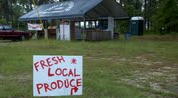
  • Roadside stand operated by a local farm
  • Neighborhood grocery store that promotes local produce

However, the shock for me recently was a neighborhood grocery store that was promoting peaches – not locally picked but shipped from California – in the middle of the local peach season. How much expense is involved in transporting peaches from one side of the country completely across to the other side? It’s like “carrying coal to Newcastle” and is a complete waste of energy as well as a detriment to the local food economy (and the out-of-state peaches were 10 cents a pound more than local peaches being sold by a local farmer at a roadside stand about 2/10ths of a mile from the store).

Regional food chain has window display
that advertises fresh peaches ...
... but the small print indicates
that the peaches are out-of-state
(and cost 10 cents a pound more than local ones)

Several businesses, schools, and local communities have joined in an effort – known as the 10% campaign – to buy at least 10% of their food budgets from farmers in their local areas. The campaign, an effort to rebuild a local food economy, also helps to educate the public about food choices. Eating fresh fruits and vegetables as a regular part of a diet provides many long-term health benefits. Although the increasing obesity rates are a national problem, they are particularly troubling for the American South. Most states in the South exceed the national average for both adult and childhood obesity. 

Roadside stand with fresher, cheaper
peaches (less than 2/10ths of a mile
from regional grocery chain)
Even with the example of peaches being shipped across the country, the effort to buy locally is gaining support as many across the South are recruited to become a “locavore,” a word used increasingly by local food advocates. It was the word of the year in 2007 for the Oxford American Dictionary, even though it had only been coined in 2005 when residents on the West Coast were encouraged to eat only food grown or produced within a 100-mile radius. Although later in 2008 Congress defined “local food” much broader -- food marketed in the same state where produced or less than 400 miles from origin -- the “buy local” effort focuses on growers much closer.

What a shame that a regional grocery chain in the South (owned by a Belgium corporation), where peaches are grown with so much success, sees fit to ship them completely across the county and that local shoppers buy them. Be more selective, and enjoy produce that your area grows. Become a locavore.