Showing posts with label fruit. Show all posts

Friday, December 6, 2013

Time for Persimmon Pudding

[Note: This post, prepared originally for the NC Folklife Institute's NCFood blog, is hosted on the institute’s website, with excerpts and a link to the website posted here.] 

Cool temperatures mean fall fruits and vegetables. When the summer temperatures drop, one tree becomes more noticeable as its round fruit ripens and takes on an orange-brown hue. Is it time to pick persimmons and make pudding?

Many of us remember days from childhood when we asked if the persimmons could be picked. Impatiently we had to wait until the fruit was ready. Picked too early, persimmons can leave a sharp or bitter taste. As many children learn, being patient and giving persimmons a long period to ripen (sometimes as long as until the first frost occurs) can improve the flavor. The extended time increases the sugars and decreases the acids that cause the bitterness.


Continue reading at the NCFood blog... 

Note: The family recipe of persimmon pudding at the end of the article will be reprinted with permission in Eating Appalachia by Darrin Nordahl that is scheduled for publication in early 2015 by Chicago Review Press.

Wednesday, July 18, 2012

Local Food: A Preferred Choice in the South

Peaches sold by local farmer:
$20 for 23-pound basket ($1.15 a pound)
One of the worst cultural changes in the American South is how many residents neglect the availability of local fresh fruits and vegetables when once local produce was a mainstay of the Southern diet. Such produce today is easy to find and buy, particularly because farmers’ markets where local farms sell their crops have experienced a resurgence as well as community-supported agriculture programs have gained in popularity.

The following video illustrates how the buy local effort has even spread to college campuses:


The local produce available throughout the year is amazing, and my home state of North Carolina is one of several states in the South that provides a quick reference guide about the availability of fresh fruits and vegetables. In the summer months, one of the favorites where I live is peaches, which are available from May through September.

Farmer stand at state farmers' market
I occasionally visit the N.C. State Farmers’ Market in Raleigh, which is impressive with its selection and availability of peaches in season. In addition, because I live in the peach-growing Sandhills area of the state, I also have the opportunity to go to a you-pick-it farm as well as get local peaches through a community-supported agriculture program.

In fact, imagine the additional ways in this area for buying fresh peaches:
  • Local farmers’ market
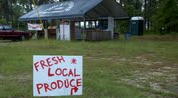
  • Roadside stand operated by a local farm
  • Neighborhood grocery store that promotes local produce

However, the shock for me recently was a neighborhood grocery store that was promoting peaches – not locally picked but shipped from California – in the middle of the local peach season. How much expense is involved in transporting peaches from one side of the country completely across to the other side? It’s like “carrying coal to Newcastle” and is a complete waste of energy as well as a detriment to the local food economy (and the out-of-state peaches were 10 cents a pound more than local peaches being sold by a local farmer at a roadside stand about 2/10ths of a mile from the store).

Regional food chain has window display
that advertises fresh peaches ...
... but the small print indicates
that the peaches are out-of-state
(and cost 10 cents a pound more than local ones)

Several businesses, schools, and local communities have joined in an effort – known as the 10% campaign – to buy at least 10% of their food budgets from farmers in their local areas. The campaign, an effort to rebuild a local food economy, also helps to educate the public about food choices. Eating fresh fruits and vegetables as a regular part of a diet provides many long-term health benefits. Although the increasing obesity rates are a national problem, they are particularly troubling for the American South. Most states in the South exceed the national average for both adult and childhood obesity. 

Roadside stand with fresher, cheaper
peaches (less than 2/10ths of a mile
from regional grocery chain)
Even with the example of peaches being shipped across the country, the effort to buy locally is gaining support as many across the South are recruited to become a “locavore,” a word used increasingly by local food advocates. It was the word of the year in 2007 for the Oxford American Dictionary, even though it had only been coined in 2005 when residents on the West Coast were encouraged to eat only food grown or produced within a 100-mile radius. Although later in 2008 Congress defined “local food” much broader -- food marketed in the same state where produced or less than 400 miles from origin -- the “buy local” effort focuses on growers much closer.

What a shame that a regional grocery chain in the South (owned by a Belgium corporation), where peaches are grown with so much success, sees fit to ship them completely across the county and that local shoppers buy them. Be more selective, and enjoy produce that your area grows. Become a locavore.

Tuesday, May 22, 2012

Strawberry Adventure: Finding the World’s Largest

Want to go on a strawberry adventure? As spring days become warmer, the trip can be a visit to a festival, a you-pick-it farm, or a noteworthy strawberry landmark. Strawberry ice cream, shortcake, or fresh berries themselves are the rewards for making the visit, particularly in the American South where one place claims to have the world’s largest strawberry.

A fruit with a long history
The only fruit with the seeds on the outside rather than the inside, the strawberry has been a favorite of not only Southerners but others around the world because its sweetness, juicy texture, and bright red color are unmatched. The history of the strawberry dates back to Romans who gathered wild strawberries, but it wasn’t cultivated in Europe until the 1300s. Although it had become a common garden plant by the 1500s, the strawberry from eastern North America, introduced to Europe in the early 1600s, is the variety that is credited by developing today’s big-fruited strawberry.

This variety was popular with Native Americans who mixed crushed berries with cornmeal that was baked as strawberry bread. After trying this bread, according to some scholars, the colonists modified the recipe and created an early version of strawberry shortcake.  

Strawberry shortcake is frequently featured at regional strawberry festivals. Michigan claims the “national” strawberry festival, although many states, particularly in the South, celebrate with at least one festival, such as in Georgia, South Carolina, and West Virginia, and some festivals were inaugurated well before Michigan began its event in 1976.

North Carolina even has two: the Carolina festival in Wallace and the N.C. festival in Chadbourn. In fact, Chadbourn, NC, considers itself as the strawberry capital of the world because it claims the largest one-day shipment of strawberries – 180 rail boxcar loads – picked by 15,000 workers between one sunrise and sunset as well as a historic festival that began as early as 1926.

Florida began its festival four years later in Plant City, which claims to be the winter strawberry capital of the world. Lasting more than 11 days with about half a million visitors, the Florida festival is not only huge but also the earliest of the year, sometimes starting as early as late February.

You-pick-it farms help promote
local economy.
Rather than being satisfied with attending a festival, many strawberry fans visit a you-pick-it farm to select fresh berries each season. Strawberry associations in states such as North Carolina help by providing strawberry farm locators online.

When I was searching for a “strawberry event” to attend, I became interested in finding the world’s largest strawberry at The Berry Patch near Ellerbe, NC (population of 1,021), and I made it my destination one day. Because The Berry Patch, which began as a small strawberry farm in 1995, is owned by a family whose last name appropriately is Berry, I thought that it should be worth the trip.

The world's largest strawberry (actually an ice cream stand) at The Berry Patch in Ellerbe, NC

All homemade -- but
strawberry tops the list.
What I found was not a farm but an ice cream stand in the shape of a huge strawberry about 20 feet tall. When I arrived, several people were waiting in line to place their orders while others who had already been served were walking with cones or cups and looking over fresh produce from the local area for sale in the market area. Although The Berry Patch offers 19 homemade flavors, why pick any other than strawberry? It was definitely a winner and the most popular choice.

Although easily seen from the highway,
signs point to the new location.
The Berry Patch is easily seen from the highway although it had been in a much more visible location near the Berry’s farm. The N.C. state government took that property by eminent domain to construct Interstate 73-74, and Lee Berry, the owner, had to move the huge strawberry stand, which had been built in 2002, two miles north to keep serving his customers, many who are on their way to or from the beach.  It took eight hours to get the four-ton berry stand onto a mover’s truck. Because it was so wide and no traffic could pass, state troopers had to escort it on the slow journey to the new location.

Market area with local produce
Visiting the “world’s largest strawberry” was well worth the trip because the homemade ice cream is excellent. It clearly surpasses a competing “world’s largest strawberry” claimed by Strawberry Point, Iowa, (population 1,463) that is only 15 feet high and stands in front of the town’s city hall without any homemade strawberry ice cream to offer. Knowing that the 20-foot berry stand required a police escort for its move made it that much more noteworthy to visit.

Saturday, September 17, 2011

Making the South Flavorful Throughout the Year

Looking for a flavorful treat that has excellent regional flavors and connections? Although the pecan pie is an excellent Southern desert, particularly during the fall, many homes entertain guests with a “nutty” fruitcake at the end of the year, especially at Christmas. No fruitcake in the United States has gained more attention that the one made in central North Carolina by the Scott family at its Southern Supreme business.

Although begun very humbly in 1985 in the Scotts’ garage, Southern Supreme has become an international gourmet food company. As a result, it has expanded into a modern building with four kitchens and a retail sales room. Sales have grown to more than 200,000 pounds of fruitcake annually. However, the business still retains its family-oriented practices that emphasize quality and value. (Its emphasis on customer service is best illustrated by its record with Better Business Bureau, which gives its highest rating of A+ to Southern Supreme and has no complaints to report.)

Bear Creek, an unincorporated community (zip code 27207) where Southern Supreme is located, is just as traditionally Southern as its products. With only 4,100 residents in 1,625 households in 81 square miles (a population density of 51 people per square mile), neighbors don’t see each other too frequently, except at church -- or at Southern Supreme when they work there part-time. Several dozen residents are hired near the end of the year to meet the seasonal demand for fruitcakes and other specialties. In fact, family members of several students in my college classes have worked part-time there.

For more than 25 years, Southern Supreme has sold its fruitcake and other specialties by mail order as well as from the retail store in the farmland of southwestern Chatham County. Before October, Southern Supreme operates primarily as a mail order business, although the retail store remains open year round.

When is the best time to visit? For most it is mid-October when the Scotts have their annual open house. Despite the isolated location of its retail store, more than 10,000 people visit during the four-day event that starts usually on the second Thursday. After the open house, the store remains a fashionable destination and is so popular that some cities and counties, such as Carrboro Recreation and Parks and Fayetteville-Cumberland Parks and Recreation, offer tours before Christmas.

Although I’ve been to an open house, I dropped in on a rainy Saturday a month early when the store was uncrowded and I didn’t have to stand in line to sample the goodies. I enjoyed being able to taste samples at my leisure, linger at the photo display of days ago and read more information about fruitcakes and Southern Supreme than the average person should know:

  • 2,100 calories in one pound of fruitcake

  • 21 servings in one pound of fruitcake

  • 1,800 eggs cracked in a day

  • 2,800 pounds of fruitcake made in a day

  • 8 Scott family members who own and operate the shop

  • 100 employees during peak season

  • 2,400 packages sent out on the first day of a week


However, I missed seeing the store decorated in its finest holiday attire as it is for the open house and I wasn’t able to view cooking stations that are set up to show how cookies, cakes, and other goodies are created. In addition, I missed the picturesque foliage in October when many visitors select the Devil’s Stomping Ground Scenic Byway (NC 902) to travel to Bear Creek from Pittsboro, the county seat to the northeast, or the small towns of Seagrove and Robbins to the southwest. To enjoy the seasonal experience, I might have to return during an open house and be part of the excitement with the crowd again.

Southern Supreme takes advantage of being in the South to use ingredients with wonderful flavors connected to Southern culture in not only fruitcakes but other favorites as well:

  • Fruitcakes with regional fruits and native pecans are especially Southern (although fruitcakes are as old as the Romans). Fruitcakes date to the colonial period when European settlers brought traditions of having made them in their home countries.

  • Nut specialties feature regional favorites, such as the pecan that is native to the American South and the peanut that has a long tradition in the South. Both are featured prominently in nut boxes, bags, and candies.

  • Jams, jellies, and marmalades are also beloved Southern choices, particularly those made with strawberries, blackberries and peaches grown in the South.

  • Relishes made using old family recipes depend on garden tomatoes and bell peppers of the South that have been enhanced with mixed spices.


Although fruitcake will always be its claim to fame, Southern Supreme has many regional delights than Southerners enjoy. Rather than struggle with an Internet search for find something generic for the holidays, take a fall trip to Bear Creek where the Scotts’ store still beckons to past guests as well as first-time visitors. The Southern connections to traditional flavors are appreciated not only at the end of the year but also throughout the year.