Showing posts with label biscuit. Show all posts

Thursday, October 24, 2019

Making Biscuits at the State Fair

A huge mixing bowl is used to make 80 biscuits.

My first year as a biscuit-maker at the N.C. State Fair is now in the history book, and I am very happy with my experience. I was fortunate to work with dedicated people who have worked many years at the booth of Cary United Methodist Church, which is the longest-serving food vendor at the fair and is renowned for its biscuits, especially country ham.

Cary United Methodist Church, which first opened its booth at the fair in 1916, is the longest-serving food vendor.

First Experience

The biscuits that I made at the fair were far superior to than the ones made at the training class. I was surprised at how good they looked. Midway through the first shift I had a 10-minute break, so I took a ham biscuit outside to eat. It’s hard to be modest. I don’t think I’ve eaten a better biscuit. 

Biscuits just taken out of the oven are ready for the "stuffers."

The shifts that I worked were all in the afternoon, so I missed the morning crowd that comes early and wants biscuits for breakfast as well as the late-night fairgoers who order a few (or a dozen) ham biscuits to take home for the next day. In one five-hour afternoon shift about 600 biscuits were made—a busy time—but the previous shift that morning had baked 1,360 (in six hours).

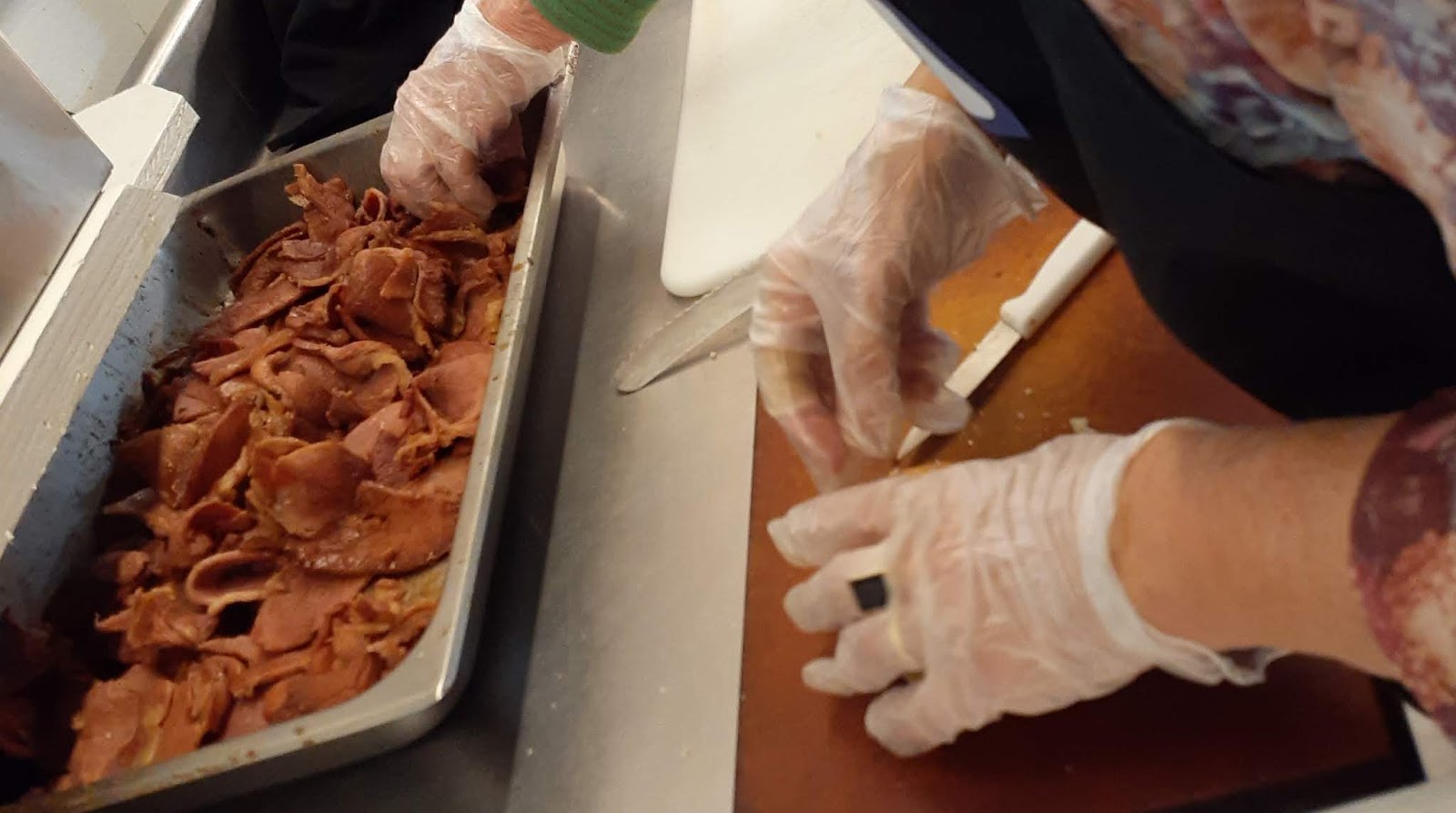
Ham cooking has to keep up with the orders, too.

Fortunately for my first experience I was paired with a veteran biscuit-maker. Suzy worked five days this year, which is her seventh consecutive one. I could tell that she had been a kindergarten teacher: She was very patient and positive, and she offered tips and ideas that were helpful.

Biscuit "stuffers" keep busy fulfilling all the orders.

Biscuits at the Fair

Making biscuits at the fair was almost the same as at the training class except we kept making tray after tray after tray. The biggest difference is at the fair most teams don’t make biscuits by feel—we use a recipe! Six parts flour to one part shortening. For each batch, we used 24 cups of self-rising flour, 4 cups of shortening, and 3 quarts of buttermilk. (Don’t try this at home unless you want to make 80 biscuits.) Otherwise, the process is the same as in the class.

Customers sit and await patiently their orders inside the booth.

For only $2, the ham biscuit is a hot seller, and we ran out briefly for only a few minutes one afternoon. Otherwise, we had hot biscuits ready for orders, although when someone ordered a dozen to go followed by another person who wanted ten biscuits to take home, we had to expedite the tray that we were making.

The kitchen space is limited, but everyone works as a team.

Best Biscuits Ever

When a young family was eating biscuits near my work area, I leaned over and asked if they were the best biscuits ever. The mother nodded and gave a thumbs-up sign. When I told her that it was my first day, we exchanged expressions that indicated we both were surprised.

"Veteran" biscuit-maker Suzy and I made a LOT of biscuits.

Now that I’m an authentic biscuit-maker, I’ve joined the circle of legendary bakers who have made biscuits for more than a century at the state fair. I hope to return next year and continue the tradition.

Above: My hat that proves that I worked in the kitchen.
Below: At the top of the 155-foot-tall SkyGazer Ferris wheel, the largest traveling wheel in the U.S., a rider can see up to 15 miles in any direction. The gigantic wheel is adorned with 524,000 LED lights.

Saturday, October 5, 2019

Learning to Make Biscuits for the State Fair

A buttermilk biscuit with ham is a crowd-pleaser at the State Fair.

Walking among the food vendors at the N.C. State Fair held in Raleigh each October is enough to tempt you to try all the creative and traditional foods. Although the exotic creations—such as a double cheeseburger sandwiched between two Krispy Kreme donuts—captivates the media each fall and is what many fair-goers talk about, a simple buttermilk biscuit is what attracts my attention.

A lot of ham is cooked for all the biscuits at the fair.

Training Class

Last fall I was amazed at one booth in particular. Operated by First and White Plains Methodist Churches of Cary, NC, the booth was cranking out biscuit after biscuit (served with country ham or sausage) to a long line of customers. When I was told that this booth makes up to 1,200 biscuits each shift, I had to learn more and soon wanted to be a biscuit maker.

A training class is offered each year for new biscuit-makers.

Several days before the fair begins, First Methodist holds a biscuit-making training class for new volunteers. (During the fair, the booth is too busy to conduct training.) I quickly signed up for the class and was the first person to show up on the morning when it was held. Maybe I was that excited.

Working the shortening into the flour is the first step.

Flour, Shortening, and Buttermilk

For a couple of hours, we amateur biscuit-makers watched as veterans demonstrated the process. Then we divided into teams to make our own and see if we could be successful. The challenge is high because First Methodist is the longest-serving food vendor at the fair and is so renowned for its biscuits (many customers stop every time they come to the fair for the biscuits).

As the dough is kneaded, the flour and shortening begin to adhere to each other.

In the class we didn't use a written recipe, but the process is simple. Fill a mixing bowl about two-thirds full with self-rising flour. At the fair, the booth uses 25-pound bags of Snowflake brand. (For the training class, we used tried-and-true White Lily.) Then scoop a handful of shortening about the size of a softball and knead the dough on a lightly floured work surface. After a few minutes, you quickly learn if more shortening is needed (all the flour is not adhering in clumps) or if a little more flour should be added to have a good dough consistency.

Biscuits are placed on an ungreased cookie sheet for baking.

Next buttermilk (at room temperature, not chilled) is added. For our mixing bowls, we added about a quart of buttermilk and continued to knead the dough. Again from the feel of the dough, you can tell if more buttermilk is needed. When you are satisfied with the dough, it’s time to roll it into the desired height (about the distance from the end of your thumb to the first knuckle) to form the biscuits. An empty metal can (that once contained pineapples) cuts each biscuit simply by pressing it into the dough. No twisting!

Into the oven goes the first pan. 

Baking to Perfection

The biscuits are then placed on an ungreased cookie sheet – about 40 to a sheet – and baked at 400 degrees initially for six minutes. After the sheet is rotated, the biscuits are baked for six more minutes. When the timer sounds, you have biscuits that every person who comes to the fair wants. If rolled to the right height (not too tall), the biscuits are perfect--and not gooey. If any extra flour is shaken off when they are placed on the sheet, they should be golden-brown when they come out of the oven. They are then filled with hot country ham or sausage by other kitchen volunteers.

Patience is needed as the biscuits bake.

About a dozen were trained in the class, and we are ready to show off our talents. Each one of us is expected to sign up for two shifts during the 11 days that the fair is held. Each shift has two biscuit-makers. When we beginners make biscuits, we will work with a veteran who will help to guarantee the consistency of our work.

After the biscuits have baked for six minutes, the tray is rotated in the oven.


A Tradition of Teamwork

Because each day of the fair has three shifts (usually five hours long each), a lot of biscuit-makers are needed. However, even more volunteers are required; about 40 are needed for each shift. The team effort is huge. More than 500 volunteers work at the booth each year. Although making biscuits is important, it is only a part of the much larger overall effort.

Finally a tray of biscuits just out of the oven are ready for tasting.

What First Methodist started in 1916 has developed into a great tradition, and amazingly it has continued unbroken all these years. The original hand biscuit has been served every year since the first one. I’m ready to show off my new biscuit-making skills.

A benefit of being in the class is the chance to take home extra biscuits, which I enjoyed with homemade strawberry jelly.

Note: Several biscuit recipes (with specific measurements) are available online, including this one by Crisco


Tuesday, October 4, 2016

Loveless Cafe, an Iconic Southern Restaurant

When a restaurant garners award after award, you want to be sure that a visit there will match its highly publicized reputation. Such is the case with Loveless Café in Nashville. It is more than deserving of every award and accolade that it’s received.

The sign for Loveless Cafe has stood the test of time.

Loveless has been judged one of the best places for friendly family dining and among the top “essential” places to eat in Nashville. It has been also listed as an iconic Southern restaurant by USA Today’s Travel 10 Best series. Even People magazine has acknowledged the special connections of Loveless to the culinary traditions of Nashville after its chefs handed out 1,200 biscuits at the Music City Food + Wine Festival. These awards and recognitions are for 2014 alone; each year before also has its own special tributes to this exceptional place.

Country ham, two eggs with red-eye gravy, and stone-ground grits
Everyone who enters through the doors seems to be interested in the made-from-scratch biscuits. Thank goodness breakfast is served throughout the day and that biscuits are served with every meal all day long. Up to 7,000 biscuits are made daily. However, a quick check of the menu shows that more than biscuits attracts the lines of customers waiting for a table.

Up to 7,000 biscuits are made daily.

Trying to be prepared, I checked the Loveless website in advance to see when to arrive. I learned that the best time to avoid a waitlist is to arrive by 11 o’clock for an early lunch or 5 o’clock for an early supper. What I don’t remember the site mentioning is that those suggestions apply for only weekdays. When I arrived on a Saturday at 10:50 a.m. expecting a table available for lunch, I was amazed at how many people were meandering in the front of the restaurant and soon learned that my wait would be 75 minutes. (I’m glad that I arrived for lunch before 11 o’clock!)

Peach cobbler with ice cream
However, the time was well spent reviewing all the autographed photos of the famous who have made a pilgrimage to the Loveless, browsing among the goodies and keepsakes for sale in the restaurant’s shops, and looking over the historic property that includes a recently built special-event barn (very popular for weddings).

Carol Fay Ellison, known as the Biscuit Lady, is remembered in art work at the Loveless.

What began as Loveless Motel and Café in 1951 quickly became a destination for hearty eaters as they learned about its delicious homemade preserves and made-from-scratch biscuits. Although the property has changed hands several times, biscuits are still made using the original Loveless recipe. In fact, my biscuits were so good that I tweeted a picture of them – and Loveless later added it to its online collection of Twitter photos and comments.

Biscuits with homemade preserves (and sorghum on request) are served with every order.
The food was more than memorable, and the portions are also more than ample. After I had ordered a peach cobbler with lunch, people at the next table had to comment that the banana pudding was the best ever (“Banana pudding to go, please”). Because I couldn’t try everything that I wanted at lunch, I also ordered two additional items – braised turnip greens and more stone-ground grits – to go with the pudding just so that I could continue to savor the tastes of Loveless later in the day.

Banana pudding is the best dessert!

Because Loveless Café is such an iconic Southern restaurant, I’ll be back soon. I’ll even drive the eight hours from home just for the biscuits – but will also take advantage of the full menu again. Located near the Natchez Trace Parkway, Loveless has a prime location for travelers, but its food is much more important than its location for attracting appreciative customers and preserving its well-deserved reputation.


Sunday, October 5, 2014

Biscuit Traditions and Love on Wheels

A search for made-from-scratch biscuits brought me to Nashville, the home of country music and also the home of the food truck Biscuit Love. I had just learned about Biscuit Love from a blog post by Southern Foodways Alliance announced on Twitter.

Biscuit Love has garnered quite a following since 2012 when it began rolling the streets around Nashville. The husband and wife team of Karl and Sarah Worley source about 80 percent of their ingredients locally, which they creatively use to prepare a rotating menu of seasonal biscuit choices.

The line for biscuit orders starts early.

Chef Karl (right) keeps biscuits
moving in Nashville.
Karl is also known for his ability to make “beaten biscuits,” described by Southern Foodways Alliance as “an art form.” Karl, who learned how to make these biscuits from the late John Edgerton, noted Southern food author, is supplying them to SFA’s fall symposium later this year.

“Beaten” biscuits were the first biscuits in the South, according to food historians, and were an improvement on hardtack, the bread of traveling warriors and sailors. This “lighter” version of hardtack was made by beating the dough. In the recipe for biscuits in The American Cookery of 1796, the directions specifically call for the cook to “break” the dough while the oven was heating.

My order: farm cheese grits; biscuit with pumpkin spice and chai cheese;
biscuit with smoked sausage, fried egg and cheddar cheese

To break meant to beat with a rolling pin or other instrument – very tough work typically relegated to slaves or servants in the antebellum South. The “beating” process creates pockets of air and develops glutens in the dough that make the biscuits lighter. The recipe’s ingredients were simple: 1 pound flour, 2 ounces butter, 1 egg, wet with milk.

Deciding on which biscuit to order is not easy.

Beaten biscuits, made without leavening agents, declined with the arrival of baking powder and baking soda and the introduction of self-rising flour. The legacy of making beaten biscuits was preserved by several food historians, notably Egerton, whose family owned a “biscuit break.” This machine flattens dough that is run though the machine again and again by the cook. Edgerton once said that dough was beaten “100 times for family and 500 times for company.”

The next order is ready.
The Worleys are keeping a significant Southern tradition alive with their food truck and their knowledge of biscuits. Later this year they will open Biscuit Love Brunch, a new restaurant in Nashville. But for now, Biscuit Love rolls on wheels!

Thursday, February 14, 2013

Getting Romantic on Valentine’s Day with N.C. Food Traditions

[Note: This post, prepared originally for the NC Folklife Institute's NCFood blog, is hosted on the institute’s website, with excerpts and a link to the website posted here.]

How do you celebrate Valentine’s Day? Many celebrate with traditional gifts such as sweet chocolates or red roses. Not me. I take advantage of the foodways traditions of North Carolina to make the day special.

Start Valentine's Day with
something special for breakfast.
First, start with a breakfast treat that says love better than chocolate: BoBerry Biscuits from Bojangle’s, which got its start in Charlotte in 1977. Instead of a standard biscuit, celebrate with a special made-from-scratch sweet biscuit baked with blueberry flavor and topped with icing. This Valentine’s special is a Tar Heel version of the English blueberry scone and gets taste buds thinking about the next foodways tradition to celebrate February 14.