Showing posts with label recipe. Show all posts

Thursday, October 24, 2019

Making Biscuits at the State Fair

A huge mixing bowl is used to make 80 biscuits.

My first year as a biscuit-maker at the N.C. State Fair is now in the history book, and I am very happy with my experience. I was fortunate to work with dedicated people who have worked many years at the booth of Cary United Methodist Church, which is the longest-serving food vendor at the fair and is renowned for its biscuits, especially country ham.

Cary United Methodist Church, which first opened its booth at the fair in 1916, is the longest-serving food vendor.

First Experience

The biscuits that I made at the fair were far superior to than the ones made at the training class. I was surprised at how good they looked. Midway through the first shift I had a 10-minute break, so I took a ham biscuit outside to eat. It’s hard to be modest. I don’t think I’ve eaten a better biscuit. 

Biscuits just taken out of the oven are ready for the "stuffers."

The shifts that I worked were all in the afternoon, so I missed the morning crowd that comes early and wants biscuits for breakfast as well as the late-night fairgoers who order a few (or a dozen) ham biscuits to take home for the next day. In one five-hour afternoon shift about 600 biscuits were made—a busy time—but the previous shift that morning had baked 1,360 (in six hours).

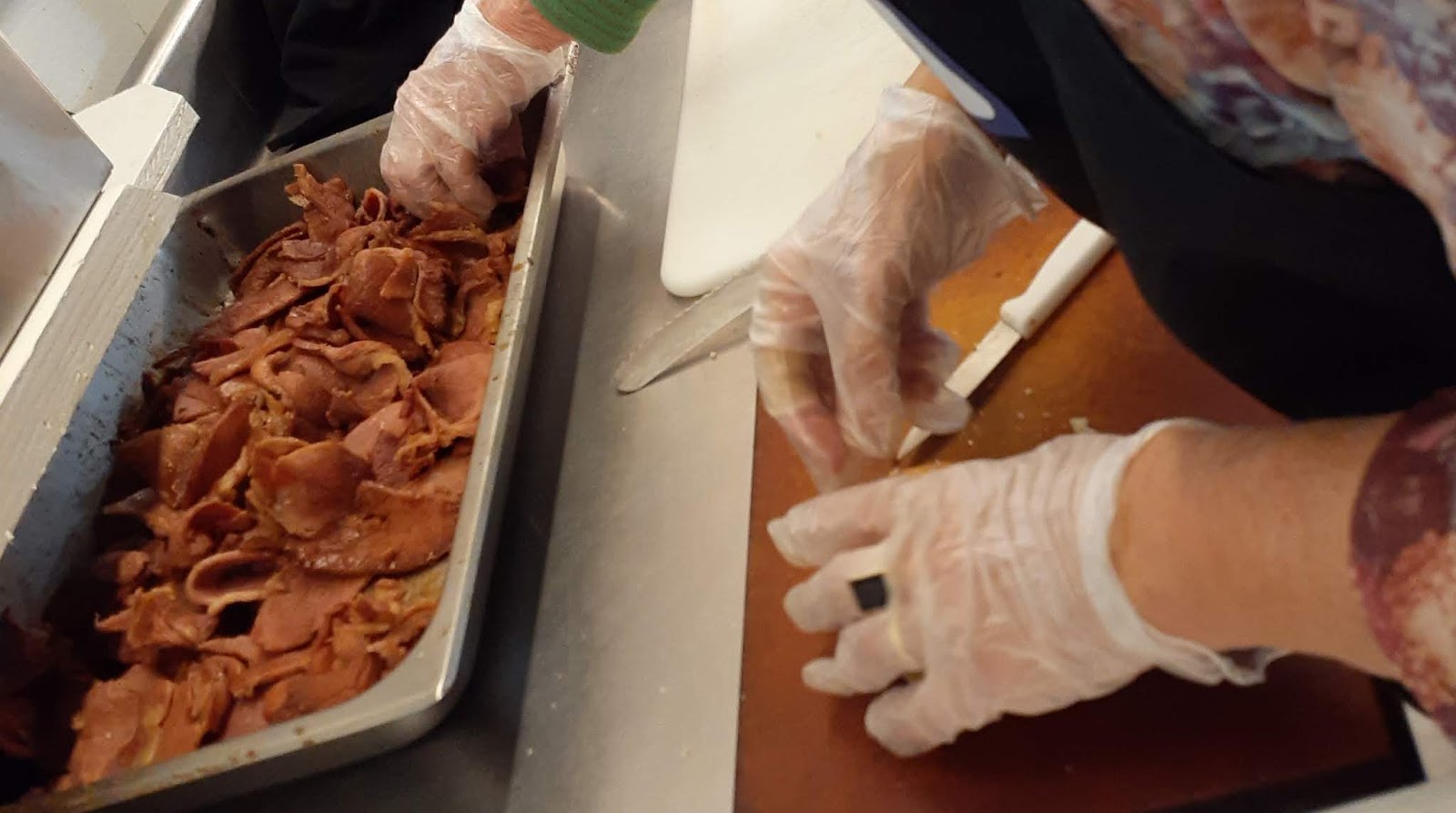
Ham cooking has to keep up with the orders, too.

Fortunately for my first experience I was paired with a veteran biscuit-maker. Suzy worked five days this year, which is her seventh consecutive one. I could tell that she had been a kindergarten teacher: She was very patient and positive, and she offered tips and ideas that were helpful.

Biscuit "stuffers" keep busy fulfilling all the orders.

Biscuits at the Fair

Making biscuits at the fair was almost the same as at the training class except we kept making tray after tray after tray. The biggest difference is at the fair most teams don’t make biscuits by feel—we use a recipe! Six parts flour to one part shortening. For each batch, we used 24 cups of self-rising flour, 4 cups of shortening, and 3 quarts of buttermilk. (Don’t try this at home unless you want to make 80 biscuits.) Otherwise, the process is the same as in the class.

Customers sit and await patiently their orders inside the booth.

For only $2, the ham biscuit is a hot seller, and we ran out briefly for only a few minutes one afternoon. Otherwise, we had hot biscuits ready for orders, although when someone ordered a dozen to go followed by another person who wanted ten biscuits to take home, we had to expedite the tray that we were making.

The kitchen space is limited, but everyone works as a team.

Best Biscuits Ever

When a young family was eating biscuits near my work area, I leaned over and asked if they were the best biscuits ever. The mother nodded and gave a thumbs-up sign. When I told her that it was my first day, we exchanged expressions that indicated we both were surprised.

"Veteran" biscuit-maker Suzy and I made a LOT of biscuits.

Now that I’m an authentic biscuit-maker, I’ve joined the circle of legendary bakers who have made biscuits for more than a century at the state fair. I hope to return next year and continue the tradition.

Above: My hat that proves that I worked in the kitchen.
Below: At the top of the 155-foot-tall SkyGazer Ferris wheel, the largest traveling wheel in the U.S., a rider can see up to 15 miles in any direction. The gigantic wheel is adorned with 524,000 LED lights.

Saturday, October 5, 2019

Learning to Make Biscuits for the State Fair

A buttermilk biscuit with ham is a crowd-pleaser at the State Fair.

Walking among the food vendors at the N.C. State Fair held in Raleigh each October is enough to tempt you to try all the creative and traditional foods. Although the exotic creations—such as a double cheeseburger sandwiched between two Krispy Kreme donuts—captivates the media each fall and is what many fair-goers talk about, a simple buttermilk biscuit is what attracts my attention.

A lot of ham is cooked for all the biscuits at the fair.

Training Class

Last fall I was amazed at one booth in particular. Operated by First and White Plains Methodist Churches of Cary, NC, the booth was cranking out biscuit after biscuit (served with country ham or sausage) to a long line of customers. When I was told that this booth makes up to 1,200 biscuits each shift, I had to learn more and soon wanted to be a biscuit maker.

A training class is offered each year for new biscuit-makers.

Several days before the fair begins, First Methodist holds a biscuit-making training class for new volunteers. (During the fair, the booth is too busy to conduct training.) I quickly signed up for the class and was the first person to show up on the morning when it was held. Maybe I was that excited.

Working the shortening into the flour is the first step.

Flour, Shortening, and Buttermilk

For a couple of hours, we amateur biscuit-makers watched as veterans demonstrated the process. Then we divided into teams to make our own and see if we could be successful. The challenge is high because First Methodist is the longest-serving food vendor at the fair and is so renowned for its biscuits (many customers stop every time they come to the fair for the biscuits).

As the dough is kneaded, the flour and shortening begin to adhere to each other.

In the class we didn't use a written recipe, but the process is simple. Fill a mixing bowl about two-thirds full with self-rising flour. At the fair, the booth uses 25-pound bags of Snowflake brand. (For the training class, we used tried-and-true White Lily.) Then scoop a handful of shortening about the size of a softball and knead the dough on a lightly floured work surface. After a few minutes, you quickly learn if more shortening is needed (all the flour is not adhering in clumps) or if a little more flour should be added to have a good dough consistency.

Biscuits are placed on an ungreased cookie sheet for baking.

Next buttermilk (at room temperature, not chilled) is added. For our mixing bowls, we added about a quart of buttermilk and continued to knead the dough. Again from the feel of the dough, you can tell if more buttermilk is needed. When you are satisfied with the dough, it’s time to roll it into the desired height (about the distance from the end of your thumb to the first knuckle) to form the biscuits. An empty metal can (that once contained pineapples) cuts each biscuit simply by pressing it into the dough. No twisting!

Into the oven goes the first pan. 

Baking to Perfection

The biscuits are then placed on an ungreased cookie sheet – about 40 to a sheet – and baked at 400 degrees initially for six minutes. After the sheet is rotated, the biscuits are baked for six more minutes. When the timer sounds, you have biscuits that every person who comes to the fair wants. If rolled to the right height (not too tall), the biscuits are perfect--and not gooey. If any extra flour is shaken off when they are placed on the sheet, they should be golden-brown when they come out of the oven. They are then filled with hot country ham or sausage by other kitchen volunteers.

Patience is needed as the biscuits bake.

About a dozen were trained in the class, and we are ready to show off our talents. Each one of us is expected to sign up for two shifts during the 11 days that the fair is held. Each shift has two biscuit-makers. When we beginners make biscuits, we will work with a veteran who will help to guarantee the consistency of our work.

After the biscuits have baked for six minutes, the tray is rotated in the oven.


A Tradition of Teamwork

Because each day of the fair has three shifts (usually five hours long each), a lot of biscuit-makers are needed. However, even more volunteers are required; about 40 are needed for each shift. The team effort is huge. More than 500 volunteers work at the booth each year. Although making biscuits is important, it is only a part of the much larger overall effort.

Finally a tray of biscuits just out of the oven are ready for tasting.

What First Methodist started in 1916 has developed into a great tradition, and amazingly it has continued unbroken all these years. The original hand biscuit has been served every year since the first one. I’m ready to show off my new biscuit-making skills.

A benefit of being in the class is the chance to take home extra biscuits, which I enjoyed with homemade strawberry jelly.

Note: Several biscuit recipes (with specific measurements) are available online, including this one by Crisco. 


Saturday, September 21, 2019

Moravian Chicken Pie, a Tradition Worth Preserving

Moravian chicken pie
Moravian chicken pie is a very savory dish.
How many times have I enjoyed Moravian chicken pie, a savory meat pie? I‘m not sure. Because I grew up in Winston-Salem, NC—the center of Moravian culture in America—it was featured often at church suppers.

This regional specialty is a flaky double-crusted pie packed with tender chicken that is served in slices with a rich gravy. A humble dish that is appetizing and hearty, it brings together chicken, pasty and gravy in a simple format with nothing else. Because the chicken has been boiled and chopped into bite-size pieces before being baked in the pie, it is deliciously tender, and the rich gravy guarantees a flavorful taste that is moist.

Moravian chicken pie
Chicken pies on the serving line at Fairview Moravian Church in Winston-Salem are ready to be served.

Colonial Origin

That city in the Piedmont region of the state grew out of the colonial settlements of Moravians known as Wachovia, a tract of almost 100,000 acres purchased in 1752 from John Carteret, the British statesman known as the 2nd Earl Granville.

Colonial Moravian settlers
Each table is decorated with a centerpiece of early Moravian settlers in colonial dress.

Most accounts credit the Moravians who in 1766 founded the town of Salem (that merged with the industrial town of Winston in 1913) as being the originators of the pie. They were familiar with meat pies, a staple of their diet in Europe. The Moravian Church, one of the world’s oldest Protestant denominations, has its roots in central Europe that is now part of the Czech Republic. Early Moravian immigrants to America began arriving—with their baking traditions—in 1735 in Pennsylvania to escape persecution by governments and state churches in Europe.

Serving line
The serving line is staffed with very efficient (and experienced) church volunteers.

Simple Recipe

Unlike some Moravian culinary traditions—such as sugar cake (my favorite), cookies, and spiced tea—that are very popular at Christmas, the chicken pie is served year-round. Little has changed to the pie’s recipe since it was first served in colonial times. Unlike traditional chicken pot pies, the Moravian pie doesn’t have any vegetables.

Chicken gravy
A rich chicken gravy is ladled on top of each pie serving.

True to the Moravians’ simple, frugal lifestyle, the pie requires only five ingredients that would have been readily available: chicken, broth, flour, butter and salt. The pie was likely a way to use scraps of cooked meat.

Plate of chicken pie supper

Supper includes more than chicken pie. Fairview Moravian plates also have country ham, green beans, apples, and a biscuit.

The Tavern in Old Salem, a family-operated restaurant built in 1816 as an annex to the historic 1784 tavern, is steeped in Moravian traditions and history. Embracing its heritage, it serves a Moravian chicken pie and gravy for Sunday brunch and a tavern chicken pie with gravy, potatoes, and green beans as a plate at lunch on other days.

Sign of Fairview Moravian Church
Proceeds of annual suppers at Fairview Moravian Church have paid for mission projects and building improvements.

Community Appreciation

Although I didn’t grow up in a Moravian Church in Winston-Salem (which still shares the distinction of having the highest concentration of Moravians in North America with Bethlehem, Pa.), members of my church (a Presbyterian one) and other neighboring churches were admirers of the Moravian pie, so much so that it was routinely duplicated by congregations at events regardless of their denominations.

Congregation members and guests linger after eating supper to enjoy each other's company.

In addition to satisfying the appetites of a church and the local community, chicken pie suppers (yes, they are not called "dinners") have also enriched social connections as well as contributed to fundraisers and building programs. According to Moravian archives, churches in Winston-Salem held chicken pie suppers as fundraisers as early as 1920.

Moravian cole slaw
A tangy Moravian cole slaw is served family style at each table.

Enjoying the pie at Fairview Moravian Church in Winston-Salem, which I still consider as a “neighborhood church,” with its congregation made me appreciate even more how Moravians have enriched our culture—religious, social, musical, culinary, and other aspects. I’m glad that the chicken pie served more often than at only Christmas.

Placemats come complete with the Moravian blessing (on lower left corner).

Note: Several recipes are available online, including, this one recently in Our State magazine.


Thursday, October 12, 2017

Can I Win a Food Contest at the State Fair?

Entering a food competition at the state fair has never been high on my “bucket list” – until this year. Because I’m not a cook, know little about winning recipes, and seldom want to show my food projects to a judge, I’ve been content to observe winning entries and read about the winners. However, this year I was inspired to enter and compete.

Ribbons are ready for the winners.

For this year, I decided to enter the cooking competitions at the N.C. State Fair coordinated by the N.C. Department of Agriculture & Consumer Services. Specifically, I was attracted to the contest sponsored by the N.C. Peanut Growers Association that was held on Thursday, October 12. Each entry was to be “a delicious breakfast recipe that is filled with peanut flavor and will be sure to get your morning started with a smile.” I could place in a contest that featured peanuts, right?

Cooking contests are held annually at the N.C. State Fair.

The first critical step is to submit a recipe by the deadline, which was ten days before the date of the contest and meant that I had to brainstorm about possibilities even a month in advance. After evaluating several options, I picked a favorite, which I called “Peanut Buttery Breakfast Pizza,” that I hoped would be a winner.

My entry starts to take shape.

The recipe starts with a package of soft tortillas about five inches in diameter. After spreading a tablespoon of peanut butter on each tortilla, banana slices are added to half of the tortillas (the remainder are saved to use as “tops”). A little honey is drizzled and finely chopped peanuts are sprinkled over the tortillas with bananas. Next, the tortillas without banana slices are placed over the other tortillas. Finally, the doubled tortillas are sliced into quarters.

Doesn't my entry look like a winner?

On the day of the contest, entries are turned in mid-afternoon, and judging takes place an hour later. Judging is based on flavor and taste (50%), creativity (25%), and ease of preparation (25%). I felt good about the flavor/taste category (what is better than peanut butter and banana flavors?) and the ease of preparation (the entry only took me about 10 minutes to prepare). Each recipe needed to contain at least one-half cup of peanuts or peanut butter, and entries needed to serve six to eight judges. The winning recipes were awarded cash prizes: $200 for first place; $150, second; $100, third; and $50, honorable mention.

I proudly turn in my entry with high hopes.

I was amazed at the creativity of the winners. First place was spicy peanut butter and banana breakfast braid. Second place was peanut butter French toast with nutty pig candy. Third place was peanut butter and jelly pop tarts. One recipe, peanut butter and banana waffles, received honorable mention. Although all are creative, the level of preparation doesn’t seem that easy. At least I was on the right track by combining peanut butter and bananas. If I compete again, I need to give more consideration to creativity, which seems more influential than only 25%.

Lisa Prince, host of the TV program NC Flavor, announces the winners.

Although I left empty handed without receiving a prize, at least I got to see what the contest is like and didn’t have to buy an admission ticket to the fair. A major benefit of entering the contest is free admission to the fair – plus the experience gained to compete next year.

Meanwhile, the carnival-like food attracts the attention of the fairgoers more than a cooking contest.

Saturday, July 22, 2017

Finding a Squash Pie

Imagine getting a daily allowance of vegetables and enjoying dessert – both at the same time. Some desserts are so sweet and hardly have any food value, not so with a traditional squash pie.

A pie made with yellow summer squash may not be familiar to many people. I confess that it’s not a pie that I remember eating, much less ever seeing before.

How do you think children who need encouragement to eat vegetables would react when they see a piece of squash pie? Walking by a potluck table when I was young, I’m sure that I would have skipped over it, but now that I’m older, I know better.

Nestled among apple dumplings, peach cobblers, and sweet breads, a squash pie for sale in Galax, Va., caught my attention.

Because one of my favorite pies is sweet potato, both in childhood and as an adult, I’m tempted to try a dessert made with a vegetable because it likely is based on a long-standing family tradition. Plus it reminds me of a time when desserts could be made without expensive ingredients if they included creativity, love, and maybe a vegetable.

Tables at the farmers market in Galax attract an early crowd when it opens on Saturday morning.

When I was meandering along the tables of foods for sale at a farmers’ market in downtown Galax, Virginia, the label “squash pie” immediately caught my attention. Topped with a baked meringue, it looked like something that I’d enjoy.

Marie Jones smiles at the table with her foods for sale.

The 95-year-old lady who was selling it made buying it an easy decision. She said that she’d been making squash pies since she was old enough to walk. Galax, a small town in southwestern part of the state, also seemed the perfect setting to find a homemade dessert.

When I got home, I enjoyed the sweetness of the pie, which is from the natural sweetness of the squash, not from sugar. The recipe is quite simple. In addition to sliced squash pieces, the pie includes margarine, eggs, and a dash of sugar. Because so much squash is included in the pie, it’s very dense and filling.

After the pie has been taken home and cut, a piece look delicious.

The taste of the squash pie is as good as that of a squash casserole. Of course, you have to be a fan of yellow squash to like either. They both deserve a place on a summer dinner table, but it you can only serve one, serve pie.

Wednesday, July 1, 2015

Adding Bounce to Your Life

Would you invite Amos Owens into your home or ask him to attend your next party?

Perhaps the most famous moonshiner in North Carolina during his lifetime, Owens slipped into obscurity before many of us were born. In his heyday, however, he was often sought for his special concoction known as Cherry Bounce.

Amos Owens
His legendary recipe was three parts corn whiskey, one part cherry juice, and one part sugar. Although his corn whiskey was special, even more precious was the juice because it was pressed from the fruit by the bare feet of his beautiful daughters.

People from all over the South traveled to visit him and taste his celebrated beverage, which was renowned as far away as the Mississippi River. Old-timers even claimed that it had medicinal value. 

Rutherford County in western N.C. celebrates this legacy with the Cherry Bounce Trail to promote sightseeing in the area. As visitors enjoy the beauty of the county’s landscape and rural history, they can reminisce about “the memories of old-time moonshiners who frequented these hills and valleys years ago.” The trail passes by Cherry Mountain, a high peak on the horizon, where cherry trees still grow wild -- and once offered a safe haven to Owens and his moonshining neighbors for distilling liquor.

Owens, who was born in 1822, brought 100 acres near Cherry Mountain in 1845 and by 1851 had earned enough money from moonshining to buy the entire mountain itself. Here, according to a local schoolteacher who recorded Owens’ life history at his request before he died in 1906, cherry trees yield “every June a crop of fruit remarkable for its size and flavor.”

Every second Sunday in June, Owens invited friends to celebrate the black-heart cherries when they were the ripest. His festival was known for its food, dancing, and physical contests. His granddaughter observed that “people danced and drank for as long as the food and drink and money lasted. Some would get so drunk and carried away that they danced in the nude.”

Although the trees on Cherry Mountain are “found nowhere else,” versions of Cherry Bounce existed well before Owens’ lifetime. A popular drink in the 1700s, it was even made at Mount Vernon for George Washington (although without Owens’ illicit moonshine).

Owens’ arrests are still legendary. Once when revenue agents discovered his operation, he invited them into his home for breakfast. Although they declined food, they did accept his kind offer to sample his Cherry Bounce. After several drinks, one officer passed out, and another staggered into the woods and did not return for hours. Owens made no attempt to escape, and the officers arrested him when they regained their sobriety. After serving six months in jail, Owens returned to his home (known as “The Castle”) and renewed his operations.

Cherry Bounce served by Gary
Crunkleton at State of the Place conference
For most of his life, Owens was the Cherry Bounce King. Although he was also once locked up for an entire year, he continued to make moonshine until 1890 when he was arrested again. During this trial, a judge convinced him to stop violating “the law.” He returned home, became a devout member of his church, and never again fired up his still.

Fortunately today, Cherry Bounce enjoys new life in the hands of skilled mixologists, such as Gary Crunkleton, who operates his private eponymous club in Chapel Hill. When I attended the “State of the Plate” conference, which explored local and global connections of Southern foodways, Crunkleton was a speaker and provided samples of Cherry Bounce inspired by Owens’ recipe. Attending a conference never provided such a rewarding benefit.

Celebrate cherries from the N.C. mountains – whether you enjoy the fruit or drink – and think about the man who enhanced the lore of this state.


Note: This post appeared originally in the June 2015 issue of OutreachNC, a monthly magazine distributed in 10 counties of central North Carolina. Click here to see the article as it appeared in print.

Friday, June 12, 2015

Keeping Wild Foods in Our Culinary Culture

[Note: This post, prepared originally for the NC Folklife Institute's NCFood blog, is hosted on the institute’s website, with excerpts and a link to the website posted here.]

Is cooking with wild foods out of place in today’s modern society? Because it’s so old-fashioned, I was surprised by how many kids had entered the Wild Food Cooking Contest in RichmondCounty.  It’s the event of the spring in Ellerbe, NC, when youth and adults show off their skills for cooking deer, moose, rabbit, beaver, squirrel, and other wild game. After the judges have scored each entry, everything is served buffet-style as a tasting party for the participants, their families and friends, and others like myself who attend to see how wild our food once was and still can be.

Rabbit pot pie was one of the many
tasty entries in the Richmond County
Wi
Dishes prepared by kids age 16 and younger were the most interesting. They included teriyaki rabbit, beaver pot roast, rabbit pot pie, duck and dumplings, Eastern wild bear and wild hog sausage, and catfish stew. When I had the opportunity to sample them, each was so good that I could have made a complete meal of it.

My first surprise was not so much that young people had prepared tasty food; it was that the game, fowl, or fish could not have been purchased. It had to be hunted, trapped, or caught legally or received as a gift. The actual step of cooking is only the final stage in the process and only the visible one at the contest.

Friday, January 31, 2014

Simmering Stew Brings a Community Together

[Note: This post, prepared originally for the NC Folklife Institute's NCFood blog, is hosted on the institute’s website, with excerpts and a link to the website posted here.] 

The center of small town is not always a town hall, courthouse, or church. Sometimes it’s a pot of bubbling stew as it is each fall in Mount Gilead, a community of slightly more than 1,000 residents in Montgomery County. Although the community is small, just about everyone knows about the Brunswick stew served when Brown’s Hardware has its open house.
A tasty pot of Brunswick stew
creates a lot of interest.

Incorporated in 1899, Mount Gilead boasts a downtown historic district listed in the National Register of Historic Places.  The heart of historic downtown is a hardware store that has been open continuously for more than 100 years, and the floor creaks like it is even older. Known now as Brown’s Hardware, the business presents itself as an “old timey general store and mercantile,” and it is.


Saturday, August 10, 2013

Peach Dessert Competition: Taking Home First Place but No Leftovers

The first-place winner:
Peach Glazed Cheesecake with Blueberries
Nothing brings out a crowd better than a dessert competition where everyone can sample the entries. So it was when the Sandhills Farmers Green Market set aside a Saturday as Peach Day and announced a competition for the best peach dessert.

I knew that I wanted to attend. On a hot August day nothing can beat tasting all the peach desserts prepared for a contest. However, I wanted to be more than a bystander -- I decided to prepare an entry.  Because peach is my favorite fruit and the contest was in the heart of N.C. peach-growing territory, I quickly signed up to enter.

Setting the cheesecake on
the table for judging
The contest rules specified that each dessert had to be made with N.C. peaches, and each entry required two cups of peaches. After checking the rules, I immediately thought of an old family peach pie (listed at the end of the recent post on N.C. Food blog of N.C. Folklife Institute). Although this recipe is a family favorite, I began having doubts that it would compete well for creativity or appearance. It tastes great but looks like any other peach pie brought to potlucks or reunions in the summer. After lots of thought, I settled on a cheesecake recipe that I modified by adding a layer of sliced peaches on top in a peach glaze – as well as substituting peach moonshine for some flavoring.

Fresh blueberries from
C.V. Pilson Farm can accentuate any dessert.
For the cheesecake, I wanted to use more than only peaches from the farmers market and stopped by the week before the contest was held. Of course, I bought peaches – they had just been picked by Better Be Ellerbe Peaches (Ellerbe, NC). In addition, I bought farm eggs from Riley’s Ranch (Carthage, NC) and blueberries from C.V. Pilson Farm (Cameron, NC). The judges (who included the mayor, the chef of a restaurant known for using local products, the chef of the farm to table program, a TV producer, and the news anchor of a local radio talk show) would select the winners on flavor, appearance, quality, and creativity, and these local ingredients should help to create a successful entry.

Riley's Ranch has the best farm eggs.
The recipe is a four-step process, so it’s not a simple preparation. Even the glaze took extra effort. My chief critic during preparation was my wife, who is tougher than the judges on the Food Channel. Even though I was confident the recipe would be successful, she encouraged me to make the glaze more than once – I did ... four times ... just to make sure that nothing would go wrong on the final effort.

On the morning of the competition, I brought a nice looking cheesecake. The peach glaze itself required the minimum two cups of peaches. In addition, two more cups of sliced peaches decorated the cake’s top around blueberries in the center: very peachy indeed.

Nancy Fiorillo, mayor of Pinehurst,
awards first-place prize of $75.00
At the appointed time, I gathered near the judges area and waited for the results to be announced. I was hoping to place at least third in the contest. When Melanie Riley of Riley’s Ranch announced the third and second place winners (a peaches and cream pie and peach crepes respectively), I was disappointed that my entry had not been selected. When “peach glazed cheesecake” was announced as the first-place winner, I was really surprised and delighted.

After the contest I went to get the platter and the remaining cheesecake, but there was none to take home. It had all been eaten. I guess I have to make another one soon.


Want the recipe? (Remember that it's not simple.)


Peach Glazed Cheesecake with Blueberries

Crust

2 cups graham cracker crumbs
6 tablespoons melted butter
2 tablespoons flour
¼ cup raw sliced almonds, chopped

Combine ingredients and press evenly onto bottom and sides of buttered 9x3-inch spring form. Bake at 350 degrees for 5 minutes. Then continue with cheesecake portion.


Cheesecake

3 eight-ounce cream cheese
¾ cup sugar
3 eggs 
2 tablespoons lemon juice
2 tablespoons peach moonshine
2 tablespoons vanilla
2 teaspoons grated lemon rind

Beat cream cheese until soft. Add sugar, blending thoroughly. Add eggs one at a time, beating well with each addition. Mix in lemon juice, moonshine, vanilla, and rind. Blend well. Put in spring form. Bake at 325 degrees for 40 minutes or until cake is firm. Then continue with sour cream layer.


Sour Cream Layer

2 cups sour cream
3 tablespoons sugar
1 teaspoon vanilla

While cake is baking, blend sour cream, sugar, and vanilla. When cheesecake comes out of over, spread sour cream mix over cake and return to over for 12 more minutes. Cool cheesecake until it is room temperature before adding peach glaze.


Peach Glaze

2 cups peeled, sliced fresh peaches (approx. 4) 
½ cup water
1 cup sugar
3 tablespoons cornstarch
2 tablespoons butter
1 tablespoon peach moonshine

Place peaches and water in blender; cover and process until smooth. Pour pureed fruit into medium saucepan. Combine sugar and cornstarch, stirring well. Add sugar mixture to pureed peaches. Cook over medium-high heat 5 minutes or until mixture is thick and clear, stirring constantly. Remove from heat. Add butter and peach moonshine, stirring until smooth. Cool and set aside until room temperature.


Top Layer

2 cups peeled, sliced fresh peaches (approx. 4) 
1/2 cup blueberries 

Arrange peeled, sliced fresh peaches as needed in attractive pattern on top of the cheesecake. Pour peach glaze on top. Add blueberries around side or in center. Chill several hours or overnight.

Final Note: If not served immediately, sliced peaches may start to brown. Use Sure-Jell Ever-Fresh to stop browning. Dissolve 2 teaspoons Ever-Fresh in 2 tablespoons water; toss with peaches; refrigerate and serve within 8 hours.