Showing posts with label NC. Show all posts

Saturday, January 1, 2022

How to Celebrate with New Year’s Day Food During a Pandemic

The boxed New Year's Day lunch had everything important.

It’s January 1 and time to celebrate with a Southern meal of collards, black-eyed peas, and cornbread, even though the world has been beset with the coronavirus pandemic for almost two years. What is a community to do when social distancing and mask-wearing are as important as serving traditional New Year’s Day food? 

A line of cars was waiting well before the start time.

Open a drive-through line is what Culdee Presbyterian Church in Moore County, NC, decided. Takeout is better than no food or no celebration at all. If students can learn remotely during a pandemic, people can enjoy food in a similar manner. 

Several volunteers were busy helping to keep the line moving.

The church’s congregation was busy early in the day preparing the food and assembling the boxes, and the takeout line was growing well before the start time. The long line of cars waiting for boxed lunches to take home was an indication of how much people enjoy celebrating together (even when they have to stay in their vehicles) and how important the food traditions of New Year’s Day can be. The desire to participate in a joint activity can override the reality of how little social inaction might occur. 

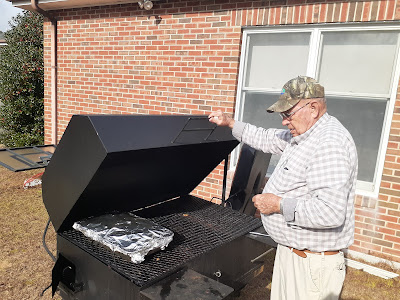
A pitmaster keeps the remaining barbecue warm.

The process was simple: Drive in, stop to order and pay, advance to pick up, and leave. No special orders. Every box was the same: Boston butt barbecue, collards, black-eyed peas, cornbread, and dessert (which was either a slice of pound cake or two cookies). The barbecue and dessert were added attractions—I would have gone for just the collards, black-eyed peas, and cornbread. 

So many cars were driving through the line and being served, I thought that the church would sell out early, well before the end time that was three hours later, and they did. Of course, most of us know to show up early for these events and then sit back and watch all the activity unfold. 

A sign at a busy intersection promotes the event in advance—without indicating the location (but the locals knew).

Starting the New Year correctly is so vitally important, and eating collard greens and black-eyed peas with cornbread guarantees good health and fortune (or so we have been told). If we do, life is good.


Note: An article about a different community gathering on New Year’s Day and its food traditions that I wrote for N.C.Food Blog of N.C. Folklife Institute is published here.   


Wednesday, April 8, 2020

Finding a Historic Culture in Our Backyard


The chance to find an ancient culture seems like an adventure worth pursuing. Imagine exploring the political and ceremonial center of a complex society that engaged in widespread trade, supported craft specialists, and built earthen mounds for spiritual and political leaders.

Early Civilization

The mysteries of past centuries and an early civilization are hidden in plain sight, but visible if you venture to Town Creek Indian Mound near the town of Mount Gilead in southwestern Montgomery County, NC.


The only state historic site in North Carolina dedicated to Native American heritage, Town Creek offers a glimpse into how people lived here well before the arrival of Europeans and Africans in an era known as “pre-Columbian,” or before Columbus first crossed the Atlantic Ocean in 1492.

Several thousand years earlier, Native peoples began settling in permanent villages near rivers. When they stopped their nomadic lifestyles to search for wild foods, they planted plots of squash, corns, beans, and other produce and made pottery with clay from riverbanks.


Archeological Evidence

Around 1100, these societies began building ceremonial centers, some surrounded by stockades. Town Creek represents such a center, although it has largely been reconstructed using archeological evidence. Scholarly research and archeology have been conducted there for more than half a century. Excavations first began in 1937, when the site was acquired by the state, and still continue today, although on only a limited basis. Because these people left no written record, archeology has been vital to uncover their history.

When I first visited Town Creek and saw the palisade, or fence of wooden stakes, that surrounds the site, it reminded me of stockades built in the 1600s at Jamestown and other colonial settlements. However, entering inside lets you know that you are experiencing a much earlier history when survival might have been even more difficult. Archaeological evidence indicates that the palisade was rebuilt at least five times.


The open area inside Town Creek made me think of parade grounds in early U.S. coastal forts such as Fort Sumter in the harbor of Charleston, S.C., or open plazas typical of cities designed by the Spanish and best illustrated in the South by the one in Saint Augustine, FL. However, these sites don’t have a huge ceremonial mound as their centerpiece.

The mound at Town Creek was actually the site of three separate structures: first an earthen lodge, then a temple built over the lodge after it had collapsed with age, and finally a ceremonial structure that had a ramp leading to a large plaza or public area where societal meetings and ceremonial activities took place. Around the edge of the plaza, several structures that served as burial or mortuary houses containing graves of a clan were built.


Graves of the elite were decorated with treasured relics, such as copper from the Great Lakes region and conch shells from the coast, that reflected their status in society. Some graves included medicine bundles as well as pots of food for the voyage to the afterlife. Learning that 563 burials have been found at Town Creek captivated me more than seeing the burial artifacts.

Cultural Traditions

In addition to being a burial site, Town Creek was also where socially high-ranking members lived and important matters were discussed among collective clans of the society. It was also the scene of tribal feasts as well as important religious events, including annual purification ceremonies.

After extinguishing all fires in their homes, people from outlying villages came to Town Creek and participated in ceremonial bathing, took “cleansing” medicines, and ate corn to prepare for each new year. When the annual ceremonies ended, villagers returned home to relight their hearths with embers from a sacred fire to symbolize unity with each other. Sharing the fire fostered the idea that they were “people of one fire.”


Town Creek was abandoned around 1400 when the Pee Dee adopted a more egalitarian social structure. Priestly temples atop mounds that reflected government by an elite fell into disuse. As large council houses were created to conduct government by consensus, burial practices changed as well.

The site is a popular destination for field trips by schoolchildren. “It’s fun to see how amazed they are when they walk through the guard tower and see what a village once looked like. It’s like stepping back in time,” says Rich Thompson, site manager. He estimates that about 12,000 children on school field trips visit each year, some from as far away as Ocracoke Island on the Outer Banks and others from neighboring states.


The oldest state historic site, Town Creek Indian Mound has several special events throughout the year that focus on archaeology and explore the lifestyle of the Native peoples, known as “Pee Dee,” who are not culturally connected to familiar regional groups such as Lumbee, Catawba and Cherokee but were influenced by a different tradition known as South Appalachian Mississippian. Learning more about an ancient culture is definitely an adventure worth pursuing


Note: The post is based on my article about Town Creek published in the March 2019 issue of OutreachNC Magazine.

Thursday, April 2, 2020

Scheduled for Demolition but Now Thriving as a Museum


Imagine a small, bustling community taking shape in a remote, isolated area and growing with the development of agriculture, naval stores and iron works. That scene is an early picture of what is now Lee County (before it was carved in 1907 from Moore and Chatham counties).

Commerce was initially transported over unpaved roads and waterways — the Cape Fear and Deep rivers. Once coal was mined commercially and added to other products of the local economy, a rail connection was indispensable for further growth.

At the junction of two new railroads, the community of Sanford began to take shape in the 1860s, and soon T. W. Tucker arrived to manage the burgeoning rail business. As the first depot agent for the Raleigh and Augusta Air Line Railroad, he and his family became the initial residents of the Railroad House, the oldest house in the city.

Built near the depot in the center of town in 1872, two years before Sanford itself was incorporated, the classic Gothic Revival frame cottage has always occupied a very prominent spot in the community and demonstrates that the city was originally a railroad town. Because the city was named for C.O. Sanford, the chief civil engineer for the railroad, the influence of transportation is clearly important.

The well-being of the Railroad House has had its peaks and valleys. Fortunately, today it is thriving as a principal component of Depot Park, which has evolved into the cultural and communal center of Sanford where concerts and events are held and families play and enjoy leisure time. However, the stability of the house was not so certain several decades ago.

While Tucker and his family lived at the Railroad House, a school for girls was run there by his wife Inder. Because Tucker was also Sanford’s first mayor, the house flourished as a mainstay of community life. However, its importance began to fade. In 1916 the railroad sold the then 44-year-old house, which next became the home for several families before it was used as a tea room.


Because the house had deteriorated, it was scheduled for demolition in 1962. However, interested citizens banded together to save it and formed the Railroad House Historical Association. Through their efforts the house was moved across the street to its current location, restored and given a new life first as the home of the Chamber of Commerce for 30 years and now as the only historical museum of Lee County.

“Interesting artifacts are located throughout the house,” says Emily Mierisch, who volunteers regularly at the Railroad House because “I just love history.” With historical photos, objects and documents of the area’s early days, the house is indispensable in preserving local history as itself is being preserved.


A historic steam engine, known as Old No. 12, anchors an important part of the landscape near the house. With two small wheels in front and eight large driving wheels, it was placed in service in 1911 and officially retired in 1955.

Also part of the park is the passenger depot (circa 1900), a one-story brick structure typical of its period and renovated in 1976. Its charming, wide, overhanging red tile roof with flared eaves almost rivals the artistic architecture of the Railroad House.


The house’s central chimney with a recessed lancet panel (inspired by the beauty of cathedral windows) on each face and a crenellated cap adds an antiquated charisma to Sanford’s historic district that encompasses 53 buildings, most dating from 1895 to 1930.

The Railroad House’s simple board-and-batten siding is enriched in the front by decorative features such as central double windows, each with a four-over-four sash. Other embellishments include gables on the main roof, two dormers and entrance porch that are ornamented with a finial and cross-bracing.


The interior of the house is finished in simple fashion with wide beaded baseboards and plaster walls. The original floors are mostly intact, and the mantels have a typical nineteenth-century design. The house consists of a one-and-half-story main block, which has three rooms on the lower level, and a one-story rear wing with its own chimney.

Visiting the Railroad House, which is listed on the National Register of Historic Places, is a great way to celebrate local and national history.


Note: The post is based on my article about the Railroad House published in the April 2020 issue of OutreachNC Magazine.

Wednesday, January 15, 2020

Sharing Favorite Foods with Family and Friends


If you want a lot of great home-cooking, your best bet is the all-you-can eat Southern buffet at Fuller’s in Pembroke, NC. Although Fuller’s is open daily, the Sunday crowd seems like family and makes the restaurant lively.

On that day more tables are taken by family groups than on other days. Tonya Rouben, who grew up in Pembroke, was having lunch with 11 family members who still live in the area. Now living in Atlanta, Rouben says, “I wish I had a place with home-cooking like this where I live. I love the barbecue and fried chicken. “A lot of Lumbees are in the kitchen cooking. It’s hard to beat Native American cooking,” she adds.


Sisters in Faith

At a table for eight, LaVica Farmer of Fayetteville, NC, was eating with her sisters in faith, including one who is 93. All are members of Bethany Presbyterian in Lumberton, NC, that was formed in 1875 and has a historic African-American legacy. Some are descendants of families who established an adjoining academy in 1903 and built the current church building in 1938.


They were with Rev. Helane Church, the pastor at Bethany, and were spending the day praising the Lord, eating Southern food and praising the Lord again. They had just attended the 9 o’clock service in Lumberton conducted by Church before coming to Fuller’s for lunch. Then they were attending an afternoon service, again conducted by Church, at Freedom East Presbyterian in Raeford, NC.

Service and Atmosphere

“Not only is the food delicious, but the service and atmosphere are a treat, so warm. I’ve lost count of how many times I’ve been here. We come here as often as we can,” says Farmer. Although she did not make one of the iconic collard sandwiches, Farmer says she came close. “I got some fatback, fried cornbread, and ate them with collards,” she adds.

The church ladies appreciate Fuller’s approach for serving fish. “We like ours with the bone in, which is what is on the buffet, but they also made a bowl of boneless just for us. This is a treat,” says Farmer, holding a piece of croaker.

Elder Linda Carter of Lumberton remembers eating at the original location of Fuller’s in that city. It opened in 1986 but was closed permanently after being inundated by eight feet of floodwater from Hurricane Matthew in 2016. About the original location, she says, “I went there a long, long time. The same people who now work here remember your face. They are like family.”


New and Repeat Customers

At another table was Lasheena Jones, who was visiting Fuller’s for the first time with nine family members aged 8 to 74, all from Florence, S.C. Although her favorite on the buffet is the turnip greens, her cousin Francenia Cooper says, “The pork sausage is the best.”

You can tell customers who are new by how they hesitate before going to one of the four buffet stations from a repeat customer who makes a beeline for the favorite. Only in the South would more people hover around the station for vegetables than the one for main dishes. Such was the case where 20 vegetables make customers linger and struggle with narrowing the options before filling their plates.

My favorites are anything green — collards, limas, peas, cabbage, turnip greens, okra (fried). With just a third of the plate now open, I had a hard time choosing among rutabagas, mashed potatoes, corn, succotash, mac ‘n’ cheese and nine more. (Yes, mac ‘n’ cheese is a vegetable.) The second most popular station has main dishes — chopped pork barbecue, chicken (fried, baked and barbecue), fried crab, shrimp and fried fish, sliced roast beef, pork sausage, chicken livers — plus breads such as hushpuppies, biscuits and corn fritters.

Desserts at Fuller's

Customers are not timid about taking desserts — some have at least three. Chocolate layer cake (four layers), strawberry shortcake and banana pudding seem to be the top choices. Other choices included a fruit cobbler, a vanilla layer cake and self-serve soft ice cream. When the dessert station runs out of space, sometimes more desserts are on the fourth station, which is mostly salad ingredients.


The buffet stations are brightly lighted by clerestory windows, a series of small windows along the top of the building near the roofline. Don’t worry about anything on the buffet being stale or sitting too long. Items are continually taken by customers and quickly replenished by servers, who keep the chicken — an obvious favorite — piled high.

Table of Brotherhood

Kristyn Sabara, one of the servers, said that Sunday is the most popular day and a waitlist that day around 1 p.m. is common, although the buffet price of $12.99 on Sunday is $4 more than on weekdays. A menu is also available, but most choose the buffet.

Fuller’s brings to life the dream of Dr. Martin Luther King Jr., who envisioned how we would “sit down together at the table of brotherhood.” People of all colors and heritages — once separated by the power of Jim Crow — mingle as they enjoy favorite foods. The scene could be improved only if everyone were served family-style and sat at one communal table.


Note: The post is based on my article about Fuller's published in the January 2020 issue of OutreachNC Magazine.

Saturday, September 21, 2019

Moravian Chicken Pie, a Tradition Worth Preserving

Moravian chicken pie
Moravian chicken pie is a very savory dish.
How many times have I enjoyed Moravian chicken pie, a savory meat pie? I‘m not sure. Because I grew up in Winston-Salem, NC—the center of Moravian culture in America—it was featured often at church suppers.

This regional specialty is a flaky double-crusted pie packed with tender chicken that is served in slices with a rich gravy. A humble dish that is appetizing and hearty, it brings together chicken, pasty and gravy in a simple format with nothing else. Because the chicken has been boiled and chopped into bite-size pieces before being baked in the pie, it is deliciously tender, and the rich gravy guarantees a flavorful taste that is moist.

Moravian chicken pie
Chicken pies on the serving line at Fairview Moravian Church in Winston-Salem are ready to be served.

Colonial Origin

That city in the Piedmont region of the state grew out of the colonial settlements of Moravians known as Wachovia, a tract of almost 100,000 acres purchased in 1752 from John Carteret, the British statesman known as the 2nd Earl Granville.

Colonial Moravian settlers
Each table is decorated with a centerpiece of early Moravian settlers in colonial dress.

Most accounts credit the Moravians who in 1766 founded the town of Salem (that merged with the industrial town of Winston in 1913) as being the originators of the pie. They were familiar with meat pies, a staple of their diet in Europe. The Moravian Church, one of the world’s oldest Protestant denominations, has its roots in central Europe that is now part of the Czech Republic. Early Moravian immigrants to America began arriving—with their baking traditions—in 1735 in Pennsylvania to escape persecution by governments and state churches in Europe.

Serving line
The serving line is staffed with very efficient (and experienced) church volunteers.

Simple Recipe

Unlike some Moravian culinary traditions—such as sugar cake (my favorite), cookies, and spiced tea—that are very popular at Christmas, the chicken pie is served year-round. Little has changed to the pie’s recipe since it was first served in colonial times. Unlike traditional chicken pot pies, the Moravian pie doesn’t have any vegetables.

Chicken gravy
A rich chicken gravy is ladled on top of each pie serving.

True to the Moravians’ simple, frugal lifestyle, the pie requires only five ingredients that would have been readily available: chicken, broth, flour, butter and salt. The pie was likely a way to use scraps of cooked meat.

Plate of chicken pie supper

Supper includes more than chicken pie. Fairview Moravian plates also have country ham, green beans, apples, and a biscuit.

The Tavern in Old Salem, a family-operated restaurant built in 1816 as an annex to the historic 1784 tavern, is steeped in Moravian traditions and history. Embracing its heritage, it serves a Moravian chicken pie and gravy for Sunday brunch and a tavern chicken pie with gravy, potatoes, and green beans as a plate at lunch on other days.

Sign of Fairview Moravian Church
Proceeds of annual suppers at Fairview Moravian Church have paid for mission projects and building improvements.

Community Appreciation

Although I didn’t grow up in a Moravian Church in Winston-Salem (which still shares the distinction of having the highest concentration of Moravians in North America with Bethlehem, Pa.), members of my church (a Presbyterian one) and other neighboring churches were admirers of the Moravian pie, so much so that it was routinely duplicated by congregations at events regardless of their denominations.

Congregation members and guests linger after eating supper to enjoy each other's company.

In addition to satisfying the appetites of a church and the local community, chicken pie suppers (yes, they are not called "dinners") have also enriched social connections as well as contributed to fundraisers and building programs. According to Moravian archives, churches in Winston-Salem held chicken pie suppers as fundraisers as early as 1920.

Moravian cole slaw
A tangy Moravian cole slaw is served family style at each table.

Enjoying the pie at Fairview Moravian Church in Winston-Salem, which I still consider as a “neighborhood church,” with its congregation made me appreciate even more how Moravians have enriched our culture—religious, social, musical, culinary, and other aspects. I’m glad that the chicken pie served more often than at only Christmas.

Placemats come complete with the Moravian blessing (on lower left corner).

Note: Several recipes are available online, including, this one recently in Our State magazine.


Saturday, August 3, 2019

Temperance Hall: A Place to Debate and Proclaim Vows of Abstinence

Old historic structures always have a tale or two to tell. Temperance Hall, listed on the National Register of Historic Places in 1973, near Wagram, NC, has had an important role in its community for decades. Although it's a simple brick building, it has many stories to tell.

Formally known as the Richmond Temperance and Literary Society Hall, this historic structure in Scotland County is believed to be the only structure in North Carolina built to house a temperance society. The hall was the scene of lively debates in its early days and is still used for meetings of civic groups.

The simple structure of Temperance Hall was completed in 1860.

To elevate the moral and cultural life of its community, the Richmond Temperance and Literary Society was founded in 1855 in what was then lower Richmond County in an area settled in 1773 by Highland Scots. Built of hand-molded local bricks, the hall is still standing in tribute to its sturdy construction in 1860 by the Scottish descendants, although it was sacked five years later by U.S. soldiers advancing toward Fayetteville during Sherman’s Carolinas Campaign of the American Civil War.

Influenced by the temperance movement, the charter members vowed to “neither make, sell, buy, nor use as a beverage any intoxicating drink whatever.” The cultured and worried citizens at that time were troubled by the “deadly influence” that alcohol consumption was “exerting over the morality of our country and seeing the ravages that it is daily making in our midst.” Within a few years of organizing, the society built the small one-story, one-room hexagonal building with sixteen-foot sides near what is now the town of Wagram. Here they met and coordinated their “uncompromising hostility to intemperance and untiring zeal for the advancement of literature.” 

The finial on the roof portrays the twin aims of the Richmond Temperance and Literary Society.

The society’s twin aims are illustrated at the peak of the building’s roof by a wooden finial that represents an inverted wine goblet on top of a closed Bible. Both pieces of the finial were reportedly shot down by Sherman’s troops, and pot marks made by their bullets fired during target practice can still be detected on the hall’s exterior. The interior ceiling was once painted blue with a constellation of gold stars; each star represented a member of the society. However, if the member broke the vow of abstinence, the star was painted black. (Several stars had alternating coats of gold and black.) When a member died, the star was gilded with silver. 

The society continued to meet in the hall until the 1890s. In 1899, the area around Wagram became part of the new Scotland County, and the hall found a new role until the 1920s as a school for white students (as segregation ruled during the Jim Crow era). After many years of neglect and decay, the hall was restored as accurately as possible in 1959 by reconstructing a two-tier wooden platform that supports a lectern used by speakers, adding a cast-iron stove similar to the one that originally heated the hall, and rebuilding the pairs of recessed bookshelves on the northeast and south walls. In its role as a museum today, it serves a symbol of cultural attitudes of a bygone era. 


A two-tier platform with lectern was reconstructed in 1959.

The restored home of North Carolina poet-laureate John Charles McNeill, a Scotland County native and grandson of Scottish immigrants, was moved to the site of Temperance Hall in 1960 and serves as the visitor center for both properties. 

Although hexagonal, the hall is architecturally significant because it is a diminutive version of the octagonal mode popularized in North Carolina in the mid-1800s by the concepts of Orson Squire Fowler, who analyzed that an “octagon house” (a term that refers specifically to octagonal houses built in North America during this period) with its eight sides encloses more space than a square one with equal wall space.  

The Richmond Temperance and Literary Society still meets all these years since its founding, although now only annually. The hall is about 1½ miles west of US 401, which is Main Street in Wagram, off Old Wire Road near Spring Hill Cemetery.

Temperance Hall has survived decades as the area around it has changed, and its history is quite phenomenal. Although meetings held in the hall today no longer promote abstinence, its continued use guarantees that its history is not yet complete and it may inspire more tales for future generations to tell.


Note: The post is influenced by two articles about Temperance Hall that I have written. One is an entry uploaded in June 2019 in NCpedia, the online encyclopedia about North Carolina. The other is an article published in the May 2019 issue of OutreachNC Magazine.

Monday, July 22, 2019

Snappy Lunch: Where a Pork Chop Sandwich Is King

Mount Airy, NC, is the destination for travelers who want to enjoy and preserve the legacy of “Mayberry,” the small town made famous by The Andy Griffith Show. The city is the birthplace of Griffith and has been nicknamed as Mayberry for inspiring the fictional N.C. town where the show is set.


The Andy Griffith Show


Fans of the show step back in time when they visit Mount Airy, which now hosts “Mayberry Days” each September, and stroll down Main Street that looks almost like it was created for the show. Most also plan a visit to The Snappy Lunch, which is next door to Floyd’s City Barber Shop.

A vintage sheriff's car is usually parked on Main Street.

The diner was made famous on The Andy Griffith Show when Andy suggests to Barney that they get a bite at The Snappy Lunch. (Show fans can see the scene in “Andy the Matchmaker,” an early episode.) Griffith also mentions the diner in his version of the song “Silhouettes.” Surprisingly, the diner is the only Mount Airy business ever mentioned on the TV show.

Pork Chop Sandwich


The Snappy Lunch is decorated with memorabilia from the 1960s.

The fried pork chop sandwich is the menu item of distinction. All the way includes chili, cole slaw, mustard, onion, and tomato. (Lettuce and mayo are also available.) Considering its celebrated status, it is served unceremoniously—simply wrapped in waxed paper. A variety of other sandwiches are on the menu, but few customers order them. Almost everyone having lunch when I was there ordered the famous sandwich.

The pork chop sandwich is the most popular item on the menu.

The menu itself is as simple as the trademark meal. The only “side” available is a bag of potato chips. No fries, no potato salad, no beans, no dessert. Beverages are served in Styrofoam cups. Memorabilia from the 1960s displayed on the walls and the mid-century vinyl chairs at Formica-topped tables also give the diner an authentic feel.

Diner History

In four years, the diner will celebrate the 100th anniversary of its opening in the location where it has always been: 125 North Main St. In its early days, customers were local workers and students. (Local schools did not yet have cafeterias.) Then a hot dog sold for 10 cents (now $1.60), and a bologna sandwich (now $1.90) was a student’s bargain for only a nickel. Griffith often talked about getting a hot dog and a soft drink at The Snappy Lunch when he was young.

The diner will soon celebrate the 100th anniversary of its opening.

I still remember my first visit to The Snappy Lunch. I marveled at how it is “locked in time” and adds to the old-timey atmosphere of Mount Airy. If you haven’t been before, now’s the time to go.


Note: This post is influenced by a more detailed article about The Snappy Lunch that that I wrote for OutreachNC Magazine published in its October 2019 issue.

Saturday, June 23, 2018

Appreciating Gospel Music at the Annual Benson Sing

When I arrived in Benson, NC, I anticipated a great musical experience at the State Annual Singing Convention. Because the event has such a long rich history, the Benson Sing is a premier event to attend each June.

A historical marker in the grove commemorates the initial event held in 1921.

The event, begun in 1921 in a tobacco warehouse, takes place at the Singing Grove in downtown Benson, which includes a 54-acre historic district on the National Register of Historic Places. It’s easy to appreciate live music in such a picturesque setting where the main stage is in the center of the oak-filled town park, and tall, old trees provide abundant shade.

Some spectators set up their own chairs in the grove.

Held on the weekend of the fourth Sunday in June, the Benson Sing is the oldest and largest gospel sing in the United States. One of the oldest annual music shows in the country, it is even four years older than the Grand Ole Opry in Nashville. For the inaugural event 97 years ago, two choirs performed for a crowd of 200 on that day.

Trophies on the center shelf of the stage await the winners as a quartet performs.

The Sing has since expanded to three days, and two local radio stations broadcast live during the competition. The popularity of the convention has waned from its peak in the 1940s and 1950s when 10,000 spectators were common. However, its format is very attractive: the Sing is free for both contestants and spectators. Area businesses underwrite all expenses and sponsor the trophies. 

Although the Sing encourages first-time entrants, several groups are semiprofessionals who sell CDs of their award-winning gospel songs at display tents in the grove.

Trophies are won by participants who compete in several categories, which may change from year to year depending on the number of entrants. The larger the ensemble, the more I appreciated its singing. Because solo acts are not permitted, the smallest group is a duet. Next are trios and quartets. A family group includes five or more members related to each other. A special category is a junior group; its members must be younger than 17. The largest group is an adult church choir.  Each group sings no longer than five minutes, and the winner in each category takes home a trophy.

A church choir is the largest competitive category of the convention.

The opening night, which has no competition, features a “singspiration,” a 30-minute performance by six professional ensembles each. On the second night, a nationally acclaimed ensemble called the host group gives a two-hour concert after an opening act.

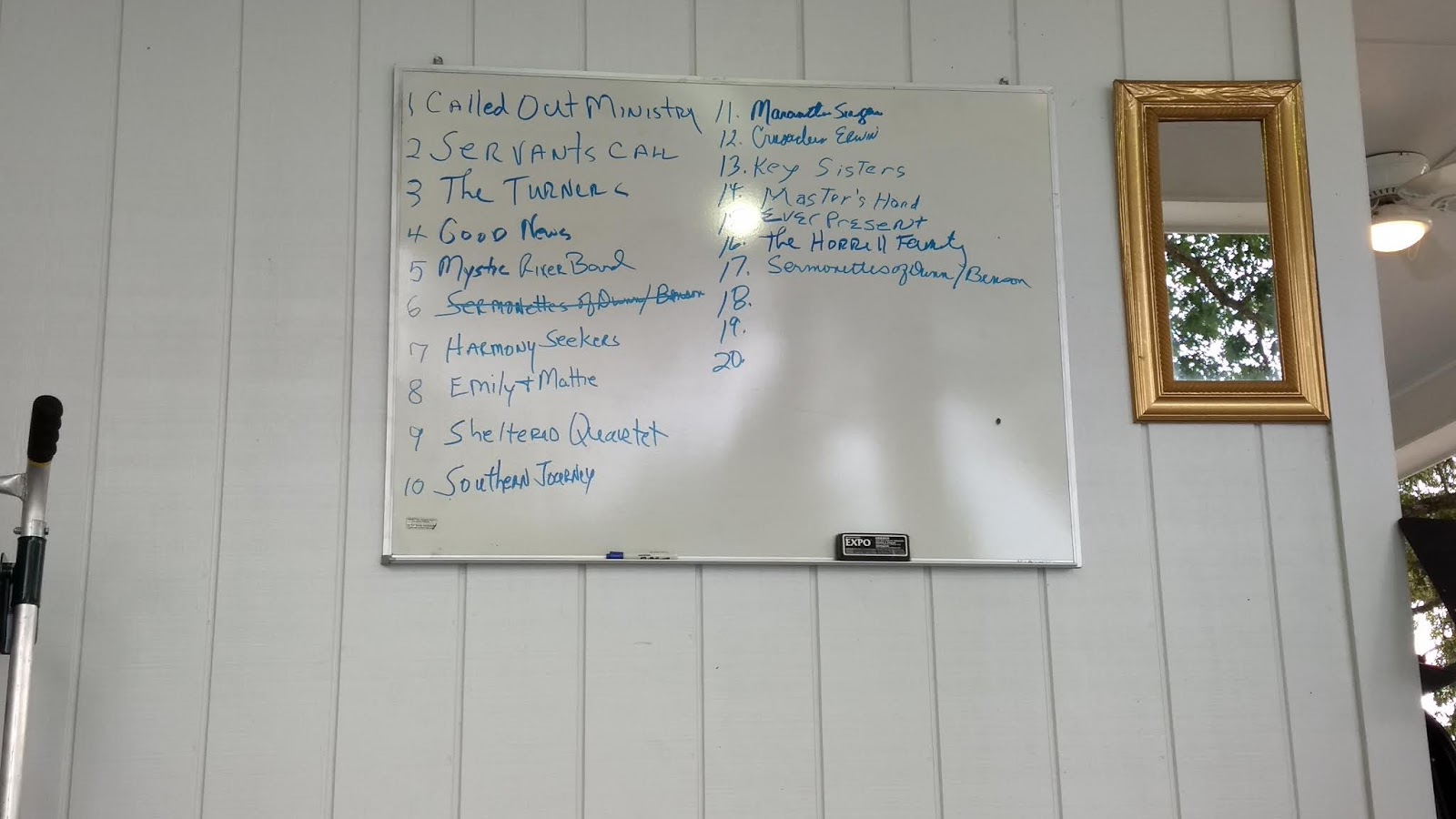
A sign-up board sets the order for an informal "round-robin" session.

On Saturday and Sunday, singers compete in categories for trophies. The highest scoring groups that compete on both days (they must sing a different song each day) are eligible for the overall grand champion and consolidation trophy. The grand champion is typically a quartet from within North Carolina, although trios have also been successful and the past winner was from Florida.

A bluegrass category was added in 2017 to the Benson Sing.

When I arrived on Saturday morning, a session of non-competitive singing, known as “round-robin,” was underway. This time is informal and gives the groups an opportunity to become familiar with the stage and setting before the actual competition begins. As spectators come and go, they casually chat with each other and greet musicians who are not singing.

Being at the 98th annual Sing and listening to the harmony of talented vocalists was a special experience, and the city park of oak trees is the ideal setting to appreciate gospel music. Benson will continue to be a fitting host for this historical musical event.