Showing posts with label music. Show all posts

Saturday, June 23, 2018

Appreciating Gospel Music at the Annual Benson Sing

When I arrived in Benson, NC, I anticipated a great musical experience at the State Annual Singing Convention. Because the event has such a long rich history, the Benson Sing is a premier event to attend each June.

A historical marker in the grove commemorates the initial event held in 1921.

The event, begun in 1921 in a tobacco warehouse, takes place at the Singing Grove in downtown Benson, which includes a 54-acre historic district on the National Register of Historic Places. It’s easy to appreciate live music in such a picturesque setting where the main stage is in the center of the oak-filled town park, and tall, old trees provide abundant shade.

Some spectators set up their own chairs in the grove.

Held on the weekend of the fourth Sunday in June, the Benson Sing is the oldest and largest gospel sing in the United States. One of the oldest annual music shows in the country, it is even four years older than the Grand Ole Opry in Nashville. For the inaugural event 97 years ago, two choirs performed for a crowd of 200 on that day.

Trophies on the center shelf of the stage await the winners as a quartet performs.

The Sing has since expanded to three days, and two local radio stations broadcast live during the competition. The popularity of the convention has waned from its peak in the 1940s and 1950s when 10,000 spectators were common. However, its format is very attractive: the Sing is free for both contestants and spectators. Area businesses underwrite all expenses and sponsor the trophies. 

Although the Sing encourages first-time entrants, several groups are semiprofessionals who sell CDs of their award-winning gospel songs at display tents in the grove.

Trophies are won by participants who compete in several categories, which may change from year to year depending on the number of entrants. The larger the ensemble, the more I appreciated its singing. Because solo acts are not permitted, the smallest group is a duet. Next are trios and quartets. A family group includes five or more members related to each other. A special category is a junior group; its members must be younger than 17. The largest group is an adult church choir.  Each group sings no longer than five minutes, and the winner in each category takes home a trophy.

A church choir is the largest competitive category of the convention.

The opening night, which has no competition, features a “singspiration,” a 30-minute performance by six professional ensembles each. On the second night, a nationally acclaimed ensemble called the host group gives a two-hour concert after an opening act.

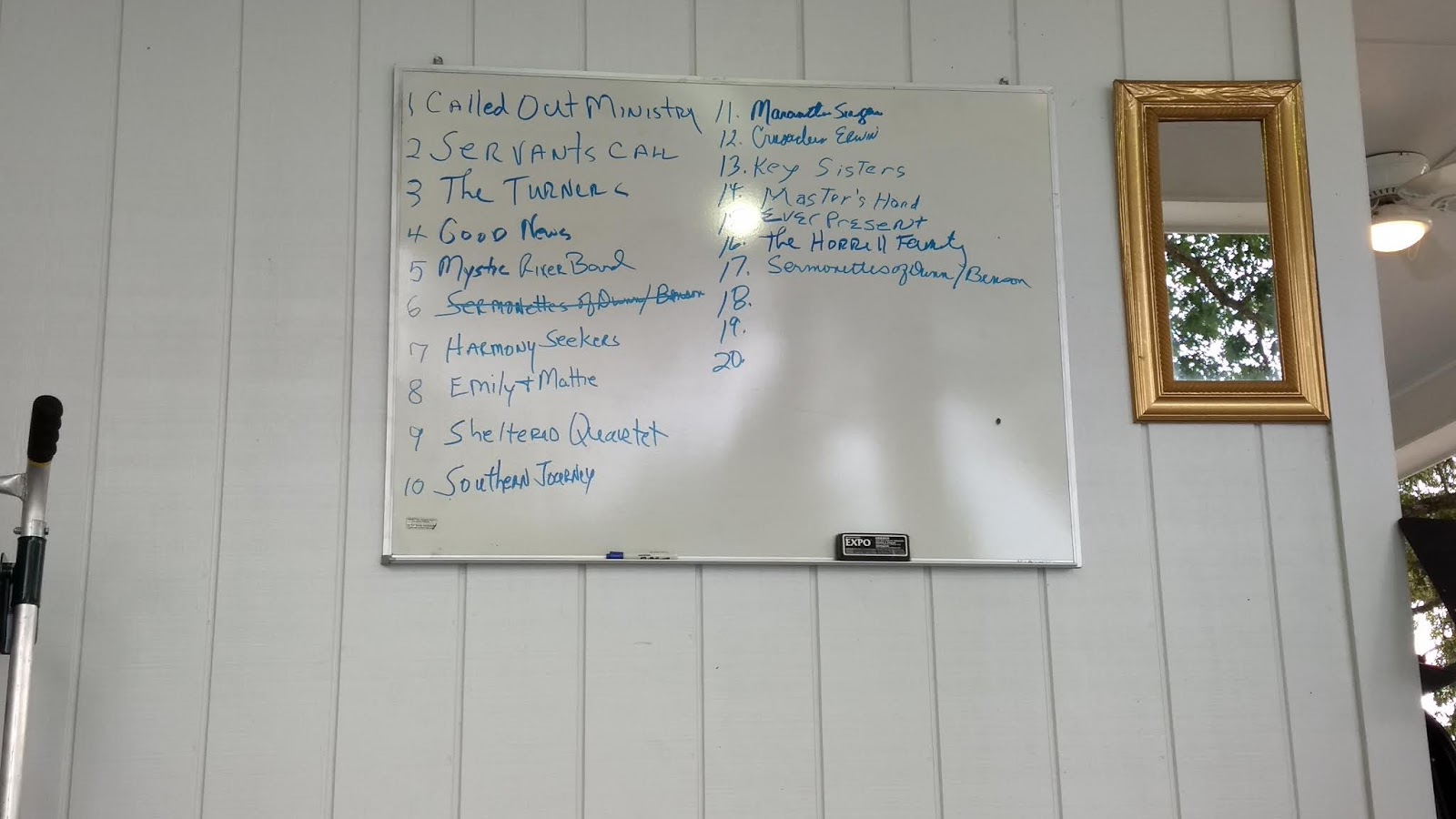
A sign-up board sets the order for an informal "round-robin" session.

On Saturday and Sunday, singers compete in categories for trophies. The highest scoring groups that compete on both days (they must sing a different song each day) are eligible for the overall grand champion and consolidation trophy. The grand champion is typically a quartet from within North Carolina, although trios have also been successful and the past winner was from Florida.

A bluegrass category was added in 2017 to the Benson Sing.

When I arrived on Saturday morning, a session of non-competitive singing, known as “round-robin,” was underway. This time is informal and gives the groups an opportunity to become familiar with the stage and setting before the actual competition begins. As spectators come and go, they casually chat with each other and greet musicians who are not singing.

Being at the 98th annual Sing and listening to the harmony of talented vocalists was a special experience, and the city park of oak trees is the ideal setting to appreciate gospel music. Benson will continue to be a fitting host for this historical musical event.

Sunday, December 24, 2017

Bluegrass on Christmas Eve

Bluegrass musicians play the tunes of carols at Christmas at a Lutheran church established by German immigrants? Where and why does this happen, you ask.

A bluegrass service is held annually on Christmas Eve in Newton, NC.

The church is located in Newton, NC, a well-established city that received its charter in 1855. Almost a century earlier a group of German immigrants, mostly from Pennsylvania and sharing Lutheran and Reformed (now United Church of Christ) faiths, arrived in what was then the wilderness of North Carolina. About 1759 they organized the first church in the colony west of the Catawba River, and the congregation erected their first church, known as the Dutch Meeting House, after obtaining the deed to the property in 1771.

The Historic Church is listed on the National Register of Historic Places.

In 1818, a replacement two-story log weather-boarded church was built with a separate, now repurposed, slave gallery. It is still the oldest existing church in North Carolina west of the Catawba River and is now known as the Historic Church of Old St. Paul’s Evangelical Lutheran Church, whose congregation now regularly meets in a nearby brick building built in 1952.

The award-winning Sigmon family fills the church with the sweet sounds of strings.

The initial congregation met without a pastor until 1776, when John Arndt, a veteran circuit rider, traveled from Lutheran settlements near Salisbury. In 1781, he became a full-time missionary to the region west of the Catawba and preached in the German language, the common speech of local families for several generations.

The language spoken initially at the Historic Church was German.

Much like the shift from German to English, the music of the service also changed and now includes bluegrass, known for having been born in the Appalachian South with roots in Irish, Scottish, and English music. Several times during the year (May, July, October), the congregation conducts bluegrass worship services at the historic church. On Christmas Eve, it has also conducted a bluegrass worship service since 2011.

The second level was a slave gallery before the end of the American Civil War.

The bluegrass services make the Historic Church come alive. The old structure is still as solid as the year when it was constructed. However, now the language spoken inside is English, and the sounds of banjo, fiddle, string bass, guitar, and mandolin accompany the voices of the carolers.

A bluegrass worship service has been held at the Historic Church since 2011.

Monday, June 1, 2015

Shaggin' in Carolina

Shagging is the official popular
dance in North Carolina.
Does shag music evoke beach scenes and coastal memories for you? Although sandy beaches may be several miles away and some old dance pavilions no longer exist, the music is known to transport many fans to a different place and time.

The Baby Boomers of today are the teenagers of yesterday who escaped to beach towns for a weekend, a full week, or the entire summer (if they could get permission). After Baby Boomers matured sufficiently to win political office, they nurtured a bill through the N.C. General Assembly to recognize the importance of shag music in our culture. In 2005 the legislators established shagging as the official popular dance of the state. The rationale for this recognition: shag brings entertainment value to “participants and spectators in the State.”

Not only is shag the official popular dance, but shaggers now enjoy their own personalized license tag that was recently approved when the minimum 300 applications were submitted. The “shag tag” conveys the logo of “I’d Rather Be Shaggin’.” Part of the license fee supports the Hall of Fame Foundation, begun in 1991 by shaggers to help friends in need.

Modern shag dancing gained in popularity along the Carolina coast in the 1940s and early 1950s. According to the General Assembly, shagging “evolved from the jitterbug and jump blues of the big band era.” A better source on its roots, however, is the Fayetteville Area Shag Association, which dates the shag to the 1930s and proclaims that the standard tempo is 110-135 beats per minute. This club describes the shag as smooth and graceful and emphasizes footwork rather than turns.

Harry Driver in the early
1950s at Myrtle Beach, SC
One of the charismatic and best-known dancers in the late 1940s was Harry Driver from Dunn, just minutes from Raleigh and about two hours via U.S. 421 from Carolina Beach, where the term “Carolina shag” was coined. Considered the Father of Shag, Driver was renowned for his moves. In a 1982 interview, he said, “If you were going to the beach in the summer, you had better know how to dance.”

The shag dancers of today recognize the contributions of Driver and his generation in creating a culture they enjoy. Driver, who served as a shag contest judge in the 1980s, said that part of the reason for the dance is that guys wanted a way to impress girls. The classic tune “Best Things Happen While You’re Dancing” explains:
          Even guys with two left feet 
          Come out alright if the chick is sweet. 

The website of the Society of Stranders, a group that perpetuates “the dance, music, and culture that make up the shag,” opens with the Fantastic Shakers singing the song to also let us know:
           The best things happen while you’re dancing. 
           Things that you would not do at home 
           Come nat’rally on the floor. 

According to Driver, the dance wasn’t called the shag until the ‘60s. After the music survived through the ‘60s and ‘70s, it enjoyed a renaissance in the late ‘70s and early ‘80s. Then groups, such as the Society of Stranders formed in 1984, were created as Baby Boomers reached middle age to preserve and expand the music that shaggers love. Also established in 1984 were the Association of Beach and Shag Club DeeJays, formed Chapel Hill, and the Association of Carolina Shag Clubs, formed in Columbia, SC.

As shaggers were brought together by these associations, Baby Boomers organized local clubs as they settled in the Triangle, Sandhills, and other areas distant from the coast, proving that proximity to the beach is not a factor for organizing a club – only an interest in preserving shag music. In fact, North Carolina has more shag clubs that any other state.

In 1984, the same year that regional shag associations were formed, the Fayetteville Area Shag Association was founded as a local club. In central North Carolina, soon other clubs were encouraged to capitalize on the growing interest in shag music and dancing. The Burlington club has been active since 1985. Raleigh shaggers waited until 1993 to form their club. Clubs now cover the state from Boone to Wilmington, with a club in Fuquay-Varina established as late as 2006.

As shag historian Bo Bryan writes in his poem on shag dancing, “If you are a Baby Boomer, / you won’t be alone / in The Land of Shag.” Nurtured by the Association of Carolina Shag Clubs, local clubs bring people together to preserve the shag dance and its music while they enjoy fellowship and develop friendships. The club in Pittsboro says, “It’s not just a dance; it’s a lifestyle.”

A new Guinness Book record
was set with 744 dancers.
With such dedicated organizations promoting shag culture, shaggers are listed in The Guinness Book of World Records, of course. However, it didn’t happen until last year. By dancing in synchronized steps for five minutes, 744 dancers – three times the number needed – established the record for “Largest Carolina Shag Dance.”


Note: This post appeared originally as a longer article in the June 2015 issue of OutreachNC, a monthly magazine distributed in 10 counties of central North Carolina. Click here to see the article as it appeared in print.

Saturday, October 4, 2014

Musical Roots in Nashville

If you want to explore the history of country music and appreciate its contributions to America’s music scene, where would you travel? Nashville, Tenn., is the destination for many because The Grand Ole Opry and the famous venues where it has played such as the Ryman Auditorium have such historic importance.

Ryman Auditorium gave birth to bluegrass in 1945.

A long-running radio program, the Opry has always featured the biggest starts in country music. The stage concert, which began in 1925, was initially a simple broadcast known as a barn dance on radio station WSM. Since then the Opry has built a solid reputation by showcasing country music legends as well as contemporary artists who continue their traditions.

The stage of the Ryman and the Confederate gallery
have historic importance to country music fans.

Ryman Auditorium became the home of the Opry in 1943, although it first opened in 1892. When I drove by it the first time, I thought it looked like a church. In fact, its original purpose was to hold revivals downtown for Rev. Samuel T. Jones, who preached hard against gambling and drinking. Known as the Union Gospel Tabernacle, the building was later renamed for Thomas Ryman, a riverboat captain, who had built it for Rev. Jones. As I stood in the auditorium among the curved pews, I could almost imagine Rev. Jones delivering a fiery sermon to an overflow crowd, many in the balcony built to add seating needed for the reunion of Confederate veterans in 1897.

Arched windows of the Ryman still give the appearance of a church.

The Opry continued to be broadcast from the Ryman until 1974, when The Grand Ole Opry House, a much larger and more modern venue, opened in 1974 in eastern Nashville. When artists perform at the Opry House, they stand in a six-foot oak circle cut from the Ryman’s stage to carry on the traditions in the new location.

Curved pews of the Ryman retain their tabernacle look.

A show consists of several segments, each one with an artist “host” who introduces other performers. For the show that I attended, the hosts were music legends: Connie Smith, Riders in the Sky, Ray Pillow and Jeannie Seely. My main reason for attending the night that I did was to see Kellie Pickler (the new) and Mel Tillis (the old); they with Gretchen Peters, soon to be inducted into the Nashville Songwriters Hall of Fame, were the principal draws for the large crowd of 4,000 plus that night.

Kellie Pickle sings in the oak circle brought from Ryman Auditorium.

Because the Opry is a radio broadcast, the segments are pieced together by the radio announcer who also does the on-air commercials live in front of the audience. Be prepared for several commercial breaks.

The live Opry broadcast is complete with commercials for the audience watching the show.

The mix of artists at the Opry includes bluegrass, folk, and gospel musicians as well as comedic performances and skits. Even the Ryman Auditorium was the scene for lectures by national leaders such as President Teddy Roosevelt and performances by notables such as magician Harry Houdini. 

The Grand Ole Opry House ends the pilgrimage by many country music fans.

The buildings themselves almost seem as important as the Opry, but the magnets to attend a performance are the old-time favorites and the opportunity to see the famous show live. For many in the audience their trip was a pilgrimage to Music City. The growth of country music has significantly shaped Nashville and far beyond this city founded in 1779.

Thursday, October 2, 2014

Scottish Heritage Preserved in Games, Music, Food, and Religion

Cultural history of the American South can be learned by attending events that preserve traditions of previous generations, particularly when the activities emphasize music, skill contests, food, religion, and other aspects of society and family. An excellent example occurs in Scotland County, N.C., during the first weekend of each October.

The Highland Games of Scotland County, held on the grounds of the John Blue Home and Historical Complex in Laurinburg, celebrate the rich Scottish heritage of the Upper Cape Fear and Pee Dee regions of the Carolinas. Even though events extend over three days, the primary day is Saturday (the second day), when the field opens to the general public at 8 a.m. The opening ceremonies feature pipe bands and a parade of tartans. The morning activities typically include Scottish athletic events, sheep dog demonstrations, piping and drumming competitions, and other entertainment. In the afternoon, more music and athletic competitions are held, including children games. The games continue a tradition of Scottish games in the area (that began in 1976 with the Flora MacDonald Highland Games, which had been held annually in nearby Red Springs but were discontinued in 2007).

Athletic Competitions
The athletic events seem particularly archaic when compared to today’s popular sports, such as football that emphasizes throw, punt, and run skills or basketball with a focus on dribble, pass, and shoot proficiency. However, the Scottish contests demonstrate skills needed in arduous conditions for taming both native and foreign lands. For example, one event – turning of the caber – involves throwing a caber (a tree that can range from 17 to 21 feet and weigh up to 160 pounds) so that it turns end over end with the large end striking the ground before the small end follows through and then strikes the ground. The champion wins by landing a caber in a perfect 12 o’clock position (on an imaginary clock). In contrast, competitors in other events are judged by the height or distance that they can throw a cumbersome object. The highest toss wins for these two events:

  • Sheaf toss. A sheaf (bundle of twine wrapped in a burlap bag), which weighs up to 16 pounds, is tossed with a pitchfork over a horizontal bar.
  • Weight over bar. Using only one hand, competitors toss a weight (up to 56 pounds) with an attached handle over a horizontal bar.
The longest throw wins for other events.
  • Open stone. A stone weighing up to 22 pounds for men (12 pounds for women) is thrown (or “put”) from the shoulder with only one hand.
  • Heavy weight toss. A competitor throws an implement weighing up to 56 pounds with one hand.
  • Light weight toss. Similar to the heavy weight toss, this event also uses an implement but a lighter one (28 pounds for men and 14 pounds for women).
  • Scottish hammer throw. A hammer (with a shaft of 50 inches or less), weighing up to 22 pounds, is thrown over the shoulders using both hands.
Can children participate? At the games in Scotland County, children from 4 to 16 can compete in several basic activities, including Scottish competitions, such as the stone throw; caber toss; clachneart, an event resembling the shot put; and hammer throw. In addition, running events (not exceeding one-fourth of a mile) and a tug of war offer other competitive contests for young participants.

Music
Music seems to be playing continually during the Highland Games of Scotland County. Although a central entertainment stage has continual performances and demonstrations of music and dance, the main music attraction is the piping and drumming competitions. Because the sweet and melodious tunes of the bagpipe have been heard in the Carolinas since the 1730s when the first Highland Scots arrived in the region, the music competition for pipes and drums bands is intense.
The music competition honors the Argyll Colony that arrived in 1739 in the Upper Cape Fear region and was the first group of a large emigration of Highland Scots that continued for about 100 years. As they arrived, music was an indispensable component of social life and prominent in several historical settings. For example, pipers during the American Revolutionary War were known for creating a ruse to confuse Patriot forces as to the location of Loyalist forces. Because suspicions arose about the “alien British” community in the region during the War of 1812 and they were pressured to assimilate into American ways, piping became less prominent.

As a result, piping was replaced by fiddling in providing music for dance, even though the local conservative Presbyterian clergy typically viewed music and dance as irreconcilable with spiritual life. Recovering slowly from this decline, pipe bands began to appear in the Carolinas by the mid-20th century. An early example is the Blue Ribbon Caledonian Pipe Band, established around 1947 in the N.C. Triad area, that played for the inauguration of Governor Scott in 1947. A few years later in 1955, The Citadel in Charleston began a pipe band that is still part of the cadet music program.

However, even with these early encouraging examples, piping and pipe bands were not part of this region of traditional Highland settlements until recently. Typical competitors at the Highland Games include the oldest continually organized pipe band in North Carolina. Wearing the Carolina tartan (the state tartan of North Carolina), the band, organized in 1968 by graduate students, is from N.C. State University. Formed in 1991 (earlier than most other bands) is the pipe band from St. Andrews Presbyterian College, which regularly competes throughout the U.S. South. Other bands in the Carolinas, formed mostly after the mid-1990s, from Raleigh, Columbia, Huntersville, and Jamestown also vie for music awards.

Food
Food is another way to connect culturally to previous generations. During the Highland Games, many Scottish foods are available. For example, Scottish meat pies, sausage rolls, haggis puffs, and Forfar bridies (a meat pastry) made by Cameron’s of Kearny from Sumter, SC, were tempting. Drinks included Irn-Bru (a popular Scottish carbonated beverage) and ginger beer. (The meat pie was an excellent mid-afternoon snack.)

Scott’s Keltic Kitchen & Bakery of Murrells Inlet, SC, delighted spectators with Scottish desserts. Scottish meat pieI was particularly impressed with the clootie dumpling with devon custard that I had never tasted before. The bakery was also offering scones with strawberries and cream (very popular) as well as sticky toffee pudding, cream meringue, and chocolate bread pudding (with chocolate sauce).

Family Bonds and Other Heritage Connections
Although the food selections are popular, the vendors detain the attendees only briefly from the main gathering area of the clans. The primary game field is encircled by more than 40 clan tents where families, societies, and other groups mix and mingle. On display are histories, migration patterns, insignia, and tartans (the symbol of the family association or home district). Each clan, a gathering of families for economic and political protection as well as social support (who are not necessarily related by blood), in Scotland had its own tartan.

Several vendors from throughout the Carolinas set up tents for the Highland Games to display and sell Scottish merchandise – metalworks, fine arts, clothing and fabrics, utensils, and souvenirs. The booths were quite popular and attracted serious as well as casual shoppers.

Religion
Although some competitors and vendors seem to request divine intervention throughout the weekend, the primary religious event occurs on Sunday morning when worshipers at the nearby Old Laurel Hill Presbyterian Church (founded in 1797 by Highlanders) conduct a “kirkin’ of the tartans” service. According to Scottish legend, the ceremony can be traced to the Parliamentary Act of 1846 in England. The act banned the kilt, plaid, or other tartan garment to destroy Highland clan identity. In defiance of the British Crown, the Scots ignored the ban when they went to church and carried remnants of their tartans in their pockets, and the minister added a blessing into the service for the clans represented by the tartans. The first kirkin’ was held in Washington, D.C, in 1947 by the Saint Andrew’s Society (whose members are all Scottish descendents). A growing number of Presbyterian churches in the Southeast celebrate this service annually to recognize the transfer of faith to America by clans whose families arrived almost 300 years ago.

The Highland Games of Scotland County are an excellent way to learn more about the cultural history of the American South and traditions of previous generations. The skill contests — athletic as well as music — celebrate a heritage shared by many families. Because many Southerners live near venues that host Highland games (such as Grandfather Mountain, NC; Stone Mountain Park, GA, The Plains, VA; Tallahassee, FL; Greenville, SC; Maryville, TN; and San Antonio, TX), these games will continue to increase in popularity. Attend one soon and observe the past in the present.

Friday, July 25, 2014

Bluegrass Music in the Mountains

Want to hear authentic bluegrass music performed by an internationally known artist? Then travel the Music Trails of the Blue Ridge National Heritage Area that take you to the opry house in Maggie Valley, NC. This performance venue is in Haywood County, where the banjo has played in unison with the fiddle for generations since the Scots-Irish began to settle the eastern slopes of the Blue Ridge Mountains to make “mountain music.”

The banjo skills of Raymond Fairchild draw guests each night to the Maggie Valley Opry House.

When I visited, I enjoyed music by Raymond Fairchild and the Maggie Valley Boys that connected me to the traditional folklife of the mountains. Fairchild played his five-string banjo as if he were performing again at the Grand Ole Opry in Nashville rather than the opry (“opera” in Southern dialect that sometimes pronounces a final “a” as a “y”) in Maggie Valley. Born in 1939, Fairchild has yet to slow down. He performs with his band nightly April through October (the months that the opry house is open).

With 300 seats, the opry house has plenty of room for guests. Banjos on sale and memorabilia on the wall greets visitors as they arrive.

Fairchild has received many awards and honors, including two gold records. Most significant is the Bluegrass Banjo of the Year Award five times from the Society for the Preservation of Bluegrass Music in America, which has also inducted him into its Hall of Greats.
     
 
Fairchild’s gold records and other awards are on display next to the stage.

Fairchild is often touted as the fastest five-string banjo player. When he plays an instrumental solo as part of a number with his band, his legendary dexterity is amazing. As Fairchild performs, the expression on his face is very solemn – almost a poker-face with no expression. A gifted musician for decades, he learned to play the guitar when he was 11, although he didn’t pick up a banjo until he was 18.

Fairchild performs nightly at the opry house with the Maggie Valley Boys.

Fairchild, who is proud of his Cherokee heritage, graciously shares the stage with the other musicians. Their rhythm guitar, bass, and harmonica combine in harmony with his guitar to produce music that makes you want to dance. In fact, during the performance, several visitors in the audience when to the elevated dance area and clogged to the tune being played. Fairchild also features his manager John Lucas as a vocalist in several selections. Lucas’ rendition of “Amazing Grace” in the Cherokee language is incredibly beautiful.

Singing “Amazing Grace” in the Cherokee language, John Lucas demonstrates his talented, rich voice as he is accompanied by Fairchild and the Maggie Valley Boys.
Although the evening was enjoyable, I would have enjoyed more music to demonstrate Fairchild’s elaborate, fast picking and skills to make the banjo mimic animal sounds such as those by mules in his performance of “Whoa Mule” (illustrated in this video recorded earlier in his career).

During intermission, band members “jam” with visitors.
The opry house has been operating continuously since 1988, even during earlier years when Fairchild was on the road for other performances. Although the music by Fairchild and the Maggie Valley Boys are the reason guests continue to attend the nightly shows, Fairchild gives credit during performances to his wife Shirley for the success of the opry house. In addition to managing the opry house and selling tickets before the performance, she multitasks during intermission by selling popcorn and soft drinks at the concession stand.

Fairchild (with display of moonshiner Popcorn Sutton in background) sells music and souvenirs during intermission as wife Shirley operates concession stand.

Maggie Valley is famous for several notable people, including Popcorn Sutton (legendary moonshiner), but Raymond Fairchild is clearly the hometown favorite and a beloved member of the community.

Maggie Valley proudly proclaims itself as the home of Raymond Fairchild.

Saturday, July 6, 2013

Bluegrass Jam: In Memory of Past Tunes and Passed Musicians

The cars and trucks parked outside an old, tattered wood-frame store that appears abandoned are the first hints that a bluegrass jam is about to begin. The sign by the side of the road with an adjacent post holding the oval frame for a missing Esso sign confirms the date. Stopping for an hour or more to connect to the spirit of tunes and musicians still revered can rejuvenate the soul.

The sign by the road tells the
date of the next bluegrass jam.
The oval frame for a missing sign
confirms that life is a-changing.

The jam sessions are held twice a month in a shady area behind the store, which has been a music scene in Chatham County since 1999. The musicians seem more interested in enjoying their own company and collaboration than in entertaining guests in front of their stage. These musicians meet in memory of Reno C. Sharpe who passed in 2009, and they perpetuate the values and memories of an era being smothered by the hustle and bustle of impersonal modern life where a person is more likely to send a text message than speak to a neighbor.

A short path from the store leads to
the area where the jam is held
My wife and I arrived only a few minutes after the session had started. The musicians outnumbered the audience. Nine musicians were on stage with only five people in the audience. She quickly observed that she was initially the only woman present, but soon other women arrived as well as young girls with older men who appeared to be their grandfathers. About an hour in the session, a female guitarist joined the musicians who warmly received her and then were delighted when she picked “Tennessee Waltz,” popular since the 1940s, for them to play when it was her turn to select a song. “It’s in C, y’all,” she coached the others for the right key before starting the tune. She also sang alone except for brief sections when a few of the men joined in. In other songs, her female voice combined eloquently with the lower male voices to create a beautiful harmony.

Photos are taken frequently, even by
young members of the audience.
Almost everyone had parked in the driveway in front of the store except three cars that had parked next to the bandstand. One musician, who seemed to be the oldest in the group, arrived late and left early, and he was one of the drivers who unquestionably had next-to-stage parking. The elevated stand, covered by a rusting sheet metal roof, even has a handicapped-accessible ramp for aging musicians who need a little help as he did and can no longer climb steps easily. The chatter among the musicians after a tune had ended indicated that the sheltered stage had been built in 2010.

The Eagle Scout project
improves the area where
the jam is held.
Twelve benches, all named in honor or memory of community members, enclose the stage in semi-circle patterns in an unmowed grassy area underneath huge, leafy trees that provide welcoming shade in summer months. A marker indicates that the benches were part of an Eagle Scout project by Jason Buchanan of Troop 900 in spring 2012. When I was there on a July morning, the audience changed seats and moved among the twelve benches — to stay out of the direct sunrays — as the temperature began to rise. A musician even commented, “It’s hot – just saw a dog chase a cat, and both were walking.”

The house rules specify that only acoustic instruments can be played. After an hour into the jam session, the group peaked with 14 musicians and instruments – nine guitars, one fiddle, two mandolins, one banjo, and one bass guitar. A bass fiddle also leaned against the rear wall behind the musicians, but no one ever played it. By the time the session ended, the number of musicians had dropped to 11.

The music was harmonious, even when nearby cows joined in with their own vocal parts. “I think the cows liked that one,” one guitar player said as a song ended to acknowledge the accompaniment of the bellowing bovines. When the next song ended, another musician remarked, “The cows want more.” Then as the group played and sang “Take These Chains from My Heart,” the last of Hank Williams’ number-one hits, the cows were quiet, perhaps in respect to the memories that the song and the musicians were evoking.

Jam members play by the rules.
As informal as the jam session is, it has etiquette rules and adheres to other expectations of a bluegrass jam. A newcomer in the audience observes how politely one musician is offered to “take the lead.” Before “Why Don’t You Tell Me So?” by Lester Flatt and Earl Scruggs can begin, the lead announces, “G chord.” Sometimes a musician asks, “Which way are you going?” Another time a musician is reminded that it’s his turn: “That’s yours, Mac.” At one point, “Whose turn is it next?” is answered with “It’s Paul’s turn, ain’t it?” When the lead singer for a song appears to forget some lyrics, a group member says encouragingly, “Just make one up.” When another song ends, “Y’all make me feel so good,” is heard from the stage. An occasional “Good job” is also heard before the next tune begins.

The audience moves occasionally
to find seats in the shade.
The next song was “Crying My Heart Over You,” a hit written in 1982 by Lester Flatt, Earl Scruggs, Carl Butler, and Earl Sherry. The group moved seamlessly between songs with lyrics and others played as only instrumental tunes. As the sun continued to rise, the chords of “Down Yonder” rang out. The sweet blend of instrumental sounds makes it seem like the musicians play together much more frequently than twice a month — jam sessions at the Reno Sharpe Store are held on only the first and third Saturdays of each month, beginning at 10 a.m. In addition, a special annual celebration is held each August. (A video of a bluegrass jam inside the store with Mr. Sharpe — in the background by the window — uploaded in 2009 also helps to preserve these memories.)

The store maintains its ambiance
even though it is officially closed.
The store, built in the 1880s, was moved in 1920 to its current location. Reno C. Sharpe owned and operated the store with his brother after taking control from their grandfather in the 1940s, but it officially closed in 2003, only six years before Sharpe died. However, its history is another story – best told by the family themselves.

My morning was well spent — a time to observe a close-knit community come together and share cherished memories with their music. My only discomfort was the apparent rule that no song could end with applause from the audience. The musicians clearly deserved that usual tribute of appreciation, but perhaps at this place just showing up is all the appreciation that they need.

After the jam, the community continues to preserve memories by adopting a highway.