Friday, July 17, 2015

Where Food Is More Than Only Something to Eat

[Note: This post, prepared originally for the NC Folklife Institute's NCFood blog, is hosted on the institute’s website, with excerpts and a link to the website posted here.]

Food is more than simply sustenance. Kitchens are more than places to prepare and eat meals. No place is better for demonstrating the value in society of food and kitchens than The King’s Kitchen in Charlotte, NC. As its customers enjoy the menu of the day, the unemployed, underemployed, difficult to employ, and recently released prison inmates learn culinary and food service skills.

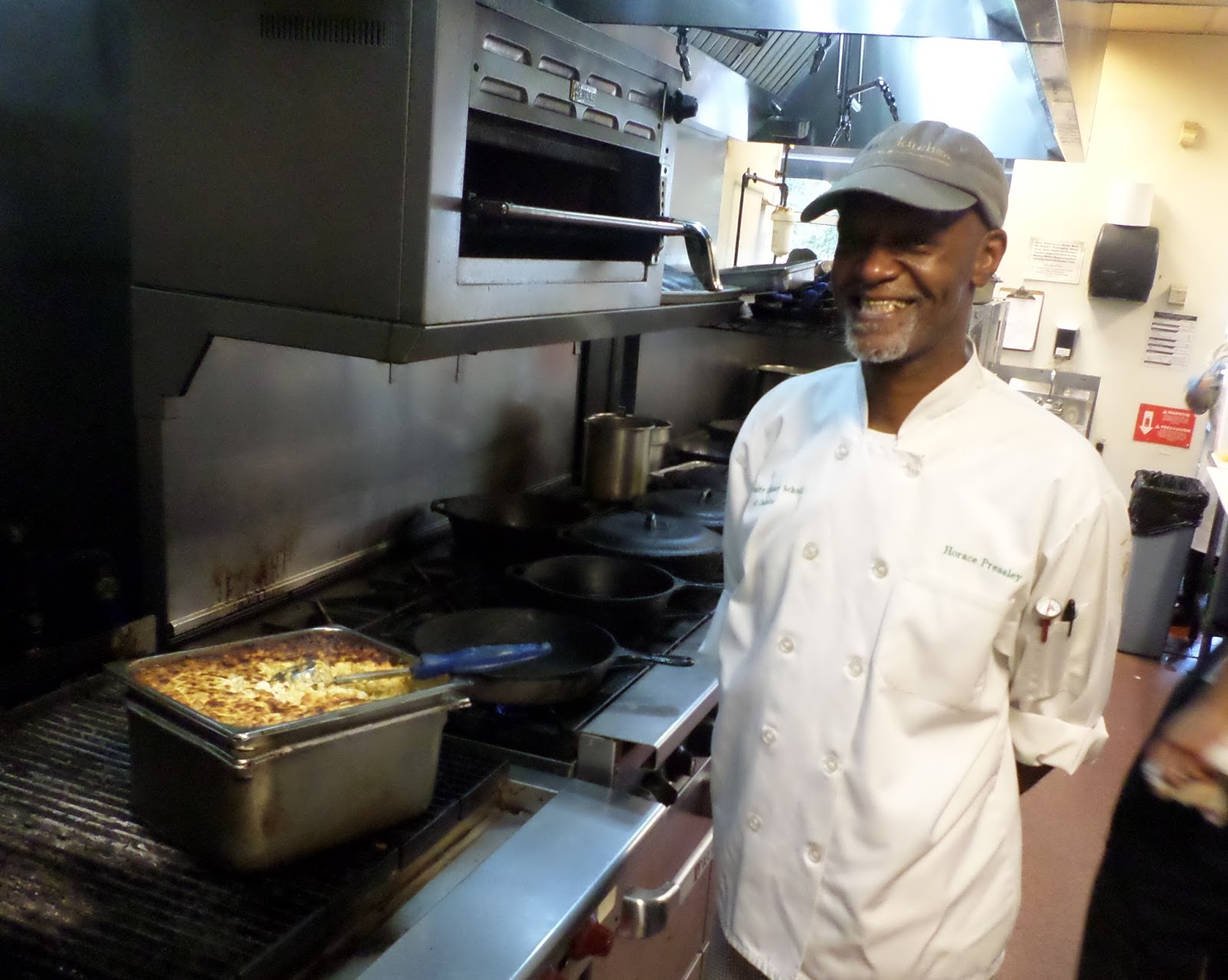
Chef-in-training Horace Pressley spreads
a big smile when someone raves about
his mac and cheese.
Customers enter because the food is excellent and the service is top-notch. The Southern meat and three sides (with bread) seems the most popular order. The entrees of braised pot roast, fried or baked chicken, fried catfish, and grilled meatloaf rival any superior Southern restaurant. Customers may also be satisfied because the restaurant has a huge heart and social conscience. When I ate recently at The King’s Kitchen, the food was so good and the service so professional, I couldn’t image that the staff could include someone once homeless, a former drug addict, or convicted felon.

Wednesday, July 1, 2015

Adding Bounce to Your Life

Would you invite Amos Owens into your home or ask him to attend your next party?

Perhaps the most famous moonshiner in North Carolina during his lifetime, Owens slipped into obscurity before many of us were born. In his heyday, however, he was often sought for his special concoction known as Cherry Bounce.

Amos Owens
His legendary recipe was three parts corn whiskey, one part cherry juice, and one part sugar. Although his corn whiskey was special, even more precious was the juice because it was pressed from the fruit by the bare feet of his beautiful daughters.

People from all over the South traveled to visit him and taste his celebrated beverage, which was renowned as far away as the Mississippi River. Old-timers even claimed that it had medicinal value. 

Rutherford County in western N.C. celebrates this legacy with the Cherry Bounce Trail to promote sightseeing in the area. As visitors enjoy the beauty of the county’s landscape and rural history, they can reminisce about “the memories of old-time moonshiners who frequented these hills and valleys years ago.” The trail passes by Cherry Mountain, a high peak on the horizon, where cherry trees still grow wild -- and once offered a safe haven to Owens and his moonshining neighbors for distilling liquor.

Owens, who was born in 1822, brought 100 acres near Cherry Mountain in 1845 and by 1851 had earned enough money from moonshining to buy the entire mountain itself. Here, according to a local schoolteacher who recorded Owens’ life history at his request before he died in 1906, cherry trees yield “every June a crop of fruit remarkable for its size and flavor.”

Every second Sunday in June, Owens invited friends to celebrate the black-heart cherries when they were the ripest. His festival was known for its food, dancing, and physical contests. His granddaughter observed that “people danced and drank for as long as the food and drink and money lasted. Some would get so drunk and carried away that they danced in the nude.”

Although the trees on Cherry Mountain are “found nowhere else,” versions of Cherry Bounce existed well before Owens’ lifetime. A popular drink in the 1700s, it was even made at Mount Vernon for George Washington (although without Owens’ illicit moonshine).

Owens’ arrests are still legendary. Once when revenue agents discovered his operation, he invited them into his home for breakfast. Although they declined food, they did accept his kind offer to sample his Cherry Bounce. After several drinks, one officer passed out, and another staggered into the woods and did not return for hours. Owens made no attempt to escape, and the officers arrested him when they regained their sobriety. After serving six months in jail, Owens returned to his home (known as “The Castle”) and renewed his operations.

Cherry Bounce served by Gary
Crunkleton at State of the Place conference
For most of his life, Owens was the Cherry Bounce King. Although he was also once locked up for an entire year, he continued to make moonshine until 1890 when he was arrested again. During this trial, a judge convinced him to stop violating “the law.” He returned home, became a devout member of his church, and never again fired up his still.

Fortunately today, Cherry Bounce enjoys new life in the hands of skilled mixologists, such as Gary Crunkleton, who operates his private eponymous club in Chapel Hill. When I attended the “State of the Plate” conference, which explored local and global connections of Southern foodways, Crunkleton was a speaker and provided samples of Cherry Bounce inspired by Owens’ recipe. Attending a conference never provided such a rewarding benefit.

Celebrate cherries from the N.C. mountains – whether you enjoy the fruit or drink – and think about the man who enhanced the lore of this state.


Note: This post appeared originally in the June 2015 issue of OutreachNC, a monthly magazine distributed in 10 counties of central North Carolina. Click here to see the article as it appeared in print.

Friday, June 12, 2015

Keeping Wild Foods in Our Culinary Culture

[Note: This post, prepared originally for the NC Folklife Institute's NCFood blog, is hosted on the institute’s website, with excerpts and a link to the website posted here.]

Is cooking with wild foods out of place in today’s modern society? Because it’s so old-fashioned, I was surprised by how many kids had entered the Wild Food Cooking Contest in RichmondCounty.  It’s the event of the spring in Ellerbe, NC, when youth and adults show off their skills for cooking deer, moose, rabbit, beaver, squirrel, and other wild game. After the judges have scored each entry, everything is served buffet-style as a tasting party for the participants, their families and friends, and others like myself who attend to see how wild our food once was and still can be.

Rabbit pot pie was one of the many
tasty entries in the Richmond County
Wi
Dishes prepared by kids age 16 and younger were the most interesting. They included teriyaki rabbit, beaver pot roast, rabbit pot pie, duck and dumplings, Eastern wild bear and wild hog sausage, and catfish stew. When I had the opportunity to sample them, each was so good that I could have made a complete meal of it.

My first surprise was not so much that young people had prepared tasty food; it was that the game, fowl, or fish could not have been purchased. It had to be hunted, trapped, or caught legally or received as a gift. The actual step of cooking is only the final stage in the process and only the visible one at the contest.

Monday, June 1, 2015

Shaggin' in Carolina

Shagging is the official popular
dance in North Carolina.
Does shag music evoke beach scenes and coastal memories for you? Although sandy beaches may be several miles away and some old dance pavilions no longer exist, the music is known to transport many fans to a different place and time.

The Baby Boomers of today are the teenagers of yesterday who escaped to beach towns for a weekend, a full week, or the entire summer (if they could get permission). After Baby Boomers matured sufficiently to win political office, they nurtured a bill through the N.C. General Assembly to recognize the importance of shag music in our culture. In 2005 the legislators established shagging as the official popular dance of the state. The rationale for this recognition: shag brings entertainment value to “participants and spectators in the State.”

Not only is shag the official popular dance, but shaggers now enjoy their own personalized license tag that was recently approved when the minimum 300 applications were submitted. The “shag tag” conveys the logo of “I’d Rather Be Shaggin’.” Part of the license fee supports the Hall of Fame Foundation, begun in 1991 by shaggers to help friends in need.

Modern shag dancing gained in popularity along the Carolina coast in the 1940s and early 1950s. According to the General Assembly, shagging “evolved from the jitterbug and jump blues of the big band era.” A better source on its roots, however, is the Fayetteville Area Shag Association, which dates the shag to the 1930s and proclaims that the standard tempo is 110-135 beats per minute. This club describes the shag as smooth and graceful and emphasizes footwork rather than turns.

Harry Driver in the early
1950s at Myrtle Beach, SC
One of the charismatic and best-known dancers in the late 1940s was Harry Driver from Dunn, just minutes from Raleigh and about two hours via U.S. 421 from Carolina Beach, where the term “Carolina shag” was coined. Considered the Father of Shag, Driver was renowned for his moves. In a 1982 interview, he said, “If you were going to the beach in the summer, you had better know how to dance.”

The shag dancers of today recognize the contributions of Driver and his generation in creating a culture they enjoy. Driver, who served as a shag contest judge in the 1980s, said that part of the reason for the dance is that guys wanted a way to impress girls. The classic tune “Best Things Happen While You’re Dancing” explains:
          Even guys with two left feet 
          Come out alright if the chick is sweet. 

The website of the Society of Stranders, a group that perpetuates “the dance, music, and culture that make up the shag,” opens with the Fantastic Shakers singing the song to also let us know:
           The best things happen while you’re dancing. 
           Things that you would not do at home 
           Come nat’rally on the floor. 

According to Driver, the dance wasn’t called the shag until the ‘60s. After the music survived through the ‘60s and ‘70s, it enjoyed a renaissance in the late ‘70s and early ‘80s. Then groups, such as the Society of Stranders formed in 1984, were created as Baby Boomers reached middle age to preserve and expand the music that shaggers love. Also established in 1984 were the Association of Beach and Shag Club DeeJays, formed Chapel Hill, and the Association of Carolina Shag Clubs, formed in Columbia, SC.

As shaggers were brought together by these associations, Baby Boomers organized local clubs as they settled in the Triangle, Sandhills, and other areas distant from the coast, proving that proximity to the beach is not a factor for organizing a club – only an interest in preserving shag music. In fact, North Carolina has more shag clubs that any other state.

In 1984, the same year that regional shag associations were formed, the Fayetteville Area Shag Association was founded as a local club. In central North Carolina, soon other clubs were encouraged to capitalize on the growing interest in shag music and dancing. The Burlington club has been active since 1985. Raleigh shaggers waited until 1993 to form their club. Clubs now cover the state from Boone to Wilmington, with a club in Fuquay-Varina established as late as 2006.

As shag historian Bo Bryan writes in his poem on shag dancing, “If you are a Baby Boomer, / you won’t be alone / in The Land of Shag.” Nurtured by the Association of Carolina Shag Clubs, local clubs bring people together to preserve the shag dance and its music while they enjoy fellowship and develop friendships. The club in Pittsboro says, “It’s not just a dance; it’s a lifestyle.”

A new Guinness Book record
was set with 744 dancers.
With such dedicated organizations promoting shag culture, shaggers are listed in The Guinness Book of World Records, of course. However, it didn’t happen until last year. By dancing in synchronized steps for five minutes, 744 dancers – three times the number needed – established the record for “Largest Carolina Shag Dance.”


Note: This post appeared originally as a longer article in the June 2015 issue of OutreachNC, a monthly magazine distributed in 10 counties of central North Carolina. Click here to see the article as it appeared in print.
Friday, April 24, 2015

Pruning Peach Orchards: A Lifetime Skill and Dedication

[Note: This post, prepared originally for the NC Folklife Institute's NCFood blog, is hosted on the institute’s website, with excerpts and a link to the website posted here.]

Nothing says spring like the arrival of flower blossoms, particularly in the Sandhills and eastern North Carolina with blooms on acres and acres of peach trees.

Trees in the Sandhills awaken at
springtime and stand ready for their
early pruning.
Many in North Carolina believe that our state’s peaches are the best (they’re right) and that peaches are native to the South (they’re wrong). Cultivated in China for more than 3,000 years, peaches arrived in the Americas in 1571 when Spanish missionaries introduced them along the Atlantic coast in an area known now as St. Simons Island, Georgia. More than 50 years later, George Minifie of England brought the first peach trees to the British colonies in North America and cultivated them at his estate near Jamestown, Virginia.

Peaches thrive in the rain, heat, and soil conditions of our state and other southern states. They are a vital fruit crop in the agricultural economy of several N.C. counties. However, as much as Mother Nature nurtures, a peach orchard is not self-sufficient. It requires constant monitoring and care, particularly pruning.

Wednesday, April 1, 2015

Taking a Historic Walk

John Lawson explores the
Carolina wilderness.
Interested in taking a good long walk? Sure. Want to trace the path of an English explorer taken through the Carolinas in the early 1700s? It all depends, right? What’s the temperature? How much rain and how many snakes? What and when do we get to eat?
  
Most of us remember history lessons about Lewis and Clark whose expedition in the early 1800s explored and mapped territory from Missouri westward to the Pacific Ocean. Along the way, a major part of their task was to study and sketch plants, animals and geography.

Lawson's journey began in Charleston, SC, in 1700.
Equally important in this area was a similarly significant journey, more than 100 years even before Lewis and Clark took their first steps. This one began in 1700, only a few years after the Carolina Colony had been chartered by King Charles II of England. Little was known about the territory that now comprises both North and South Carolina and Georgia of today.

Enter John Lawson, who was commissioned by colonial authorities to learn more about the interior of the colony. Although the coastal areas were being explored in depth, the Europeans knew little about the region farther inland.

Describing animals, plants and natives
was the mission of Lawson and his party.
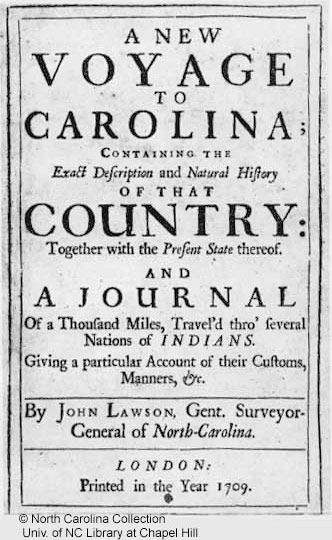
With several companions and native guides, Lawson tromped through the Carolina wilderness nearly 600 miles over several weeks to describe animals, plants, crops and natives. He dutifully recorded detailed descriptions in his journal and later returned to London in 1709 to publish “A New Voyage to Carolina.” The book attracted many new immigrant settlers to the colony because it was also translated into German and French.

Perhaps Lawson is the first person we can credit with recording the enjoyable outdoor life of North Carolina. The climate is “healthful,” and the “Land is very fruitful,” he writes. Because the soil is rich, the inhabitants “live an easy and pleasant Life.” Lawson also describes more than 70 varieties of seafood in the Carolina waters and pronounces catfish as being “very plentiful.” He identifies more than 25 “beasts” that can be hunted, proclaims that bear meat is “very good” and enjoys a “curious ragoo” made with venison and possum.

Lawson's book, published in 1709,
attracted many in immigrants.
Proving that history needs to be lived and outdoor life enjoyed, a modern-day explorer is undertaking Lawson’s journey. Scott Huler, an award-winning author who lives in Raleigh, has begun a modern walking exploration through the Carolinas to retrace Lawson’s footsteps.

Unlike Lawson, Huler is not waiting nine years to publish his account. To share his observations, he is documenting his journey online. His blog The Lawson Trek is updated with posts, images, sound, and video. On Twitter (@LawsonTrek), Huler is also tweeting images and thoughts – routine and unusual – about his adventures and has observed that he often is “walking along a sand road that has probably been trodden by human feet for a thousand years or more.”

Check out Huler’s posts and images, and follow him as he shares a historical perspective of the Carolina outdoor life.


Note: This post appeared originally in the April 2015 issue of OutreachNC, a monthly magazine distributed in 10 counties of central North Carolina. Click here to see the article as it appeared in print.

Monday, March 30, 2015

Making Mac and Cheese Better with N.C. Mountain Cheese

[Note: This post, prepared originally for the NC Folklife Institute's NCFood blog, is hosted on the institute’s website, with excerpts and a link to the website posted here.] 

How much more would Thomas
Jefferson enjoyed baked macaroni
if he had used cheese from Ashe
County?
What’s the most important ingredient in macaroni and cheese? Except for the love that the preparer personally adds, is one item more important than anything else?

The questions may seem frivolous because today the recipe at home can be quite simple – unless you’re Thomas Jefferson, who was so consumed with serving the perfect macaroni that he bought a pasta-making machine in Europe. For his baked macaroni dish, he also imported cheese from France. Too bad that he probably didn’t know how good cheese from the mountains of North Carolina could be.

Continue reading at the NCFood blog ...