Showing posts with label wilderness. Show all posts

Monday, August 1, 2016

Uwharrie National Forest

Want to pan for gold? Panning seems like such an archaic, futile exercise. But at one time the Uwharrie Mountains were a destination for gold hunters.

Do adventure seekers there today still search for gold while they are enjoying other outdoor activities? “Yes, they do, but I don’t know how successful they are,” says Terry Savery, recreation program manager at Uwharrie National Forest, land initially purchased in 1931 by the Federal Government to protect and preserve mixed woodlands of oak and pine.

Searching for gold in N.C. led to
America's first gold rush.
Gold was first found in North Carolina in 1799 only about 30 miles west of the forest. Word that gold was in “them thar hills” spread like wildfire and led to America’s first gold rush, mostly forgotten in the books of history and overshadowed by the great California gold rush of 1849. However, the chance to strike it rich in the Uwharrie Mountains brought countless prospectors and miners who searched the hills and panned the streams for the sparkling metal.

The priceless search for adventure in the Uwharrie still brings in steady streams of outdoor enthusiasts. More popular than gold panning today are camping, picnicking, hiking, hunting, mountain biking, horseback riding, kayaking, boating and fishing.

The forest gets its name from the Uwharrie Mountains, considered to be the oldest mountains in North America. Formed about 500 million years ago with peaks as high as 20,000 feet, what had been a coastal mountain range now sits more than 150 miles from the coast and lies obviously in the Piedmont region because a gravitational shift pushed today’s coastal plain above sea level. The high points of the mountains now are only a fraction of their once magnificent heights, reduced by gradual erosion to just over 1,100 feet.

Bald eagles are often spotted
in the Badin Lake area.
With its mix of hardwood and pine woodlands, the forest is home for at least 60 reptile and amphibian species and for most of the 60 mammal species that live in North Carolina. From 55 bird points in the forest, approximately 85 bird species have been observed recently. Bald eagles are regular visitors, although no active nests are known. Savery confirms that bald eagles have been spotted in the forest’s Badin Lake area.

A special area is the Birkhead Mountain Wilderness, which was established in 1984 on the northern end of the Uwharrie Mountains. Because motor vehicles, motorboats and motorized equipment are prohibited in federal wilderness areas, the Birkhead offers astonishing opportunities for solitude with nature. Even travel by bicycle and on horse is prohibited. All trails in the wilderness are designated hiking trails.

Named for the Birkhead family who moved in around 1850 and eventually owned almost 3,000 acres, the wilderness still shows clues of early Indians and settlers who occupied the area many years earlier. The Birkhead Mountain Trail traverses the wilderness from north to south for more than four miles. Along the route are remnants of old homesteads and farms, old roads, gold mining operations and evidence of timber harvesting.

The Uwharrie National Forest protects and
preserves mixed woodlands of pine and oak.
The Uwharrie is the habitat of 66 freshwater fish species. In addition to game birds, game animals that call the forest home include white-tailed deer, wild turkey, quail, bobcat, opossum, rabbit and gray squirrel. The forest is heavily hunted and has the highest use per acre of any N.C. Wildlife Resource Commission game land.

The Uwharrie is a top tourist destination for good reason. With its enticing road and trail system, abundant lake and river frontage, and moderate slopes and elevations, it’s the perfect place for outdoor enthusiasts to enjoy nature.


Note: This post appeared originally as a longer article in the August 2015 issue of OutreachNC, a monthly magazine distributed in 10 counties of central North Carolina. Click here to see the article as it appeared in print.

Wednesday, April 1, 2015

Taking a Historic Walk

John Lawson explores the
Carolina wilderness.
Interested in taking a good long walk? Sure. Want to trace the path of an English explorer taken through the Carolinas in the early 1700s? It all depends, right? What’s the temperature? How much rain and how many snakes? What and when do we get to eat?
  
Most of us remember history lessons about Lewis and Clark whose expedition in the early 1800s explored and mapped territory from Missouri westward to the Pacific Ocean. Along the way, a major part of their task was to study and sketch plants, animals and geography.

Lawson's journey began in Charleston, SC, in 1700.
Equally important in this area was a similarly significant journey, more than 100 years even before Lewis and Clark took their first steps. This one began in 1700, only a few years after the Carolina Colony had been chartered by King Charles II of England. Little was known about the territory that now comprises both North and South Carolina and Georgia of today.

Enter John Lawson, who was commissioned by colonial authorities to learn more about the interior of the colony. Although the coastal areas were being explored in depth, the Europeans knew little about the region farther inland.

Describing animals, plants and natives
was the mission of Lawson and his party.
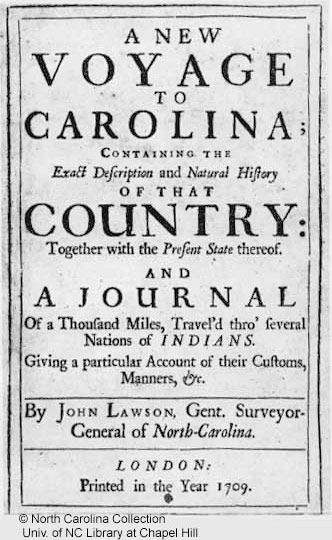
With several companions and native guides, Lawson tromped through the Carolina wilderness nearly 600 miles over several weeks to describe animals, plants, crops and natives. He dutifully recorded detailed descriptions in his journal and later returned to London in 1709 to publish “A New Voyage to Carolina.” The book attracted many new immigrant settlers to the colony because it was also translated into German and French.

Perhaps Lawson is the first person we can credit with recording the enjoyable outdoor life of North Carolina. The climate is “healthful,” and the “Land is very fruitful,” he writes. Because the soil is rich, the inhabitants “live an easy and pleasant Life.” Lawson also describes more than 70 varieties of seafood in the Carolina waters and pronounces catfish as being “very plentiful.” He identifies more than 25 “beasts” that can be hunted, proclaims that bear meat is “very good” and enjoys a “curious ragoo” made with venison and possum.

Lawson's book, published in 1709,
attracted many in immigrants.
Proving that history needs to be lived and outdoor life enjoyed, a modern-day explorer is undertaking Lawson’s journey. Scott Huler, an award-winning author who lives in Raleigh, has begun a modern walking exploration through the Carolinas to retrace Lawson’s footsteps.

Unlike Lawson, Huler is not waiting nine years to publish his account. To share his observations, he is documenting his journey online. His blog The Lawson Trek is updated with posts, images, sound, and video. On Twitter (@LawsonTrek), Huler is also tweeting images and thoughts – routine and unusual – about his adventures and has observed that he often is “walking along a sand road that has probably been trodden by human feet for a thousand years or more.”

Check out Huler’s posts and images, and follow him as he shares a historical perspective of the Carolina outdoor life.


Note: This post appeared originally in the April 2015 issue of OutreachNC, a monthly magazine distributed in 10 counties of central North Carolina. Click here to see the article as it appeared in print.