Monday, October 1, 2012

Winemaking in North Carolina

Winemaking has been a cultural tradition for centuries. Thought to have originated in the Middle East, winemaking has a rich history dating back to 6000 B.C. The value of winemaking to culture was observed as early as the fifth century B.C. by noted Greek historian Thucydides, who wrote that people “began to emerge from barbarism when they learnt to cultivate ... the vine.”

North Carolina thoroughly appreciates the connection that wine has with culture and has been a winemaking state for much of its history. Although the first commercial winery in North Carolina did not open until 1835, at least 25 wineries were in production by the early 1900s. However, because Prohibition effectively shut down winemaking, land once used to grow grapes was allocated to legal – as well as lucrative -- crops such as tobacco. Thus, the winemaking tradition felt dormant until recently.

The state has three American Viticultural Areas.
Now home to more than 90 wineries, North Carolina also has three American Viticultural Areas (AVAs) — Yadkin Valley, Swan Creek and Haw River Valley. All three reside in the state’s piedmont region, where rolling hills offer the slope (a topographical characteristic desired for a vineyard because it permits better drainage of water) preferred over flatter terrain. Receiving an AVA designation is a significant honor. To receive one, a region needs a distinguishing combination of climate and soil. In addition, to be judged an identifiable regional wine character (also known as an appellation or district), 85 percent of the grapes have to be grown in the region.

Distinguishing Characteristics

The climate and soil of North Carolina more than adequately permit it to be the home for an increasing number of vineyards, although the summer heat of the state can interfere because grapevines may shut down when temperatures regularly exceed 95 degrees Fahrenheit. To grow grapes successfully, a vineyard needs an annual mean temperature range between 50 and 68 degree Fahrenheit. In addition, according to Sotheby's Wine Encyclopedia, at least 1,300 hours of sunshine during the growing season is needed to produce grapes suitable for winemaking. Daily sunshine helps to develop a grape’s sugar and flavor, and cool nights preserve a grape’s acidity. For example, the Haw River Valley AVA (in Alamance, Caswell, Chatham, Guilford, Orange and Rockingham counties) has a long growing season with the desired temperatures -- and 214 frost-free days.

Frost can be a serious problem for some vineyards, particularly in the western parts of the state. Although dormant buds can usually avoid harm caused by an early frost, a late frost may affect the yield by reducing the number of grape clusters. Nevertheless, the beneficial rainfall of the state also serves a vineyard quite well. Little irrigation is needed even in drought conditions because a vine’s roots can travel as deep as 50 feet in search of water.

In addition, soil is another important consideration in selecting the location to plant grapevines. For example, the Swan Creek AVA compasses less than 200 square miles in only three counties -- Wilkes, Yadkin and Iredell. Because this AVA is close to the Brushy Mountains, its soil has a distinct, loamy quality and consists of schist, mica and other minerals. As a result, five vineyards take advantage of this special location.

State Support

North Carolina has been a winemaking state for much of its history. However, only recently did organizations form in the state to support growing grapes and making wine, and the demand for “local” wine has furthered the interest in winemaking. The first state group to organize was the North Carolina Muscadine Grape Growers Association. In fact, the muscadine has been celebrated extensively in North Carolina because it is the home of the 400-year-old scuppernong “mother vine,” and the N.C. Muscadine Festival in Kenansville far surpasses similar festivals in other parts of the American South.

However, interest in growing vinifera, or European-style bunch grapes, led to a major change by the early 1980s. The Piedmont Grape Growers Association was formed to champion production of vinifera grapes in the state, and this group’s effort led to the formation of North Carolina Winegrowers Association in 1993. In addition to supporting the commercial businesses, the state government through its Department of Commerce has also promoted winemaking at home.

N.C. Tourism Sign
The state’s support for wine is affected by the annual appropriation process and pressures to reduce government spending. However, even in the climate of reduced expenditures, the state government still allocates $500,000 to support the work of grape growers and winemakers. The benefits of this support are quite significant. For example, the number of overnight visitors to North Carolina who went on winetasting or winery tours in 2011 increased by 122,000 (or 24%) compared to the previous year, which itself had been a record. The state’s Agricultural Tourism Highway Signs Program guides the way and enrolls most wineries and vineyards.

The business and hobby of winemaking in North Carolina continues to build on a long-standing tradition. Some even think that wine made in North Carolina is better than that produced elsewhere in the country as well as overseas. “Tasting is believing,” says Margo Knight Metzger, former executive director of the North Carolina Wine and Grape Council.

Thursday, August 23, 2012

Competing with a Smart and Athletic Partner

Animals are important partners in many competitive events, such as in racing, falconry, sheepherding, and dog agility trials. Combining animal instincts and skills with human talents and guidance produces Olympic rewards. For example, a popular event of the Summer Olympics is dressage, an equestrian sport.

Mule jumping, a main feature of many
Southern festivals
However, do these events, particularly dressage, even remotely measure up to mule jumping, which is often a main feature of a Southern festival? Both dressage and mule jumping demonstrate skills learned through precise training, and both rely on trust of both animal and human with each other. But as President Harry Truman once said, the mule has “more horse sense than a horse.” The skills and trust in mule jumping justify a higher respect, particularly because of significant differences in scoring, affection, spectators, and expected achievements.

Scoring is important in judging both horses and mules. However, dressage scoring is very sophisticated and requires at least five judges (seven for Olympic games). Each one awards a mark from 0 to 10. The marks are combined to produce a percentage, and the rider with the highest total score wins. In contrast, scoring a mule jump is relatively simple. The mule either does or doesn’t get over the bar or obstacle. After each mule has jumped (or attempted to jump), the bar is raised in 2-3 inch increments. The mule clearing the highest bar wins. In addition, no extensive training for a judge is required – just good eyesight and common sense.

Winner of the individual dressage, gold
medalist Charlotte Dujardin of Great
Britain beams (obviously before she
decides to his her horse).
The affection by animal and human to each other bridges many gaps in communication. But would you kiss a mule? Few of us would ever admit to considering this thought. We would rather kiss any other animal, even a goat, before we plant our lips on a mule -- not so for a horse lover or the rider in a dressage. Before a competition begins, a horse receives an unusual amount of hugs and pats. If it performs well, it can expect a sloppy kiss as a reward even before the rider learns the score or the award earned. Consider the London 2012 Olympics where Charlotte Dujardin of Britain won the individual dressage gold medal on Valegro. As ESPN reported Dujardin yelled, "Wait for me," after the medal ceremony when Valegro started for the barn without her. She rushed to plant a kiss on his nose and then “with a tear-streaked face and huge grin” returned to the crowd to flash her medal. No one would be grinning after kissing a mule.

Spectators in Robbins, NC, watch the mule
jumping event, which takes endurance
and patience -- for the owner
Who watches each event is another major difference. Can you imagine anyone traveling around the world to watch a mule jump? Usually this event is part of an agricultural celebration such as Farmers Day in Robbins,N.C., or Mule Days in Benson, NC (both small towns of fewer than 4,000 residents). Spectators are typically limited to a local audience, who come to enjoy music, food, and other festivities -- and would probably show up even if the mules didn’t. In contrast, dressage events attract a dedicated hard-core group of horse admirers, who travel across states and sometimes even internationally to attend events such as the Olympics. This group typically attends only to watch equestrian events. If the horses didn’t show, neither would the spectators.

Dujardin pats Valero after
a six-minute dressage.
The most significant difference concerns the expected achievements of the animals. With dressage, a horse and its rider are expected to perform from memory a series of predetermined movements. In fact, the International Equestrian Federation defines dressage as "the highest expression of horse training.” Unlike the dressage rider, the mule trainer is not allowed to touch the animal in any way. Instead, the mule is coaxed over a bar with only voice commands. In addition, mule jumping doesn’t depend on elaborate movements established in advance. In fact, all the mule has to do is jump, a key requirement in raccoon hunting. Mules have jumped as high as 72 inches, a record set in Pea Ridge, Arkansas. Who needs an animal that can perform the mandatory movements of dressage, such as an elevated “trot in place” or a half-pass (moving sideways and forward at the same time on a diagonal)? If a fence or barrier is in the way, jump over it quickly and get on with the hunt.

Raccoon hunters riding mules
during nighttime hunts with dogs
Mule jumping (officially known as the “Coon Hunter’s Mule Jump” by the American Donkey and Mule Society in Denton, Texas) harkens back to the era when raccoon hunters rode mules during nighttime hunts with dogs. When a fence blocked the way of the chase, the rider would dismount and place a blanket or jacket over the fence (often barbed wire), and the mule would jump it from a standstill.

Although both dressage and mule jumping require athleticism and superb interaction by animal and trainer with each other, only mule jumping has any real usefulness. It also demonstrates that Truman is right about the mule’s practicality or “horse sense.” In explaining why his favorite animal was the mule, Truman said, “He knows when to stop eating -- and he knows when to stop working.”

Tarzan, the winner of the mule jump
 contest at an Annual Farmers Day
 in Robbins, NC, with  friend


Note: Mule jumping in Robbins, NC, usually occurs on the first Saturday in August around 12:45 p.m. as part of the annual Farmers Day and is sponsored by the Carolina Mule Association. In Benson, the mule competitions usually occur at 9:30 a.m. on the third Friday in September.

Wednesday, July 18, 2012

Local Food: A Preferred Choice in the South

Peaches sold by local farmer:
$20 for 23-pound basket ($1.15 a pound)
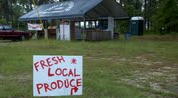
One of the worst cultural changes in the American South is how many residents neglect the availability of local fresh fruits and vegetables when once local produce was a mainstay of the Southern diet. Such produce today is easy to find and buy, particularly because farmers’ markets where local farms sell their crops have experienced a resurgence as well as community-supported agriculture programs have gained in popularity.

The following video illustrates how the buy local effort has even spread to college campuses:


The local produce available throughout the year is amazing, and my home state of North Carolina is one of several states in the South that provides a quick reference guide about the availability of fresh fruits and vegetables. In the summer months, one of the favorites where I live is peaches, which are available from May through September.

Farmer stand at state farmers' market
I occasionally visit the N.C. State Farmers’ Market in Raleigh, which is impressive with its selection and availability of peaches in season. In addition, because I live in the peach-growing Sandhills area of the state, I also have the opportunity to go to a you-pick-it farm as well as get local peaches through a community-supported agriculture program.

In fact, imagine the additional ways in this area for buying fresh peaches:
  • Local farmers’ market
  • Roadside stand operated by a local farm
  • Neighborhood grocery store that promotes local produce

However, the shock for me recently was a neighborhood grocery store that was promoting peaches – not locally picked but shipped from California – in the middle of the local peach season. How much expense is involved in transporting peaches from one side of the country completely across to the other side? It’s like “carrying coal to Newcastle” and is a complete waste of energy as well as a detriment to the local food economy (and the out-of-state peaches were 10 cents a pound more than local peaches being sold by a local farmer at a roadside stand about 2/10ths of a mile from the store).

Regional food chain has window display
that advertises fresh peaches ...
... but the small print indicates
that the peaches are out-of-state
(and cost 10 cents a pound more than local ones)

Several businesses, schools, and local communities have joined in an effort – known as the 10% campaign – to buy at least 10% of their food budgets from farmers in their local areas. The campaign, an effort to rebuild a local food economy, also helps to educate the public about food choices. Eating fresh fruits and vegetables as a regular part of a diet provides many long-term health benefits. Although the increasing obesity rates are a national problem, they are particularly troubling for the American South. Most states in the South exceed the national average for both adult and childhood obesity. 

Roadside stand with fresher, cheaper
peaches (less than 2/10ths of a mile
from regional grocery chain)
Even with the example of peaches being shipped across the country, the effort to buy locally is gaining support as many across the South are recruited to become a “locavore,” a word used increasingly by local food advocates. It was the word of the year in 2007 for the Oxford American Dictionary, even though it had only been coined in 2005 when residents on the West Coast were encouraged to eat only food grown or produced within a 100-mile radius. Although later in 2008 Congress defined “local food” much broader -- food marketed in the same state where produced or less than 400 miles from origin -- the “buy local” effort focuses on growers much closer.

What a shame that a regional grocery chain in the South (owned by a Belgium corporation), where peaches are grown with so much success, sees fit to ship them completely across the county and that local shoppers buy them. Be more selective, and enjoy produce that your area grows. Become a locavore.

Thursday, July 12, 2012

Banana Puddin' for Real

Don’t tell me that mamas and papas no longer have time to make banana puddin’ for their babies! Have you seen “trendy” grocery stores such as The Fresh Market selling pre-packaged banana puddin’? Is this where the Information Highway with incessant demands to stay connected to our smart phones, send irrelevant text messages, and check Facebook updates throughout the day has taken us?

Ready for sale at The Fresh Market
It’s bad enough that stores have sliced or cubed cantaloupe, watermelon and other summer delights to make them so easy to enjoy. All we have to do is open a cover: no messy slicing — but isn’t that half the fun of eating cantaloupe or watermelon? The joy of eating banana puddin’ is knowing that it’s homemade (and who made it).

Fortunately, these packages do include bananas unlike some places such as Smithfield's Chicken 'N Bar-B-Q that makes banana puddin’ without bananas. (Of course, this extends the shelf life by avoiding the chance that a banana slice can turn brown, but how they can call it banana puddin’ without its primary ingredient?) Any decent mama or papa never chooses banana puddin’ without bananas for their children when ordering fried chicken or pork barbecue.

Warning: A Connecticut
Yankee has made these 
cookies and hoodwinked 
Paula Deen.
What else is needed beside bananas? Nilla Wafers, of course. Even Paula Deen has screwed up this Southern tradition by substituting Pepperidge Farm Chessmen cookies for genuine Nilla Wafers. In her recipe on the Food Network, she wants you to use two bags of these high-falutin’ cookies by a company that traces its roots not to the South but to a Connecticut housewife (and is still based up yonder). At least Paula Deen has the decency to title her approach as “Not Yo’ Mama’s Banana Pudding,” so you know that you are making only a pretender. If you really want authentic banana puddin’, just follow the recipe on a box of Nilla Wafers or use the original recipe online by Nabisco World that calls for 45 wafers — and real bananas, of course (five sliced for this recipe).

What happens if you can’t eat all the puddin’ on the day that it’s made? Not a problem. Even day-old puddin’ is desirable because it’s “bold,” as Southern Culture on the Skids sings in “Banana Pudding”:
Banana puddin'
Yeah! It's day old and bold, baby.
So give me something funky with the skin on top
Something funky, that's what I've got.
Authentic puddin' just made for my classes
When I make banana puddin’ for my classes, no student ever asks, “Did you buy it?” Of course not! No self-respecting Southerner would dare to offer banana puddin’ that was not homemade. Stay true to Southern foodways: Put down your smart phone and start slicing fresh bananas.

Saturday, June 2, 2012

Reshaping a Small One-Industry Southern Town

How does a small one-industry town in the rural American South survive when the major employer shuts down and many jobs are lost? Changes in the “global economy” have cut dramatically the jobs once held in textile, furniture, manufacturing, and other businesses in the South as well as other regions during the past few decades. As a result, many manufacturing plants now stand idle in the rural, former mill towns that dot the South.

A biotechnology research center is being
built on the site of a former textile plant.
Although a wealthy benefactor may appear on the scene with a magic wand or a pot of gold to transform the town and offer it a new vitality, this possibility is very unlikely. Even though Kannapolis, N.C., has benefited from the largess of David Murdock, most towns have to reshape themselves more independently. Murdock, with a personal fortunate estimated at more than $3 billion, has adopted this former mill town. When a textile manufacturing company closed its operations in 2003, Kannapolis became the scene of the largest permanent layoff of workers in state history. However, with Murdock’s extensive investment, Kannapolis is being reborn as home to the North Carolina Research Campus, a 5.6 million square-foot biotechnology research center that promises to offer 35,000 jobs on and near the campus.

Less than 100 miles from Kannapolis is Star, NC, another small town affected by mill closings. However, it faces a more challenging future because no billionaire has stepped forward to rescue it. Unlike Kannapolis’s claim as the home for future biotechnology research, Star’s biggest boast is that it is the geographical center of North Carolina.

With an early history as a shipping point for turpentine, lumber, and brick, the town grew more prosperous when the hosiery mill industry arrived, and mill jobs formed the basis of the local economy for fifty years. However, when the industry left town in the 1990s, more than 2,000 lost their jobs, and Star began to decline.

 STARworks occupies a
former hosiery mill complex
However, Star is rebounding from the job loss not with the support of a billionaire but a local enterprise appropriately named Star works, or STARworks. STAR actually stands for Small Town Area Vitalization, but including the town’s name adds special significance. Located in a former mill building that was donated in 2004 for the project, STARworks is a “business incubator.” As the home for several renewable energy, sustainable agriculture, and creative arts-related businesses, it is nurturing their initial development by providing space, training, and encouragement. When the businesses and artisans are ready to move into the local market, STARworks continues to serve them as a support network.

Part of the clay factory
When I visited STARworks during an open house, I was intrigued to see a clay factory, which processes raw clay from the ground. The result is pottery clay. The factory is part of the ceramics materials and research activity, which conducts training workshops and also includes a clay studio and supply shop. STARworks not only is encouraging new entrepreneurs, it’s taking advantage of natural and cultural assets of the region that is well-known for its pottery tradition.

(The STARworks facility also
includes a glass studio, but it
was closed during the open house.)
 

Area for ceramics and
pottery workshops


What the Star community is doing with its business incubator provides a clear example to other communities that once depended on one industry now shut down. Rather than trying to recruit another big manufacturing company to replace the operation lost, STARworks focuses instead on entrepreneurs who can grow small businesses and develop them further in the local community. Taking advantage of local natural and cultural assets to nurture business startups also offers more promise than attempting to attract another operation with no connection to the community and whose tenure is not guaranteed.

Friday, June 1, 2012

A Plant That Bites Back

Carnivorous is such a hard word to spell, particularly when a child is in the fifth grade. That is when my class and I were introduced to one of the unusual plants of the South and particularly the Carolinas – the carnivorous Venus Flytrap. It attracts, catches, and devours insects and other tiny creatures.

In fact, Charles Darwin labeled this plant as “one of the most wonderful in the world.” When he wrote Insectivorous Plants in 1875, he brought plants that entrap insects to the world’s attention. The video below by UNC-TV helps to understand why the flytrap itself is so amazing.


However, the Venus Flytrap is not naturally a worldwide resident. It lives in only the South and only two states – North Carolina and South Carolina. In fact, its native locations are limited to within 60 miles of Wilmington, NC, where it survives in wet sandy and peaty soils. Because these areas are nutritionally poor and do not contain adequate nitrogen and phosphorus, the plant digests animals to gain nutrients for protein formation that the soil does not provide. In addition, the flytrap tolerates fires well and benefits when its habitat burns, particularly during controlled burns of longleaf pine forests, because the fires eliminate its competition.

Park ranger at start of hike
Although several hundred plants are carnivorous, the Venus Flytrap probably is the best known, particularly by school children because many see this plant in action in elementary school as I did. When I was in the Wilmington area with my school-age grandkids, rangers at a nearby state park were offering a “carnivorous plant hike.” Because they were not yet in the fifth grade, I hoped that the hike would teach them something new. In addition to the Venus Flytrap, the park is also home to pitcher plants, butterworts, sundews, and other “plants that bite back.” The starting point of the hike appropriately was the Flytrap Trail Parking Lot.

Sundew, the first carnivorous
plant on the hike
Literally in minutes we saw our first carnivorous plant — a sundew. A few steps away was a pitcher plant. Although both were easily spotted by the ranger without leaving the trail’s pathway, a casual observer probably would have missed them without being told where to look because they blend so effectively with their surroundings.


Pitcher plant seen on hike
Closeup of Venus flytrap at state park

The highlight of the walk was finding a Venus Flytrap. The first one was smaller than I had expected. Because a plant can live for more than 20 years, this one was probably very young. However, its trapping mechanism with hair-like edges was clearly discernible to us but ready to spring shut on any unsuspecting prey. Because the trap can shut in 0.1 seconds, the plant’s trapping movement is remarkable but is common knowledge to as young as now a first grader. Only during the program did I learn that my granddaughter, then entering the second grade, had already seen a flytrap in school – she was clearly less impressed with the hike than I had hoped.

Flytraps for sale at farmers
market in Saxapahaw, NC
Children also learn about the plant because it is frequently seen for sale at markets and festivals, particularly in North Carolina. Although state laws prohibit removal from its native habitats, the plant is cultivated in many locations around the world. Although it does have the reputation for being tricky to grow, the flytrap is popular with many families to teach children more about nature and the dependencies that plants and animals have for each other.

Because Mother Earth has more than a million species of insects, the Venus Flytrap is unlikely to go hungry soon. It will also probably continue to be discussed in school programs and sold as novelty plants. However, be careful about trying to impress children how “wonderful” the plant is – they may have already learned by the first grade.

Venus Flytrap at River Walk in Wilmington, NC
"Venus flytrap" on display at the River Walk
in Wilmington, NC, illustrates its connection
to coastal North Carolina

Thursday, May 24, 2012

Blueberries: Summertime Treat in the South

Does anything make summertime more enjoyable than eating fresh blueberries, particularly those that you picked yourself? Chilled, fresh blueberries are such a delightful treat on a hot day. Visiting a you-pick-it location helps you appreciate the berries much more than simply buying them at a grocery store.

You-pick-it locations are plentiful in the South.

Because blueberries are grown throughout the South, being able to pick them as they ripen is easy. Most states, such as my home state of North Carolina, help by offering maps and directories of you-pick-locations on their agricultural websites. (North Carolina has more than 100 you-pick blueberry locations.) In addition, local you-pick-it farms get extra publicity in the South when official state festivals celebrate the blueberry in late May or in June.

The calyx forms the shape
of a five-pointed star.
Picking fresh blueberries helps to connect to the culture and history of the region. One of the few fruits native to North America, the blueberry has been important for sustaining life in this region for centuries. Ripe blueberries were gathered in the forests by several Native American tribes before they also began to cultivate them. In addition to being a food source, the berries themselves and parts of the plant were used as medicine. Even the calyx, the blossom end of a berry that forms the shape of a five-pointed star, has contributed to regional lore as the legend about the Great Spirit sending “star berries” during a famine to relieve the hunger of children was retold.

Although lowbush berries (often referred to as “wild blueberries”) are native to other parts of the world, highbush blueberries are native to the North America. Even though more than 38 states grow the blueberry, only rabbiteye varieties (Vaccinium ashei) are native to the American South (from North Carolina south to Florida and west to Texas). These varieties are called rabbiteye, according to Horticulture magazine, because before turning blue they turn pink (like the color of a white rabbit). With all the varieties grown in North America, about 90% of the worldwide blueberry harvest comes from Canada and the United States. 

In my home state of North Carolina the highbush varieties can be grown anywhere from the mountains to the coast. In addition, rabbiteye varieties (which are more drought and heat resistant) can be grown in the piedmont and coastal plain.

You-pick-it bushes ready in North Carolina in late May

With the health benefits of the blueberry continually being extolled, it continues to increase in popularity. The average U.S. adult consumption has almost doubled in the last ten years. The blueberry is now the second most popular berry in the United States (second only to strawberries).

About half of each year’s production is eaten fresh rather than processed. (Fresh production has outpaced process production since 2002.) In addition, eating blueberries raw is recommended by many health experts because this way provides the best flavor and greatest nutritional benefits.

Before: Scale before picking
After:  Reward (8 pounds) after an hour  of picking


Although blueberries make great cobblers, breads, and jellies, they are thoroughly enjoyable by the handful when they have been recently picked. Because they are 85 percent water (compared to the higher and more recognized percentage of 92 for the watermelon), they are a great way to satisfy a thirst as well as meet the recommended daily water intake. That’s why visiting a you-pick-it location is so worthwhile to celebrate the start of summer.

If you don't have time to pick your own, at least buy
directly from the grower at a stand or farmers' market.