Showing posts with label Benson. Show all posts

Saturday, June 23, 2018

Appreciating Gospel Music at the Annual Benson Sing

When I arrived in Benson, NC, I anticipated a great musical experience at the State Annual Singing Convention. Because the event has such a long rich history, the Benson Sing is a premier event to attend each June.

A historical marker in the grove commemorates the initial event held in 1921.

The event, begun in 1921 in a tobacco warehouse, takes place at the Singing Grove in downtown Benson, which includes a 54-acre historic district on the National Register of Historic Places. It’s easy to appreciate live music in such a picturesque setting where the main stage is in the center of the oak-filled town park, and tall, old trees provide abundant shade.

Some spectators set up their own chairs in the grove.

Held on the weekend of the fourth Sunday in June, the Benson Sing is the oldest and largest gospel sing in the United States. One of the oldest annual music shows in the country, it is even four years older than the Grand Ole Opry in Nashville. For the inaugural event 97 years ago, two choirs performed for a crowd of 200 on that day.

Trophies on the center shelf of the stage await the winners as a quartet performs.

The Sing has since expanded to three days, and two local radio stations broadcast live during the competition. The popularity of the convention has waned from its peak in the 1940s and 1950s when 10,000 spectators were common. However, its format is very attractive: the Sing is free for both contestants and spectators. Area businesses underwrite all expenses and sponsor the trophies. 

Although the Sing encourages first-time entrants, several groups are semiprofessionals who sell CDs of their award-winning gospel songs at display tents in the grove.

Trophies are won by participants who compete in several categories, which may change from year to year depending on the number of entrants. The larger the ensemble, the more I appreciated its singing. Because solo acts are not permitted, the smallest group is a duet. Next are trios and quartets. A family group includes five or more members related to each other. A special category is a junior group; its members must be younger than 17. The largest group is an adult church choir.  Each group sings no longer than five minutes, and the winner in each category takes home a trophy.

A church choir is the largest competitive category of the convention.

The opening night, which has no competition, features a “singspiration,” a 30-minute performance by six professional ensembles each. On the second night, a nationally acclaimed ensemble called the host group gives a two-hour concert after an opening act.
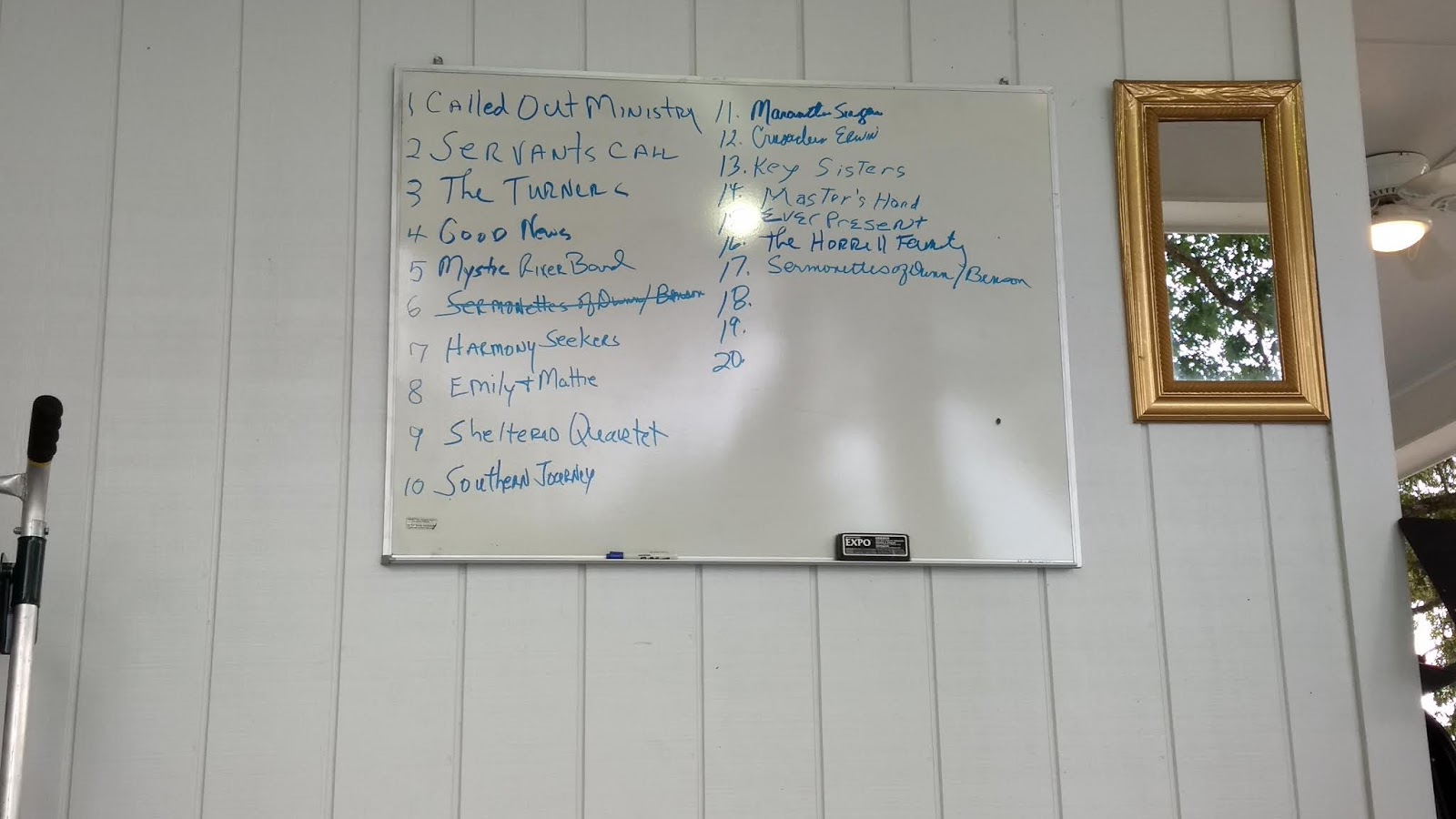
A sign-up board sets the order for an informal "round-robin" session.

On Saturday and Sunday, singers compete in categories for trophies. The highest scoring groups that compete on both days (they must sing a different song each day) are eligible for the overall grand champion and consolidation trophy. The grand champion is typically a quartet from within North Carolina, although trios have also been successful and the past winner was from Florida.

A bluegrass category was added in 2017 to the Benson Sing.

When I arrived on Saturday morning, a session of non-competitive singing, known as “round-robin,” was underway. This time is informal and gives the groups an opportunity to become familiar with the stage and setting before the actual competition begins. As spectators come and go, they casually chat with each other and greet musicians who are not singing.

Being at the 98th annual Sing and listening to the harmony of talented vocalists was a special experience, and the city park of oak trees is the ideal setting to appreciate gospel music. Benson will continue to be a fitting host for this historical musical event.

Thursday, August 23, 2012

Competing with a Smart and Athletic Partner

Animals are important partners in many competitive events, such as in racing, falconry, sheepherding, and dog agility trials. Combining animal instincts and skills with human talents and guidance produces Olympic rewards. For example, a popular event of the Summer Olympics is dressage, an equestrian sport.

Mule jumping, a main feature of many
Southern festivals
However, do these events, particularly dressage, even remotely measure up to mule jumping, which is often a main feature of a Southern festival? Both dressage and mule jumping demonstrate skills learned through precise training, and both rely on trust of both animal and human with each other. But as President Harry Truman once said, the mule has “more horse sense than a horse.” The skills and trust in mule jumping justify a higher respect, particularly because of significant differences in scoring, affection, spectators, and expected achievements.

Scoring is important in judging both horses and mules. However, dressage scoring is very sophisticated and requires at least five judges (seven for Olympic games). Each one awards a mark from 0 to 10. The marks are combined to produce a percentage, and the rider with the highest total score wins. In contrast, scoring a mule jump is relatively simple. The mule either does or doesn’t get over the bar or obstacle. After each mule has jumped (or attempted to jump), the bar is raised in 2-3 inch increments. The mule clearing the highest bar wins. In addition, no extensive training for a judge is required – just good eyesight and common sense.

Winner of the individual dressage, gold
medalist Charlotte Dujardin of Great
Britain beams (obviously before she
decides to his her horse).
The affection by animal and human to each other bridges many gaps in communication. But would you kiss a mule? Few of us would ever admit to considering this thought. We would rather kiss any other animal, even a goat, before we plant our lips on a mule -- not so for a horse lover or the rider in a dressage. Before a competition begins, a horse receives an unusual amount of hugs and pats. If it performs well, it can expect a sloppy kiss as a reward even before the rider learns the score or the award earned. Consider the London 2012 Olympics where Charlotte Dujardin of Britain won the individual dressage gold medal on Valegro. As ESPN reported Dujardin yelled, "Wait for me," after the medal ceremony when Valegro started for the barn without her. She rushed to plant a kiss on his nose and then “with a tear-streaked face and huge grin” returned to the crowd to flash her medal. No one would be grinning after kissing a mule.

Spectators in Robbins, NC, watch the mule
jumping event, which takes endurance
and patience -- for the owner
Who watches each event is another major difference. Can you imagine anyone traveling around the world to watch a mule jump? Usually this event is part of an agricultural celebration such as Farmers Day in Robbins,N.C., or Mule Days in Benson, NC (both small towns of fewer than 4,000 residents). Spectators are typically limited to a local audience, who come to enjoy music, food, and other festivities -- and would probably show up even if the mules didn’t. In contrast, dressage events attract a dedicated hard-core group of horse admirers, who travel across states and sometimes even internationally to attend events such as the Olympics. This group typically attends only to watch equestrian events. If the horses didn’t show, neither would the spectators.

Dujardin pats Valero after
a six-minute dressage.
The most significant difference concerns the expected achievements of the animals. With dressage, a horse and its rider are expected to perform from memory a series of predetermined movements. In fact, the International Equestrian Federation defines dressage as "the highest expression of horse training.” Unlike the dressage rider, the mule trainer is not allowed to touch the animal in any way. Instead, the mule is coaxed over a bar with only voice commands. In addition, mule jumping doesn’t depend on elaborate movements established in advance. In fact, all the mule has to do is jump, a key requirement in raccoon hunting. Mules have jumped as high as 72 inches, a record set in Pea Ridge, Arkansas. Who needs an animal that can perform the mandatory movements of dressage, such as an elevated “trot in place” or a half-pass (moving sideways and forward at the same time on a diagonal)? If a fence or barrier is in the way, jump over it quickly and get on with the hunt.

Raccoon hunters riding mules
during nighttime hunts with dogs
Mule jumping (officially known as the “Coon Hunter’s Mule Jump” by the American Donkey and Mule Society in Denton, Texas) harkens back to the era when raccoon hunters rode mules during nighttime hunts with dogs. When a fence blocked the way of the chase, the rider would dismount and place a blanket or jacket over the fence (often barbed wire), and the mule would jump it from a standstill.

Although both dressage and mule jumping require athleticism and superb interaction by animal and trainer with each other, only mule jumping has any real usefulness. It also demonstrates that Truman is right about the mule’s practicality or “horse sense.” In explaining why his favorite animal was the mule, Truman said, “He knows when to stop eating -- and he knows when to stop working.”

Tarzan, the winner of the mule jump
 contest at an Annual Farmers Day
 in Robbins, NC, with  friend


Note: Mule jumping in Robbins, NC, usually occurs on the first Saturday in August around 12:45 p.m. as part of the annual Farmers Day and is sponsored by the Carolina Mule Association. In Benson, the mule competitions usually occur at 9:30 a.m. on the third Friday in September.