Wednesday, February 27, 2019

Searching for Key Lime Pie

Key lime pie seems to be growing in popularity and is served at quite a few restaurants today. They don’t have to be in Florida (although it is the official pie of the state) or even in the American South. However, the pie seems to be the best on one of the Florida Keys. The most southernly the location is, the better the pie seems to taste.

Columbia Restaurant in St. Augustine, Florida, is one of several restaurants in Florida that serve the pie.

On a trip through the Florida Keys, my wife and I were watching for signs where Key lime pie was being served. The more homemade the sign was, the more enticed we were to stop. As we drove from Key Largo to Key West and returned, the first option for food had to be Key lime pie. If it wasn’t on the menu, we weren’t interested in eating there.

I found my favorite pie in Islamorada, Florida.

For me, the best Key lime pie was served in Islamorada, a village that stretches 18 miles across five keys. At the Islamorada Fish Company, I found the perfect Key lime pie, served with a graham cracker crust (not a pastry crust, which I don’t prefer) with a lime slice and a dob of whipped cream (not meringue or extra cream to avoid diluting the lime flavors) in an attractive white ceramic cup.

A  table at Islamorada Fish Company that overlooks the Gulf of Mexico is the best place to enjoy the pie. 

Although some people think that Key limes grow in only Florida, they are grown primarily in Mexico and Peru. Although they are named for the Florida Keys (the small, low islands located off the southern coast of the state) where they also grow, they are not indigenous to the area. They vary in size and color and are smaller in size and harder in texture than the more common lime (citrus latifolia).

Key limes are grown primarily in Mexico and Peru.

The juice of Key limes with egg yolks and sweetened condensed milk creates a magnificent dessert. The original recipe didn’t call for the mixture to be cooked because during mixing a reaction between the acidic lime juice and the proteins of the egg yolks and milk cause the filling to thicken on its own without baking. However, pies today are usually baked for a short time because consuming raw eggs can be dangerous.

The city of Marathon, set on 13 islands in the Florida Keys, is the home of Sweet Savannah's, which always have pie ready.

I always check to see if Key lime pie is on the menu of restaurants even in locations outside of Florida; however, whenever a restaurant in the Florida Keys indicates it serves the pie, I stop.

Whole pies are available for takeout in Key West, Florida.

Sunday, February 24, 2019

Finding a “Swamp Fest Platter” at a Fish Camp

Fish camps once were common in the South in coastal areas where commercial fishing crews worked until the early parts of the last century. Huts (or cabins) for the workers at some camps were built to last only one season of fishing, and others were more permanent and often could last more than a dozen years. In addition to housing for workers employed in the fishing industry, some camps had accommodations for their families who would spend summer months there on vacation. Other camps in the Carolinas were simple campsites where textile mill workers and their families fished and fried their catches when they had free time.

Relics of old fishing equipment are on display outside Clark's Fish Camp.

Some fish camps evolved into family-style seafood restaurants where local clientele would be served reasonably priced meals. Although the fish camps were usually located on waterways, lakes, or rivers, most bought their fish from wholesalers and farms. Although many of these restaurants have closed as they faced competition from chain restaurants, a few such as Clark’s Fish Camp on the banks of Julington Creek in Jacksonville, Florida, are still thriving.

The rustic exterior wall of Clark's Fish Camp adds to the fish camp atmosphere.

Originally a bait and tackle shop, Clark’s maintains a fish camp atmosphere with very simple and rustic features. Lilly, a five-foot alligator, makes her home in a large aquarium known as Lilly’s Pad that also houses turtles and fish. Also on display is the largest private taxidermy collection in America – lions, bears, tigers, monkeys, giraffes, deer, bobcats, and other amazing animals -- although the food is what makes this restaurant a destination for tourists and brings back local clientele. The menu includes everything imaginable.

The simple entrance to Clark's refers to its history.

My wife and I indulged on a “swamp fest platter” loaded with gator tail, soft-shell crab, frog legs, conch, calamari, catfish, and hushpuppies. Other platters can also include clam strips, oysters, shrimp, scallops, and crab cakes. Signature dishes feature trout, tuna, and salmon.

The swamp fest platter cam loaded with frog legs, gator tail, soft-shell crab, conch, calamari, catfish, and hushpuppies.

Eating by the banks of a creek with slowly flowing water added to the ambiance of the rustic building that houses Clark’s. The extensive menu is very popular, and it makes many customers wish that such fish camps were still more common.

Key lime pie is the best way to finish a meal at Clark's Fish Camp.

Two baby alligators swim near the entrance to Clark's.

Stuffed animals overlook the long rustic bar.


Note: Click on the links for history of fish camps in North Carolina and South Carolina.

Saturday, June 23, 2018

Appreciating Gospel Music at the Annual Benson Sing

When I arrived in Benson, NC, I anticipated a great musical experience at the State Annual Singing Convention. Because the event has such a long rich history, the Benson Sing is a premier event to attend each June.

A historical marker in the grove commemorates the initial event held in 1921.

The event, begun in 1921 in a tobacco warehouse, takes place at the Singing Grove in downtown Benson, which includes a 54-acre historic district on the National Register of Historic Places. It’s easy to appreciate live music in such a picturesque setting where the main stage is in the center of the oak-filled town park, and tall, old trees provide abundant shade.

Some spectators set up their own chairs in the grove.

Held on the weekend of the fourth Sunday in June, the Benson Sing is the oldest and largest gospel sing in the United States. One of the oldest annual music shows in the country, it is even four years older than the Grand Ole Opry in Nashville. For the inaugural event 97 years ago, two choirs performed for a crowd of 200 on that day.

Trophies on the center shelf of the stage await the winners as a quartet performs.

The Sing has since expanded to three days, and two local radio stations broadcast live during the competition. The popularity of the convention has waned from its peak in the 1940s and 1950s when 10,000 spectators were common. However, its format is very attractive: the Sing is free for both contestants and spectators. Area businesses underwrite all expenses and sponsor the trophies. 

Although the Sing encourages first-time entrants, several groups are semiprofessionals who sell CDs of their award-winning gospel songs at display tents in the grove.

Trophies are won by participants who compete in several categories, which may change from year to year depending on the number of entrants. The larger the ensemble, the more I appreciated its singing. Because solo acts are not permitted, the smallest group is a duet. Next are trios and quartets. A family group includes five or more members related to each other. A special category is a junior group; its members must be younger than 17. The largest group is an adult church choir.  Each group sings no longer than five minutes, and the winner in each category takes home a trophy.

A church choir is the largest competitive category of the convention.

The opening night, which has no competition, features a “singspiration,” a 30-minute performance by six professional ensembles each. On the second night, a nationally acclaimed ensemble called the host group gives a two-hour concert after an opening act.

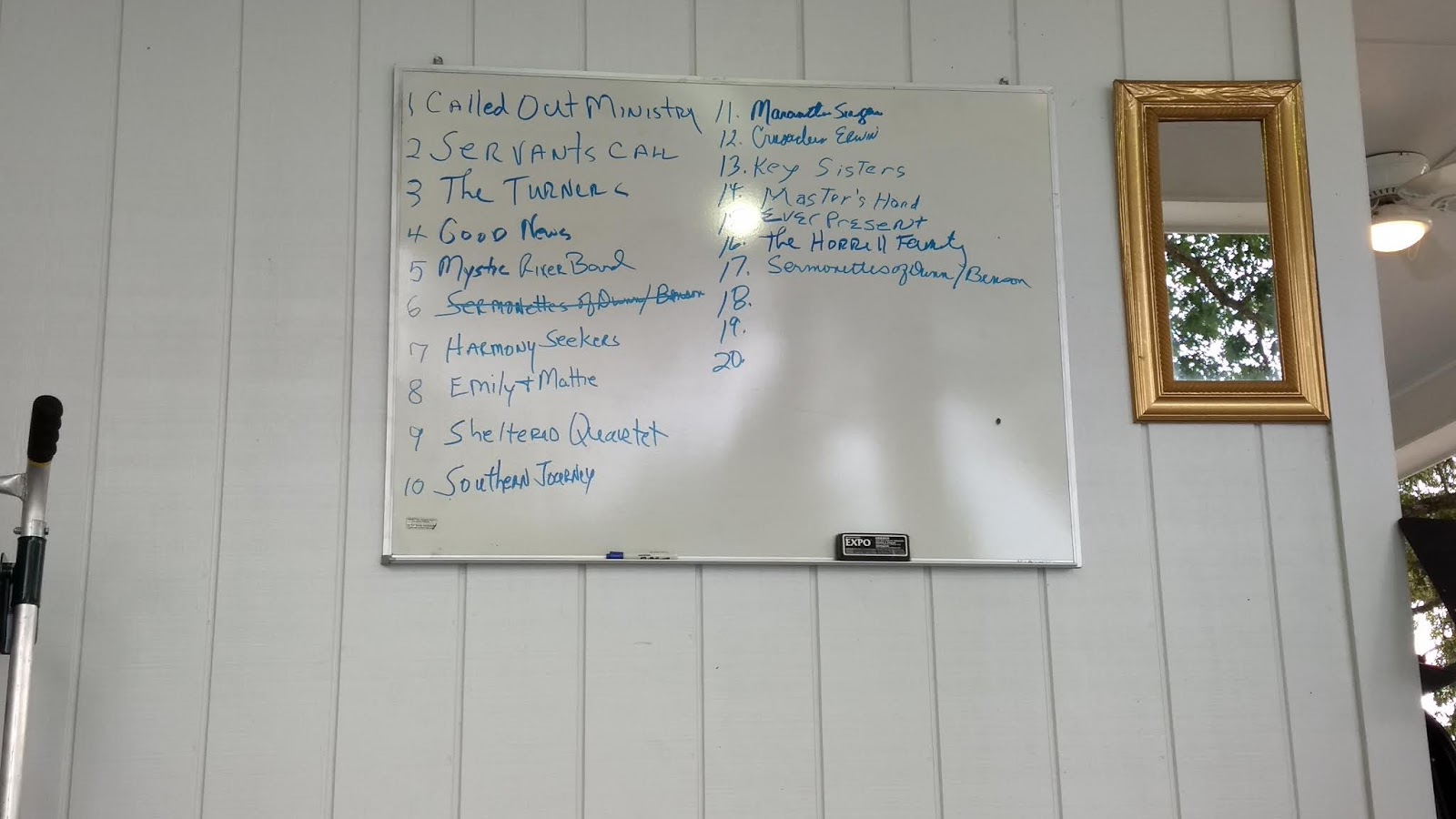
A sign-up board sets the order for an informal "round-robin" session.

On Saturday and Sunday, singers compete in categories for trophies. The highest scoring groups that compete on both days (they must sing a different song each day) are eligible for the overall grand champion and consolidation trophy. The grand champion is typically a quartet from within North Carolina, although trios have also been successful and the past winner was from Florida.

A bluegrass category was added in 2017 to the Benson Sing.

When I arrived on Saturday morning, a session of non-competitive singing, known as “round-robin,” was underway. This time is informal and gives the groups an opportunity to become familiar with the stage and setting before the actual competition begins. As spectators come and go, they casually chat with each other and greet musicians who are not singing.

Being at the 98th annual Sing and listening to the harmony of talented vocalists was a special experience, and the city park of oak trees is the ideal setting to appreciate gospel music. Benson will continue to be a fitting host for this historical musical event.

Saturday, April 21, 2018

Ice Cream Since 1915


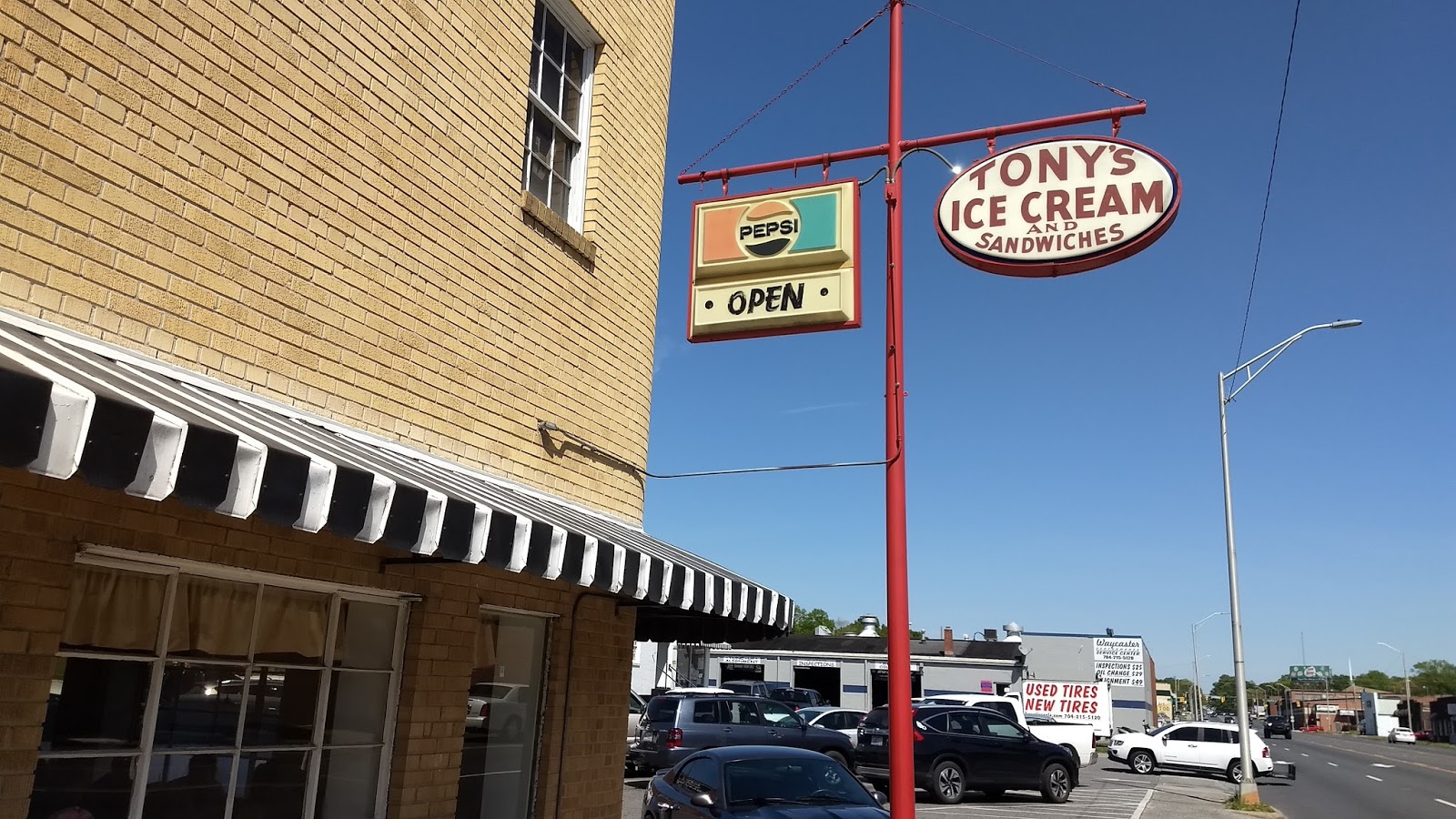
The small, ordinary sign “Tony’s Ice Cream and Sandwiches” on the northeast corner of a nondescript yellow brick building in downtown Gastonia, NC, poorly describes for passersby what treats lie inside. As I was driving through Gastonia after attending a barbecue cookoff in nearby Kings Mountain, a parking lot packed with rows of cars grabbed my attention. 

The streetside sign modestly indicates the location of a long-time favorite.

Then I saw several people walking out as they licked tall Styrofoam cups or drank from straws. (Only later did I learn that the cups were carrying milk shakes.) I immediately made a U-turn to see what I was missing. When I saw a sign on the wall that says, “Since 1915,” I knew that I needed to go inside to verify its accuracy.

An exterior wall of Tony's proclaims its service for several generations.

The interior of the store looks like only modest renovations have been made over the decades. A vintage 1947-era pink and green neon clock told me that mid-afternoon had arrived, although the long lines at the counter indicated that it was prime time for ice cream. Every booth – covered in its original red vinyl – was also occupied.

The line of customers waiting for ice cream never seems to end.

A display that says Tony’s Cheerwine ice cream is “delicious” convinced me that I should choose that flavor. This choice is unusual for me, but Cheerwine is an area favorite and has a cultural connection. Because many customers were enjoying milk shakes, not ordering at least one would be a mistake. Fortunately, my wife agreed and ordered a shake that we shared – and it was better than the ice cream cup. Each milk shake is made with three scoops of ice cream, which is fresh because it’s made in the plant next door to the restaurant.

The historic wall clock has kept time for decades.

Cheerwine was my choice
of ice cream flavor.
For more than 100 years, the business has been family-owned and -operated as it still is by the third generation of the founding Coletta family. Carmine Coletta, an immigrant from Glasgow, Scotland, came to America in 1911 and began making ice cream in 1915 that he sold from push carts and horse-drawn wagons, which were taken to mill villages, ball games, carnivals and camp meetings. Trucks replaced wagons in the 1930s, and the current building was opened in 1947 by the second generation of Colettas. In 1976, ownership was passed to the third generation, the sons (Robert and Louis) of Antonio (or Tony as he was known and for whom the business is named) Coletta, the youngest son of the founder.

A milk shake has more ice cream that you can imagine.

In the Gastonia area, Tony’s is a cause célèbre. It’s been successful for more than 100 years and was cited recently by the Gaston Gazette as one of the 10 oldest restaurants in the county. If it retains its loyal following, it’ll continue to be celebrated for many more years.

Trucks at the plant next door waiting to begin their next deliveries are . . .
much more efficient than earlier delivery techniques.

Sunday, December 24, 2017

Bluegrass on Christmas Eve

Bluegrass musicians play the tunes of carols at Christmas at a Lutheran church established by German immigrants? Where and why does this happen, you ask.

A bluegrass service is held annually on Christmas Eve in Newton, NC.

The church is located in Newton, NC, a well-established city that received its charter in 1855. Almost a century earlier a group of German immigrants, mostly from Pennsylvania and sharing Lutheran and Reformed (now United Church of Christ) faiths, arrived in what was then the wilderness of North Carolina. About 1759 they organized the first church in the colony west of the Catawba River, and the congregation erected their first church, known as the Dutch Meeting House, after obtaining the deed to the property in 1771.

The Historic Church is listed on the National Register of Historic Places.

In 1818, a replacement two-story log weather-boarded church was built with a separate, now repurposed, slave gallery. It is still the oldest existing church in North Carolina west of the Catawba River and is now known as the Historic Church of Old St. Paul’s Evangelical Lutheran Church, whose congregation now regularly meets in a nearby brick building built in 1952.

The award-winning Sigmon family fills the church with the sweet sounds of strings.

The initial congregation met without a pastor until 1776, when John Arndt, a veteran circuit rider, traveled from Lutheran settlements near Salisbury. In 1781, he became a full-time missionary to the region west of the Catawba and preached in the German language, the common speech of local families for several generations.

The language spoken initially at the Historic Church was German.

Much like the shift from German to English, the music of the service also changed and now includes bluegrass, known for having been born in the Appalachian South with roots in Irish, Scottish, and English music. Several times during the year (May, July, October), the congregation conducts bluegrass worship services at the historic church. On Christmas Eve, it has also conducted a bluegrass worship service since 2011.

The second level was a slave gallery before the end of the American Civil War.

The bluegrass services make the Historic Church come alive. The old structure is still as solid as the year when it was constructed. However, now the language spoken inside is English, and the sounds of banjo, fiddle, string bass, guitar, and mandolin accompany the voices of the carolers.

A bluegrass worship service has been held at the Historic Church since 2011.

Thursday, October 12, 2017

Can I Win a Food Contest at the State Fair?

Entering a food competition at the state fair has never been high on my “bucket list” – until this year. Because I’m not a cook, know little about winning recipes, and seldom want to show my food projects to a judge, I’ve been content to observe winning entries and read about the winners. However, this year I was inspired to enter and compete.

Ribbons are ready for the winners.

For this year, I decided to enter the cooking competitions at the N.C. State Fair coordinated by the N.C. Department of Agriculture & Consumer Services. Specifically, I was attracted to the contest sponsored by the N.C. Peanut Growers Association that was held on Thursday, October 12. Each entry was to be “a delicious breakfast recipe that is filled with peanut flavor and will be sure to get your morning started with a smile.” I could place in a contest that featured peanuts, right?

Cooking contests are held annually at the N.C. State Fair.

The first critical step is to submit a recipe by the deadline, which was ten days before the date of the contest and meant that I had to brainstorm about possibilities even a month in advance. After evaluating several options, I picked a favorite, which I called “Peanut Buttery Breakfast Pizza,” that I hoped would be a winner.

My entry starts to take shape.

The recipe starts with a package of soft tortillas about five inches in diameter. After spreading a tablespoon of peanut butter on each tortilla, banana slices are added to half of the tortillas (the remainder are saved to use as “tops”). A little honey is drizzled and finely chopped peanuts are sprinkled over the tortillas with bananas. Next, the tortillas without banana slices are placed over the other tortillas. Finally, the doubled tortillas are sliced into quarters.

Doesn't my entry look like a winner?

On the day of the contest, entries are turned in mid-afternoon, and judging takes place an hour later. Judging is based on flavor and taste (50%), creativity (25%), and ease of preparation (25%). I felt good about the flavor/taste category (what is better than peanut butter and banana flavors?) and the ease of preparation (the entry only took me about 10 minutes to prepare). Each recipe needed to contain at least one-half cup of peanuts or peanut butter, and entries needed to serve six to eight judges. The winning recipes were awarded cash prizes: $200 for first place; $150, second; $100, third; and $50, honorable mention.

I proudly turn in my entry with high hopes.

I was amazed at the creativity of the winners. First place was spicy peanut butter and banana breakfast braid. Second place was peanut butter French toast with nutty pig candy. Third place was peanut butter and jelly pop tarts. One recipe, peanut butter and banana waffles, received honorable mention. Although all are creative, the level of preparation doesn’t seem that easy. At least I was on the right track by combining peanut butter and bananas. If I compete again, I need to give more consideration to creativity, which seems more influential than only 25%.

Lisa Prince, host of the TV program NC Flavor, announces the winners.

Although I left empty handed without receiving a prize, at least I got to see what the contest is like and didn’t have to buy an admission ticket to the fair. A major benefit of entering the contest is free admission to the fair – plus the experience gained to compete next year.

Meanwhile, the carnival-like food attracts the attention of the fairgoers more than a cooking contest.

Sunday, October 1, 2017

Picking Wild Persimmons and Making Pulp

Persimmon picking is definitely a skill. Not everyone can do it – or is interested. It takes patience and perseverance. A little knowledge of the local landscape also helps. Equally important is keeping procrastination tendencies in check.

In the fall, fruit on persimmon trees is easily seen in bright sunlight.

Who today really wants to go outside in the cold and pick up fruit on the ground after it has fallen from a tree, particularly when ripe, fresh fruit is so readily available in grocery stores? The effort to pick persimmons probably is the biggest barrier for most people. For me, it’s not the effort; it’s procrastination. If I don’t pick them immediately after they fall, they quickly spoil.

Picking up the fruit soon after it has fallen is important.

Persimmon pudding is a favorite dessert, but making it doesn’t happen unless ripe persimmons are brought home. Knowing where persimmon trees are located is the first step, and then watching as the fruit on them grows and shines with a bright bronze color is crucial. Native to the eastern United States, persimmon trees like full sun and are often found on the edge of woodlands.

After persimmons are washed, they are ready for the pulp to be separated.

Wild persimmons, smaller than those available commercially, are not completely ripe until very soft. It takes only a few minutes to pick a bucket of persimmons. When you return home, wash them and then prepare to extract the pulp by mashing the fruit in a sieve or colander with a wood spoon or similar flat object. The riper the persimmons, the easier the pulp separates from the seed. (A common kitchen tool like a potato ricer works faster, but some of us prefer the old-fashioned method.)

A wooden spoon and colander are all the tools needed

The reward for picking and cleaning persimmons and removing the seeds is luscious pulp ready for making pudding. Enjoy.

Only seeds are left after separating the pulp.
Pulp, fruit, and tools are the key elements.