Thursday, June 20, 2013

Finding the Source of Your Food

[Note: This post, prepared originally for the NC Folklife Institute's NCFood blog, is hosted on the institute’s website, with excerpts and a link to the website posted here.] 

            When you eat in a restaurant, do you think about the farms that provide your meal? At excellent way to visit the source of your food is the annual farm tours conducted in our state.
Farm tour signs direct the way to
find the source of your food.
            Earlier this year I explored several farms as part of the Piedmont Farm Tour, held on the final weekend every April by the Carolina Farm Stewardship Association. This tour is one of two in North Carolina – the other is the Eastern Triangle Farm Tour – and one of four that the association sponsors. One farm – the Captain J.S. Pope Farm -- in particular is intriguing.


Saturday, June 8, 2013

Food Judging and BBQ Contests

A badge indicating certified judge
established credibility.
Do you enjoy tasting award-winning barbeque? When eating barbeque, do you compare it to a standard and rate it for taste or tenderness? If you do, you may want to attend a class and be trained as a certified judge by an authorized organization. Having the credibility of certification is particularly important when cooks are competing against each other such as in a BBQ contest.

Carol Bigler explains the judging process.
The judging class that I attended was taught by Randy and Carol Bigler of Huntsville, Alabama, who have been the Kansas City Barbeque Society's representatives to several state championships. In the class I learned how important the competitions are for the cooking teams and how much expense and effort each competitive event requires. I also realized that judging has to be taught. Even though some in the class might have thought that they are natural judges, they learned to apply consistently the Society’s standards.

Many BBQ cooking contests are now sanctioned by the Kansas City Barbeque Society -- not the most Southern of organizations since it is based in the mid-West (and also international) but it seems to be the leading group for sanctioning BBQ contests in the South as well as across the United States. The Society typically judges in four categories:
·        Shoulder, a pork entry that may be cooked in one piece or divided into two (arm picnic and Boston butt)
·        Pork ribs, which can be spare ribs (11 to 13 bones), St. Louis style (with brisket bone and all skirt meat removed), or baby back ribs (also known as loin ribs)
·        Chicken, prepared whole, half, or any combination; with or without skin; and all white or dark meat or a combination
·        Beef brisket, the underside chest muscle from beef cattle.
Regardless of category, I was surprised how the training class focused us on the quality of a meat’s cooking and not the category that the meat represented.

Large trailers haul everything
important for a cooking team.
Each category is judged according to three criteria: appearance, taste, and tenderness. A table captain presents each entry for judges to score appearance. Then each judge receives a sample to evaluate tenderness and taste on a scorecard. Each criterion is scored from a high of 9 (excellent) to a low of 2 (inedible), except when an entry is disqualified (and receives a score of 1). After a brief explanation and a few samples, most of the judges in training scored samples (prepared by a team that has already won regional awards) in relative uniform pattern -- proof that we were learning the Society’s standards.

In a contest, a table of six judges evaluates each entry, which can be submitted chopped, pulled, slices or diced. Each judge has to evaluate by the standards of the Society rather than personal preferences, and KCBS rules can be very specific. For example, although everyone has a personal idea of what makes a rib good, the Society specifies that the meat of an excellent pork rib must come off the bone with very little effort and only where the judge bites. The Society considers ribs overcooked if the meat falls all the entire bone while biting. In addition, a cook can use garnish such as green lettuce or parsley but no kale or red-tipped lettuce.

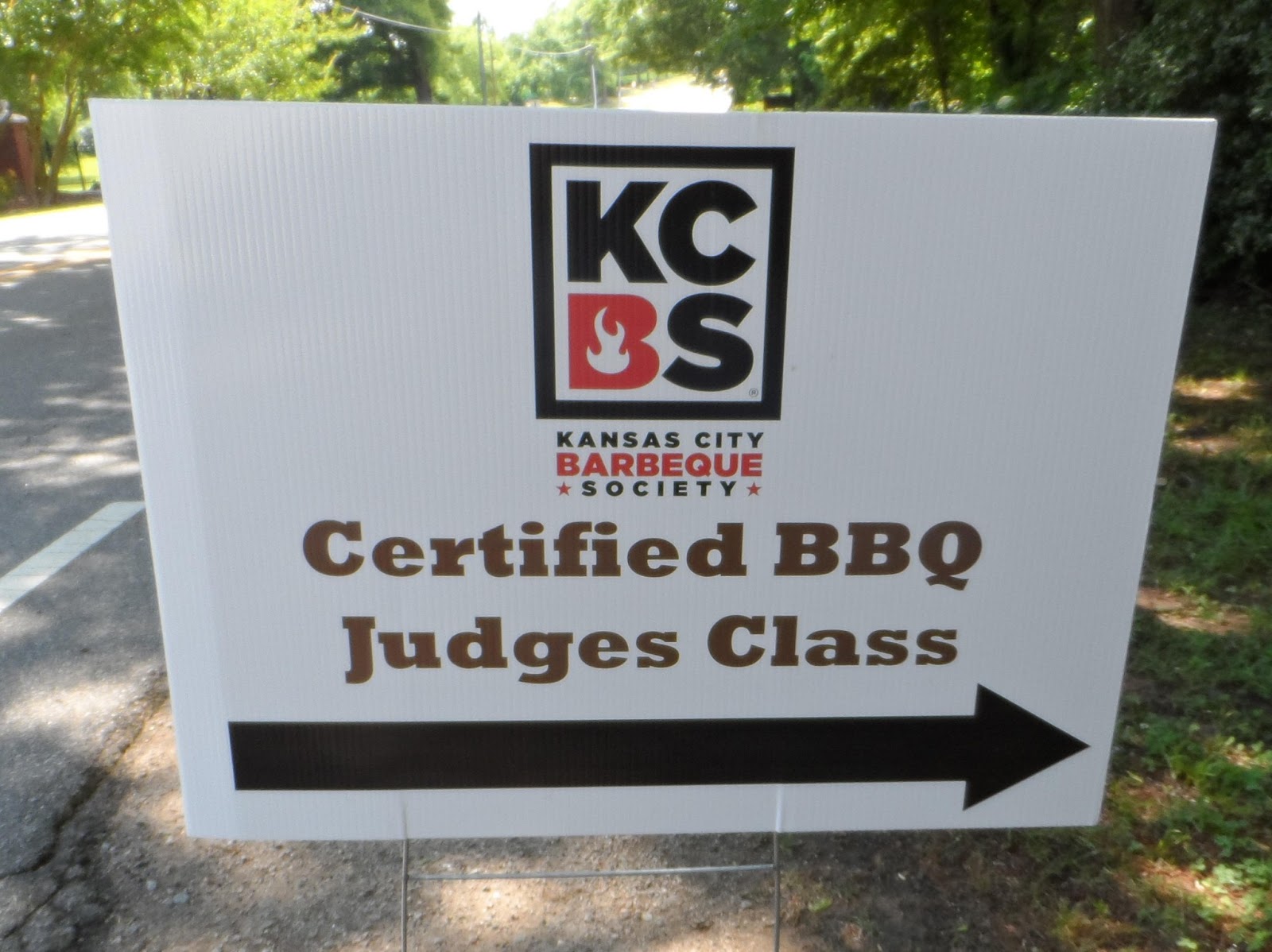
Sign alerts arrivals to location of class.
After attending six hours of instruction and sampling several entries in each category, I received what I wanted: Certification as a BBQ Judge. Now I’m ready to go on the road and judge. If you like barbecue and are interested in judging, learn more about the Society’s Judge Certification Program. Similar training classes are held in most states several times a year. The perks of a certified judge are great: tasting award-winning barbeque.

Friday, May 17, 2013

Grilling on the Side of the Highway

[Note: This post, prepared originally for the NC Folklife Institute's NCFood blog, is hosted on the institute’s website, with excerpts and a link to the website posted here.] 

What makes our state so special for grilling ribs? Most of us can remember our first cookout when someone in the family, neighborhood, or church served home-cooked ribs. They were so tender that the meat literally fell off the bones. The homemade sauce was delicious, and often the recipe was a secret not to be shared.

Ribs cooked to perfection.
Some of us can't wait for the next home-cooked ribs, yet we do have to wait because family reunions, church suppers, and neighborhood gatherings aren't held that frequently.


Continue reading at the NCFood blog…

Note: This post was also published by Sandhills Tribune on July 26, 2013 on its website with permission of the N.C. Folklife Institute.

Friday, April 19, 2013

Home of Collard Sandwich Expands on Soul Food Day

[Note: This post, prepared originally for the NC Folklife Institute's NCFood blog, is hosted on the institute’s website, with excerpts and a link to the website posted here.]

A collard sandwich is not the typical attraction to establish a regional reputation. But it is for Chef Kenneth Collins and his UPro restaurant in Aberdeen, NC, where he has developed an extensive following of appreciative customers.

Collard sandwich to go is
always an excellent choice.
The star attraction of his business begins with fresh, hand-cut collards. The greens are cooked for an hour with a little fat and a special blend of seasonings and then packed between two round fried pieces of cornbread. Strips of bacon are added over the cut collards for additional flavor and sweetness.


Friday, March 8, 2013

Local Seafood: Kitchen on the Roll

[Note: This post, prepared originally for the NC Folklife Institute's NCFood blog, is hosted on the institute’s website, with excerpts and a link to the website posted here.]

Carolina catfish tacos
are often on the menu.
Where can you get fresh fish prepared by an award-winning chef? Sometimes the location may not be on the coast or a river but instead from a mobile kitchen.

In downtown Wilmington, I found Chef Keith Rhodes hustling to serve customers eagerly standing in line at his food truck parked on North Fourth Street in front of the Brooklyn Arts Center.


Wednesday, February 20, 2013

Ernest Green: Little Rock Remembered

When we read about historic civil rights moments, we typically associate those events to earlier times, and particularly for students of today to past generations. Names like Martin Luther King Jr., Medgar Evers, and Rosa Parks are etched in our memory for the challenges they faced, gains they achieved, and sacrifices they made – some who paid the ultimate price by giving their lives.

Ernest Green received high school
diploma in May 1958 from principal
(Photo: Museum of American History)
When I learned that Ernest Green, the sole senior among the nine students who had integrated Central High School in 1957, was coming to my college to give a lecture, I knew that I had to attend and see him in person. Attesting to the contribution by Green to civil rights in the United States, Dr. John Dempsey, president of Sandhills Community College, said that Green “may not belong in the same sentence as Rosa Parks but he belongs in the same paragraph.”

Green (student at right) is blocked with
two others from entering school by
National Guardsman on Sep. 4, 1957
(Photo: Arkansas History Commission)
The events that unfolded in Little Rock, Arkansas, in 1957 are moments that my classes on the American South discuss each semester. They are significant for demonstrating that state law and officials can no longer overturn federal guarantees for civil rights. In the third year after the Brown vs. Board of Education decision, the school board of Little Rock had planned a quiet desegregation of the principal high school in the capital city of Arkansas. However, the plans were thrown into turmoil when Governor Faubus ringed the school campus with National Guard soldiers with orders to block nine African-American students.

As we all have learned, President Eisenhower deployed more than a thousand U.S. Army paratroopers to Little Rock to counter the governor’s show of force and to provide protection for the nine students. The lone senior in the group was Ernest Green, a name many Americans no longer recall, although the events are easily identified as a turning point in the Civil Rights Movement.

Greens gives a Ruth Pauley Lecture
at SCC in February 2013
The lecture that Green gave was uplifting, and everyone in the audience seemed moved by his words and deeds. In addition to the expected points of the speech, a few facts surprised me:
  • The school board had approved 26 or 27 African American students, including seniors, to transfer to Central High as part of the initial desegregation. Green said, “Others dropped out. When I turned around and looked, I was standing by myself.” 
  • His mother had voted for Gov. Faubus. He had desegregated buses and state transportation, and she thought that he represented “ideas of change.” 
  • After high school Green attended Michigan State where he received a scholarship from an anonymous donor. As a college student, Green said he actively engaged in civil rights protests and demonstrations, including several in front of the home of the university president. Green learned much later that the anonymous donor had been the president himself only after he had died.
Green speaks to state labor
convention in 1967 (10 years
after high school integration)
(Photo: Arkansas History
Commission)
As Green discussed “Living a Fearless Life,” one point was to “not settle on any one moment of your life as being good enough.” Having survived his tumultuous senior year of high school, Green could have easily rested on that achievement. I was taken by the pressure that he placed on himself to attain high achievements throughout adulthood. The Congressional Gold Medal that he received in 1998 attests to his lifetime success, much broader than his role in school integration.

At the end of the lecture, Green entertained a few questions. The audience was stunned when one person rose to say that he had been one of the National Guardsmen on duty obeying the governor's orders to keep Green and the other eight off campus. He rose not to ask a question concerning the lecture but to say that he wanted to shake Green's hand and see if Green would be willing. The long-awaited handshake took place after the event. Imagine how that handshake lifted a burden from the former soldier that he had been carrying for more than 50 years.

With Ernest Green before lunch discussion
The experience was meaningful for me by not only attending the lecture but also joining a small group who enjoyed lunch with Green earlier that day. During that session, he informally talked about being escorted from class to class by soldiers at Central High and how that experience required that he do more with his life than just graduate from high school. “We all have a Little Rock High School moment,” Green said. “The question is, do we accept it and take advantage of it?” He certainly has more than fulfilled the expectations of those who entrusted in 1957 such a fateful task to him.

As Green ended the lunchtime discussion, he said, “The future is always better than the past.” A remarkable life journey like his sometimes might make a person want to forget the past. However, as he told the lecture audience, “Remember where you came from and who went before you.”

Thursday, February 14, 2013

Getting Romantic on Valentine’s Day with N.C. Food Traditions

[Note: This post, prepared originally for the NC Folklife Institute's NCFood blog, is hosted on the institute’s website, with excerpts and a link to the website posted here.]

How do you celebrate Valentine’s Day? Many celebrate with traditional gifts such as sweet chocolates or red roses. Not me. I take advantage of the foodways traditions of North Carolina to make the day special.

Start Valentine's Day with
something special for breakfast.
First, start with a breakfast treat that says love better than chocolate: BoBerry Biscuits from Bojangle’s, which got its start in Charlotte in 1977. Instead of a standard biscuit, celebrate with a special made-from-scratch sweet biscuit baked with blueberry flavor and topped with icing. This Valentine’s special is a Tar Heel version of the English blueberry scone and gets taste buds thinking about the next foodways tradition to celebrate February 14.